
Luke 17: Jesus Heals Ten Men with Leprosy
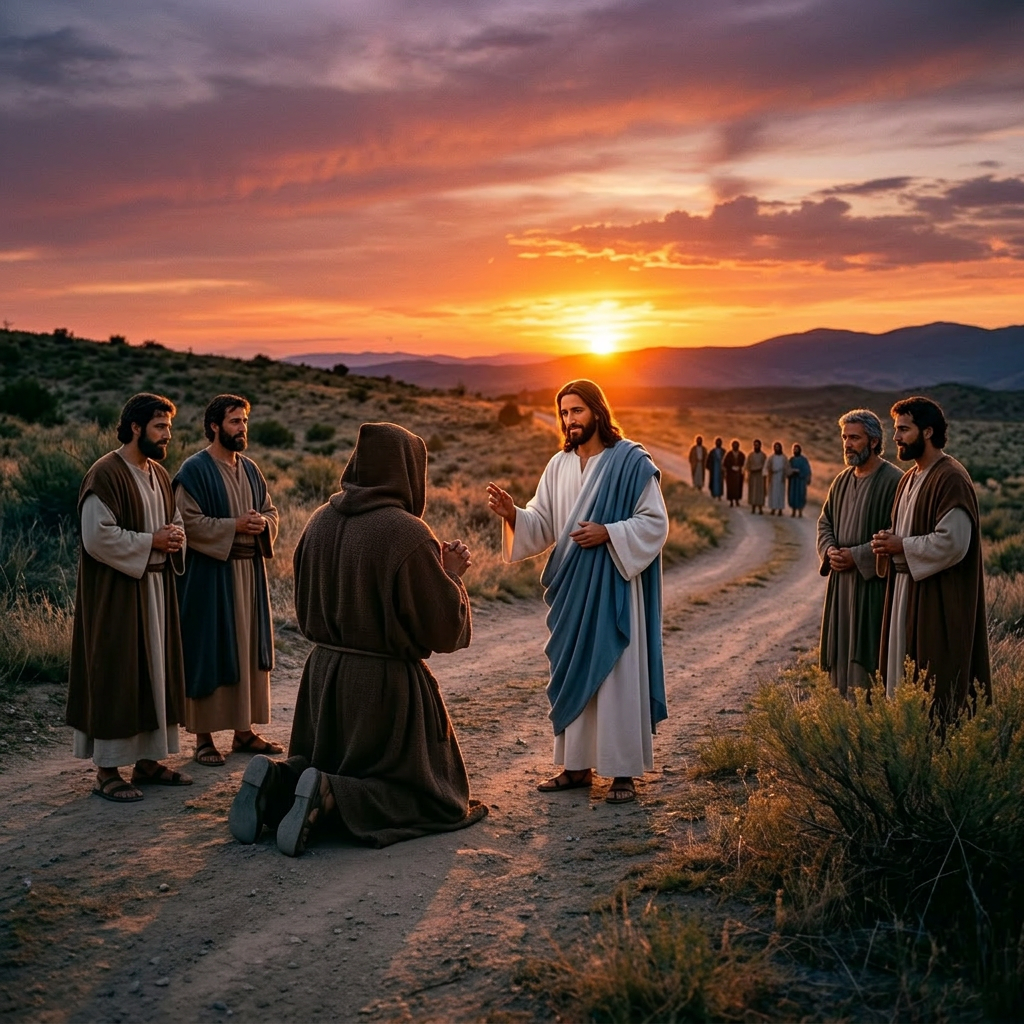
The Coming of the Kingdom
Good afternoon, brothers and sisters. May the peace of the Lord Jesus Christ and His abundant blessings be with you as we study His Word together today, and throughout your daily lives.
To be honest, it feels like I might have stepped on a few toes with my last two posts. Maybe some people took offense, maybe they think I’m a bit of a nut job, or perhaps the rumor mill has been spinning behind my back. Well, truth be told, it doesn't matter to me. At the end of the day, I only have to answer to my Father in Heaven. If something I wrote struck a nerve, it might be worth asking why. And if people are gossiping, remember that you also have to answer to God—because the same measuring stick you use on others will be used on you.
This heavy reality of personal responsibility brings me directly to our scripture today in Luke 17, where Jesus heals ten men with leprosy, and later speaks on the coming of the Kingdom.
When you look at the ten men who were healed, only one turned back to give thanks. This story perfectly illustrates a question heavy on my heart lately: Why do so many religious organizations fail to recognize that God gave us free will?
I struggle with this deeply in my own life as a parent. I have a child who states that I am the dad and I should be doing everything. But when things go wrong, I am usually the one who picks up the pieces—yet she cannot see what I truly do for her.
In the same way, God sent His Son, Jesus Christ, to save us from our own sin, and yet we so often choose to look the other way. Or, worse, we try to make others' lives feel as restricted as ours by focusing on the rigid rules and regulations of church organizations, rather than truly following the Way of the Cross.
Aside from extraordinary circumstances where control is stripped away, most of life comes down to the choices we make. The ultimate choice is ours alone: will we live inside the Kingdom of God, or outside of it?
When we look at the nine healed men who walked away without a word, we see the misuse of free will. They took the blessing but ignored the Giver. When we die and stand before the judgment seat, we won't be able to point fingers and say, "Well, my pastor told me to do it," or "Everyone else walked away too." If a leader was wrong, it’s still on us. We have the personal choice every single day to either walk in The Way, return to give thanks, or simply follow the world.
Let's dive into Luke 17 together and look at what it truly means to choose the Kingdom...
The 10% Remnant & The Outsider's Faith
Luke 17:11-19 Now on his way to Jerusalem, Jesus traveled along the border between Samaria and Galilee. As he was going into a village, ten men who had leprosy met him. They stood at a distance and called out in a loud voice, “Jesus, Master, have pity on us!”
When he saw them, he said, “Go, show yourselves to the priests.” And as they went, they were cleansed.
One of them, when he saw he was healed, came back, praising God in a loud voice. He threw himself at Jesus’ feet and thanked him—and he was a Samaritan.
Jesus asked, “Were not all ten cleansed? Where are the other nine? Has no one returned to give praise to God except this foreigner?” Then he said to him, “Rise and go; your faith has made you well.”
Now, I am no math genius, but out of ten men who were healed of leprosy, only one came back. That’s just 10%. It shows me that a tiny remnant of people really and truly have active Faith in God throughout the world. The rest grab their blessing and run right back to their busy, distracted lives.
The one who did return was already an absolute outcast. He was a Samaritan, which meant the culture looked down on him like a complete outsider, and having leprosy made things a hundred times worse. He was doubly rejected. But it didn't matter to him, because his faith carried him through.
Seeing this man run back to throw himself at Jesus' feet reminds me of why I am beginning to see the absolute beauty in the writings of the prophet Isaiah. Centuries before Jesus stood on that dirt road, Isaiah prophesied that God’s salvation wouldn't just be for a select few who thought they had it all together. God promised the Messiah would be "a light for the Gentiles, that my salvation may reach to the ends of the earth" (Isaiah 49:6).
This Samaritan was the living proof of Isaiah's words. He was in the dark, but he saw the Light. It brings to life exactly what Jesus warns us about later in the Gospels, specifically in Matthew 20:16, where He states, "The last will be first, and the first will be last." The religious insiders missed the point, but the broken outsider was the first to truly see the Kingdom.
Waiting at the Gate
Jesus then turns to His disciples and gives them a vivid warning about what it will be like to wait for His return:
“The time is coming when you will long to see one of the days of the Son of Man, but you will not see it. People will tell you, ‘There he is!’ or ‘Here he is!’ Do not go running off after them. For the Son of Man in his day will be like the lightning, which flashes and lights up the sky from one end to the other.” — Luke 17:22-24
The anticipation Jesus is describing here reminds me of waiting at an airport terminal for a loved one to come home. When you stand there staring at the arrival gate, checking your watch every thirty seconds, time stretches out unbearably. The anxiety makes the wait feel like an eternity. But when we finally relax, ease our minds, and trust the process, the time seems to move much faster.
It is the same way with our walk of faith. We are told to be ready in our hearts, minds, and souls by staying firmly on The Way. We need to be vigilant, but not to the point of panic where we lose our peace, our focus, and our trust. If you are constantly running around chasing every rumor or getting distracted by worldly things you ought not be focusing on, you are going to miss the peace of the present moment. Because when Christ Jesus returns, it won’t be a secret you have to chase down—it will happen in a flash, like lightning lighting up the sky from one end to the other.
But look at what Jesus says right after that:
“But first he must suffer many things and be rejected by this generation.” — Luke 17:25
Before He tells them how He will come in glory, He reminds the Apostles that He must first suffer and die on the cross for our sins. He points them directly to the source of our hope. We don't have to wait for Him in fear or anxiety, because through His rejection and suffering, we received the ultimate gift of Grace. Our job while we wait at the "gate" isn't to stress over the clock; it's to rest in that Grace and keep our eyes on Him.
The Three-Fold Witness
Jesus concludes this teaching by establishing a powerful double warning. First, He talks about Noah:
“Just as it was in the days of Noah, so also will it be in the days of the Son of Man. People were eating, drinking, marrying and being given in marriage up to the day Noah entered the ark. Then the flood came and destroyed them all.” — Luke 17:26-27
Then, right after, He repeats the same message using a second statement about Lot:
“It was the same in the days of Lot. People were eating and drinking, buying and selling, planting and building. But the day Lot left Sodom, fire and sulfur rained down from heaven and destroyed them all.” — Luke 17:28-29
Why does He repeat the statement? Because he is establishing a pattern. The irony of the world we live in today is how "corporate" has completely taken over the narrative of Christ. We are fed a version of life that tells us our entire purpose is to climb ladders, acquire wealth, consume, buy, sell, plant, and build.
But the warning doesn't stop with Jesus in the Gospels. We receive a third and final witness from the Apostle Peter, who ties Noah, Lot, and our modern world into a firm nudge from God telling us to pay attention:
“...if he did not spare the ancient world when he brought the flood on its ungodly people, but protected Noah... if he condemned the cities of Sodom and Gomorrah by burning them to ashes... and if he rescued Lot, a righteous man... then the Lord knows how to rescue the godly from trials and to hold the unrighteous for punishment on the day of judgment.” — 2 Peter 2:5-7
There it is. The complete, three-fold witness: Noah, Lot, and Peter.
Don’t allow yourself to be entirely consumed by the things this world offers, because just like the changing of the seasons, one day it will all be gone in an instant. Scripture slams its fist on the table three times to tell us that the mundane, corporate routine can blind us to eternity. In every single case, the warning went out, the corporate world mocked, and then—in a single flash—the season changed.
Standing on the Inside
So let's bring this full circle. If people are whispering behind my back, or if they think I’m some kind of religious nut job for writing these blogs and taking the Word so seriously, that is fine by me. I realize now that I am in fantastic company.
Noah looked like an absolute lunatic building a massive wooden ark on dry land while everyone else was busy living for the world. Lot looked like a fool telling his family to flee a prosperous city. Peter was mocked by the scoffers of his day.
But when the sky opened, the only thing that mattered was being on the inside of God's protection. You can gossip about the man building the boat all you want, but I know exactly where I want to be standing when the Lord returns.
I want to be inside the ark, not on the outside.
Summary, Call to Action, & Closing Prayer
Conclusion & Summary: Choosing the Inside of the Ark
We have traveled today from a dusty road on the border of Samaria to the sweeping warnings of Genesis, Sodom, and the prophetic urgency of the Apostle Peter. The message of Luke 17 demands an honest look in the mirror. It strips away the comfort of corporate checklists, church titles, and the crowd's approval.
When the floodgates opened in Noah’s day, and when the fire fell in Lot’s, public opinion vanished in a flash. The only thing that mattered was personal alignment with God. We cannot rely on a pastor's faith, a church organization's rules, or the comfort of a busy, distracted routine. God gave us free will—the power of choice—and with that comes complete, inescapable personal responsibility.
Will we be like the 90% who take God's physical blessings and run back to the corporate grind? Or will we be like the lone Samaritan outsider—broken, rejected by the world, but running back to throw ourselves at the feet of Jesus Christ in active, vibrant faith?
The Bridge to Luke 18: A Call to Constant Prayer
Choosing the Kingdom in a world that mocks you isn't a one-time decision; it is a daily, exhausting battle. It is easy to grow weary when people whisper behind your back. It is easy to lose heart when you feel like you are the only one building an ark on dry land.
Jesus knew this exhaustion would hit us. That is exactly why, without missing a beat, He transitions from these intense warnings of judgment directly into Luke 18. He doesn't leave us hanging in fear or burnout. Instead, He immediately gives us the ultimate practical weapon to stay on the inside of the ark: relentless, persistent prayer.
“Then Jesus told his disciples a parable to show them that they should always pray and not give up.”
— Luke 18:1
Our call to action this week is to move from passive belief to persistent, active faith. When the world presses in, when the routine threatens to blind you, and when the religious insiders try to restrict your walk with human regulations, do not give up. Drop to your knees. Return to the Giver. Pray without ceasing, because the King is coming, and His grace is sufficient to hold you steady until the gate opens.
Closing Prayer
Let’s pray.
Heavenly Father, Almighty God, Creator of the ends of the earth, we come before You today humbled by the weight of Your Holy Word. Forgive us for the times we have taken Your miraculous grace for granted, grabbing our blessings and running back to our busy, distracted lives.
Lord, give us the courage of the Samaritan leper to turn back, to ignore the whispers of the crowd, and to throw ourselves completely at Your feet. Strengthen our hearts to build our lives on Your truth, even when the world looks at us and calls us fools. Give us patience as we wait at the gate, resting in Your finished work on the cross rather than our own anxieties.
We lift up our families, our children, and our communities to You. Where there is brokenness, where there is legalism, let Your light break through. Keep us vigilant, keep us faithful, and keep us securely inside Your ark of protection until the day You return in glory.
In the powerful, unmatched name of our Lord and Savior, Jesus Christ, we pray.
Amen.
The Lord’s Prayer
Our Father, who art in heaven, hallowed be thy name; thy kingdom come; thy will be done on earth as it is in heaven. Give us this day our daily bread; and forgive us our trespasses, as we forgive those who trespass against us; and lead us not into temptation but deliver us from evil. For thine is the kingdom, the power, and the glory, forever and ever. Amen.
In His Grace,
Tomas
© 2026 The-Way.blog Digital Publications. All Rights Reserved.
Appendix & Study Resources
I. Comprehensive Biblical References
- Luke 17:11-19 – The cleansing of the ten lepers and the unique faith of the Samaritan outsider.
- Luke 17:20-37 – The coming of the Kingdom of God and warnings regarding the days of the Son of Man.
- Luke 18:1-8 – The Parable of the Persistent Widow (the immediate programmatic response to eschatological weariness).
- Genesis 6:5-22, 7:1-24 – The historical narrative of Noah, the corruption of the ancient world, and the ark of salvation.
- Genesis 19:1-29 – The historical account of Lot, the systemic corruption of Sodom, and divine rescue.
- Isaiah 49:6 – Prophetic declaration of the Messiah as a light to the Gentiles and global salvation.
- Matthew 20:16 – The great reversal: "So the last will be first, and the first will be last."
- 2 Peter 2:5-9, 3:3-10 – Apostolic confirmation of the historical judgments of Noah and Lot as templates for end-times scoffers.
II. Critical and Exegetical Footnotes
- The Borderlands of Samaria and Galilee (Luke 17:11): Geographically, traveling "along the border" places Jesus in a liminal, marginal space. This physical setting mirrors the spiritual reality: a zone where social outcasts (lepers) and ethnic outcasts (Samaritans) congregate, outside the traditional spheres of religious institutional safety.
- "Show Yourselves to the Priests" (Luke 17:14): This commands compliance with Leviticus 14, which legally required a priest to certify the healing of a leper. Jesus demands an act of obedience before the physical manifestation of the healing occurs ("And as they went, they were cleansed").
- "Your Faith Has Made You Well" (Luke 17:19): The Greek text uses the verb sōzō (σῴζω), which goes far beyond physical healing (iaomai, used in verse 15). While all ten experienced physical cleansing (katharizō), only the grateful Samaritan received spiritual wholeness, deliverance, and salvation (sōzō) because of his active faith.
- The Corporate "Mundane" (Luke 17:27-28): Notably, the activities listed by Jesus in the days of Noah and Lot—eating, drinking, marrying, buying, selling, planting, building—are not explicitly sinful in isolation. The existential danger highlighted by Christ is spiritual blindness induced by total immersion in worldly, everyday consumerism to the exclusion of eternal realities.
III. Canonical Cross-References: The Reversal of Eschatological Status
The core thematic thread binding Luke 17, Isaiah, Matthew, and 2 Peter together is the radical reversal of status inside the Kingdom of God. Religious insiders who rely on structural security or pedigree find themselves cast out, while the marginalized who exercise active faith are brought to the center.
| Prophet / Apostle | Biblical Passage | Manifestation of Reversal |
| Isaiah | Isaiah 49:6 | Salvation is stripped from being an exclusive, localized national privilege and extended to the dynamic fringes of the Gentile world. |
| Luke (The Gospel) | Luke 17:16-18 | The 9 Jewish legal insiders take their cleansing for granted and vanish; the ethnically and physically rejected Samaritan becomes the model of saving faith. |
| Matthew | Matthew 20:16 | The structural hierarchy of the world is inverted; those who were culturally "last" occupy the primary position in the economy of grace. |
| Peter | 2 Peter 2:7-9 | The booming, wealthy, "successful" populations of the ancient world are utterly dissolved in an instant, while the mocked, isolated remnants (Noah and Lot) are vindicated and preserved. |
Digital Copyright Notice
Copyright © 2026. All Rights Reserved. This document is protected under international copyright and digital rights management laws.
- Fair Use Citation: Short quotations or excerpts used in blog reviews, theological essays, or academic papers must provide appropriate attribution referencing the author and title of this work.
- Permitted Use: Permission is granted to download, store, electronically view, and print physical copies of this text solely for personal use, private study, small group Bible discussions, or local church ministry settings.
- Prohibited Use: No part of this digital publication may be reproduced, redistributed, resold, hosted on public servers, or transmitted in any form or by any means, including photocopying, digital file sharing, recording, or translation into other languages, for commercial purposes without the prior written permission of the copyright holder.
sharing, recording, or translation into other languages, for commercial purposes without the prior written permission of the copyright holder