Luke 19: Jesus Comes to Jerusalem as King
As we continue our journey in Luke 19, we see Jesus approaching Jerusalem. It is a moment of celebration as the crowds hail Him as King. But as Jesus gets closer, the atmosphere shifts. He looks at the city, and He weeps. He weeps because He knows the road ahead leads straight to the cross.
Jesus at the Temple
Introduction
Happy Sunday, brothers and sisters. May the peace of the Lord Jesus Christ and His abundant blessings be with you as we study His Word together today.
As we continue our journey in Luke 19, we see Jesus approaching Jerusalem. It is a moment of celebration as the crowds hail Him as King. But as Jesus gets closer, the atmosphere shifts. He looks at the city, and He weeps. He weeps because He knows the road ahead leads straight to the cross.
Before we dive into the text, I want to take a small detour to talk about a profound mystery behind those tears—and it’s a mystery every parent, guardian, or adult child in this room will understand.
Think about how incredibly hard it is to watch someone you love suffer. Whether it’s watching your child fall off a bike, sitting in a waiting room during their difficult surgery, or standing by a hospital bed watching your own aging parent lie there helplessly. Sometimes, the pain in our own hearts becomes so heavy that we physically have to look away or turn around. We don’t do it in abandonment. We don’t do it because we don’t care. We look away because the anguish and love in our hearts are so deep that the sight is simply too much to bear.
Now, fast forward from the road in Luke 19 to the hill of Calvary in the Gospel of Matthew. At about three in the afternoon, Jesus cries out in a loud voice, “Eli, Eli, lema sabachthani?” which means, “My God, my God, why have you forsaken me?”
In His human agony, bearing the crushing weight of the world's sins, Jesus felt the ultimate pain of separation from His holy Father. But the beautiful truth is, the Father never stopped loving Him. Like any of us standing by a suffering loved one, our Heavenly Father experienced a deep, unimaginable emotional hurt.
But there is a glorious secret hidden in Jesus’ cry. By quoting those exact words, Jesus was pointing his listeners to Psalm 22. It’s a Psalm that starts in total heartbreak, but ends in absolute victory, declaring to future generations: "He has done it!"
So as we open Luke 19 today, let’s look at our King. He knew the agony that was coming. The Father knew the pain of the sacrifice. Yet, out of an overwhelming, unstoppable love for you and for me, He and the Father stepped forward into the heartbreak anyway, so that the world might be saved.
Before we begin, let us ask our Lord Jesus Christ to grant us the power of the Holy Spirit, so that we may receive His Word not just with our minds, but with our hearts and souls.
Let's look together at how He entered the city...
Jesus Comes to Jerusalem as King
Scripture Luke 19: 28-44
After Jesus had said this, he went on ahead, going up to Jerusalem. 29 As he approached Bethphage and Bethany at the hill called the Mount of Olives, he sent two of his disciples, saying to them, 30 “Go to the village ahead of you, and as you enter it, you will find a colt tied there, which no one has ever ridden. Untie it and bring it here. 31 If anyone asks you, ‘Why are you untying it?’ say, ‘The Lord needs it.”
32 Those who were sent ahead went and found it just as he had told them. 33 As they were untying the colt, its owners asked them, “Why are you untying the colt?”
34 They replied, “The Lord needs it.”
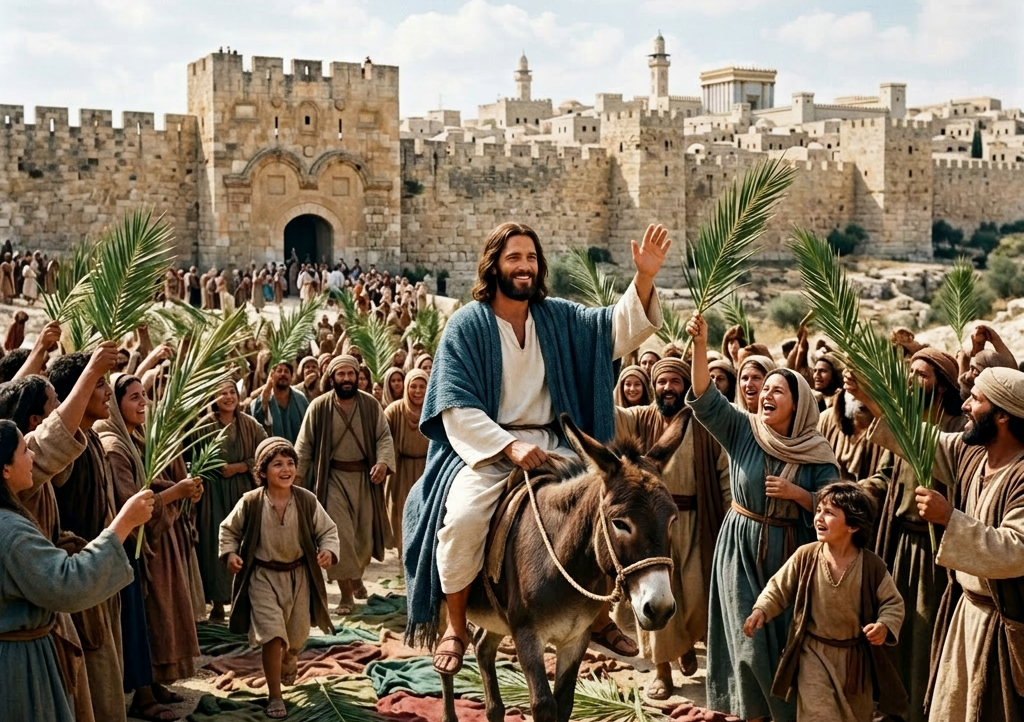
35 They brought it to Jesus, threw their cloaks on the colt, and put Jesus on it. 36 As he went along, people spread their cloaks on the road.
37 When he came near the place where the road goes down the Mount of Olives, the whole crowd of disciples began joyfully to praise God in loud voices for all the miracles they had seen:
38 “Blessed is the king who comes in the name of the Lord!”[b]
“Peace in heaven and glory in the highest!”
39 Some of the Pharisees in the crowd said to Jesus, “Teacher, rebuke your disciples!”
40 “I tell you,” He replied, “if they keep quiet, the stones will cry out.”
41 As he approached Jerusalem and saw the city, he wept over it 42 and said, “If you, even you, had only known on this day what would bring you peace—but now it is hidden from your eyes. 43 The days will come upon you when your enemies will build an embankment against you and encircle you and hem you in on every side. 44 They will dash you to the ground, you and the children within your walls. They will not leave one stone on another, because you did not recognize the time of God’s coming to you.”
Brothers and sisters, as we look closely at this passage, something incredible catches my mind and heart. It is a detail that is easy to read past, but it holds immense divine weight.
Look at verse 29. Luke specifically points out the location: the hill called the Mount of Olives.
This isn't just a random backdrop or a scenic overlook. The Mount of Olives is a sacred crossroads in God's eternal timeline. Every single step Jesus took on this hill was perfectly intentional. When you look across the entire span of Scripture, an incredible timeline unfolds on this exact mountain:
The Triumphal Entry (Luke 19)
The Beginning of Holy Week
This is where his final week begins. Jesus looks across the valley from the Mount of Olives, weeps over the brokenness of Jerusalem, and descends into the city as our humble King.
The Agony & Arrest (Luke 22)
A Few Days Later
Jesus returns to the base of this exact hill—to the Garden of Gethsemane, which literally means "oil press." Under those ancient olive trees, He is pressed by the weight of our sins, sweats drops of blood in prayer, is betrayed with a kiss, and is arrested.
The Ascension (Acts 1)
40 Days After the Resurrection
After defeating death, Jesus brings His disciples right back out to this very same mountain. He blesses them, and right before their eyes, He ascends into heaven.
The Final Return (Zechariah 14:4)
The Prophetic Future
The Old Testament tells us the story isn't over yet. Prophecy explicitly states that in the end times, the Messiah’s feet will stand once again on the Mount of Olives, and the mountain will physically split in half as He claims His ultimate victory.
The Power of the Location:
Think about the beauty of how God works. The exact place where Jesus stood and wept over the tragedy of our past is the very same place where He will stand when He returns to fix our world forever.
As Jesus heads toward Jerusalem at the Mount of Olives, He gives incredibly specific instructions to two of His disciples. He tells them:
“Go to the village ahead of you, and as you enter it, you will find a colt tied there, which no one has ever ridden. Untie it and bring it here. If anyone asks you, ‘Why are you untying it?’ say, ‘The Lord needs it.”
To our modern ears, this might sound like an interesting way to borrow a donkey. But to anyone standing there that day, every single detail of this request carried an explosive amount of meaning. There are three profound truths hidden right here in Jesus' instructions:
1. The Ride of the True King
First, this act completely mirrors the ancient traditions of Israel's kings. In the ancient world, when a ruler arrived in times of war, he would ride a majestic stallion—a symbol of military conquest and destruction. But when a king arrived in times of peace, he would ride a lowly donkey or a colt. It was a visual declaration of humility, peace, and service to the people.
We see the roots of this all the way back in the Old Testament. King David actually commanded that his son Solomon ride on his own royal mule to be anointed as the rightful king of Israel. By riding into Jerusalem on a colt, Jesus is explicitly presenting Himself as the long-awaited "Son of David"—the ultimate, rightful King.
He was walking right into the pages of Zechariah 9:9, fulfilling a promise made centuries before:
"Rejoice greatly, Daughter Zion! Shout, Daughter Jerusalem! See, your king comes to you, righteous and victorious, lowly and riding on a donkey, on a colt, the foal of a donkey."
2. A Colt "Never Ridden"
The second detail is that Jesus specifically asks for a colt that has never been ridden. In ancient Jewish ritual and law, an animal set apart for a sacred, divine purpose had to be completely untouched by ordinary, mundane tasks.
For instance, the animals used to carry the Ark of the Covenant had to be ones that had never worn a human yoke. By choosing an unridden colt, Scripture underscores the holy, sacred nature of Jesus’ mission. This young animal was an untainted vessel, set apart by God from its birth, specifically to carry the ultimate holy burden: the sinless Savior who was completely without blemish or sin.
3. Turning a Burden into Victory
And finally, look at the beautiful, powerful contrast between the burden this little colt carried and the burden Jesus Himself was carrying as they walked down that mountain:
|
The
Colt's Burden |
Jesus's
Burden |
|
Carried
the physical weight of a triumphant King entering Jerusalem. |
Carried
the spiritual weight of human sin up the hill of Calvary. |
|
Assisted
in a temporary, earthly celebration. |
Achieved
an eternal, permanent victory over death and the grave. |
The Closing Challenge
When Jesus tells His disciples, "The Lord needs it," He is claiming absolute authority over all of creation. He didn't need the colt because He lacked the strength to walk. He needed the colt to visually demonstrate to the world how God's kingdom operates.
The true King doesn't come to crush His enemies with military might or earthly pride. He arrives to conquer sin through ultimate humility, love, and sacrifice.
And that leaves us with a question we have to answer today. If that is how our King carries Himself, what about us?
The Question: Do you have what it takes to be humble, to love, and to sacrifice for your fellow man the way your King just did for you?
The Cloaks on the Road
Let's look at how the people responded to this humble King in verses 35 and 36:
They brought the colt to Jesus, threw their cloaks on it, and put Jesus on it. As he went along, people spread their cloaks on the road.
If you’ve ever been near a modern construction site, you know that one of the very first things workers do on a dry, dirt lot is spray down water over the soil. Why? To minimize the dust and keep it from kicking up into everyone's faces and ruining the equipment.
That is exactly what is happening here, at both the spiritual and historical levels. As Jesus rode into Jerusalem in this victorious, royal fashion, the people didn't have water trucks. Instead, they lined the path with their very own cloaks. It was a sign of ultimate honor that physically minimized the dust and flying debris of those dry dirt roads, ensuring that neither the colt nor their King would be covered in filth as He made His grand entry.
They were rolling out the ancient version of the red carpet, clearing the dust for the King of Kings.
The Roar of the Crowd & The Silent Stones
But notice what happens next as the crowd begins to roar. Look at verses 37 through 40:
...the whole crowd of disciples began joyfully to praise God in loud voices for all the miracles they had seen: “Blessed is the king who comes in the name of the Lord!” “Peace in heaven and glory in the highest!” Some of the Pharisees in the crowd said to Jesus, “Teacher, rebuke your disciples!” “I tell you,” He replied, “if they keep quiet, the stones will cry out.”
If we pause and put ourselves in the apostles' sandals right here, I imagine they were feeling a great deal of confusion. They are caught up in the middle of a roaring, victorious royal procession—yet just days earlier, Jesus had explicitly predicted His own violent death for the third time. They are shouting praises of victory, but they still don't fully understand how.
But look at the specific words the crowd is shouting: "Peace in heaven and glory in the highest!"
Does that sound familiar? Let’s cast our minds all the way back to the very beginning of the Gospel of Luke, on the night Jesus was born. In Luke 2:13-14, it says:
“Suddenly a great company of the heavenly host appeared with the angel, praising God and saying, ‘Glory to God in the highest heaven, and on earth peace to those on whom his favor rests.’”
Think about the beautiful shift taking place here. At His birth, the world was asleep, so the angels had to break through the heavens to shout His praise. But now, on the road to the cross, the praise has moved from heaven down to earth. Instead of an army of angels, it is an army of ordinary disciples shouting of His glory!
But, of course, the religious elite just couldn't help themselves. The Pharisees chime in, desperate to quiet the crowd. Why? Because they were completely blinded by their own guilt, pride, and fear of losing control. They couldn't see the King standing right in front of them.
When they demand that Jesus shut the crowd down, Jesus drops a line that shakes them to the core: "If they keep quiet, the stones will cry out."
What a statement! Jesus is making it clear that this moment is entirely unstoppable. God’s glory will be declared on this day. If the disciples had stayed silent, the very rocks beneath their feet or the angels above their heads would have rent the air with the exact same joyful noise. But to leave the prideful Pharisees and the self-proclaimed experts entirely without excuse, God chose to use the loud, imperfect voices of the apostles to announce His arrival.
And it's directly out of this intense spiritual battle—between the roaring praise of the broken and the bitter silence of the religious—that Jesus turns His eyes toward the city walls...
The Tears of a King & A World Out of Sync
Let’s read how Jesus responds to this spiritual battle in verses 41 through 44:
As he approached Jerusalem and saw the city, he wept over it and said, “If you, even you, had only known on this day what would bring you peace—but now it is hidden from your eyes. The days will come upon you when your enemies will build an embankment against you and encircle you and hem you in on every side. They will dash you to the ground, you and the children within your walls. They will not leave one stone on another, because you did not recognize the time of God’s coming to you.”
This heartbreaking moment brings us right back to our introduction. Why is the King weeping in the middle of His own victory parade?
Because a flood of deep, parental emotion and sorrow completely overtook Him. This is the same Savior who cried out elsewhere in the gospels, “How often I have longed to gather your children together, as a hen gathers her chicks under her wings, but you were not willing!”
Jesus looked at those massive stone walls and didn’t just see buildings; He saw the people inside them. He knew the agonizing pain, the suffering, and the horrific judgment they would face from the Roman Empire just forty years later because they rejected His path of peace. He wept because He knew the ultimate cost of atonement required to save us by His grace—and He knew they were completely missing it.
The key, sobering line Jesus drops is this: “If you had only known on this day what would bring you peace...”
Brothers and sisters, think about the world we live in today. All you have to do is turn on the news, and what do you see? You see a world that is completely fractured, broken, and out of sync with God. You look at the Middle East, and you see modern Israel surrounded by her enemies, facing conflict and tension on every single side—just like the days of old.
The tragedy of ancient Jerusalem is the exact same tragedy we face in our culture today: humanity continues to suffer because it refuses to recognize the true Kingdom of God. We look to politics, to military might, and to earthly pride to save us, completely ignoring the humble King who rode into Jerusalem to conquer our deepest problem: our sin.
Jesus didn’t look away from the city in abandonment, just like a loving parent can't truly abandon a suffering child. He walked straight down that mountain, into the heartbreak, and onto the cross, so that anyone who does recognize Him can find true, eternal peace.
The question is, when He looks at your heart today... does He see someone who recognizes His arrival?
Jesus at the Temple: The Failure of Leadership
Now let’s look at the final verses of Luke 19, where the King finally steps inside the city walls. Look at verses 45 through 48:
When Jesus entered the temple courts, he began to drive out those who were selling. “It is written,” he said to them, “‘My house will be a house of prayer’; but you have made it ‘a den of robbers.’” Every day, he was teaching at the temple. But the chief priests, the teachers of the law, and the leaders among the people were trying to kill him. Yet they could not find any way to do it, because all the people hung on his words.
When we read this account in the Gospel of Matthew, we see a raw outpouring of Jesus' righteous anger and emotional disappointment as He physically flips tables. But look at how Luke frames it. Luke focuses on something deeper: the ultimate shame of the religious leaders.
Jesus goes straight to the root of the problem. He quotes Isaiah and Jeremiah to show that the very people trusted to guard the presence of God had completely compromised. The text tells us that the chief priests, the scribes, and the leaders were the ones trying to kill Him. Why? Because Jesus exposed them.
Does that sound familiar today?
Luke’s wording shows a profound disappointment in leadership. The people whose sole job was to guide souls into holy worship had instead allowed God’s house to be turned into a spectacle—a circus, a marketplace, or the ancient equivalent of a noisy rock concert, with a focus on crowd entertainment and financial gain rather than the holiness of God.
This is a sobering warning for us. We, as leaders, parents, and believers, must ensure that we are fiercely following the Truth, the Light, and the Way of Christ Jesus. We cannot afford to let the spaces we govern—our churches, our ministries, or our homes—become a mere spectacle for the world. We must keep them dedicated to prayer, truth, and genuine discipleship.
Notice how chapter 19 ends: the corrupt leaders want to destroy Him, but they can't touch Him yet, because "all the people hung on his words."
The Closing Call and Prayer
Brothers and sisters, as we close our study today, let that be true of us.
In a world that is fractured and out of sync, and in a religious culture that can so easily turn into a circus, let us be the people who block out the noise. Let us tune out the spectacles and let us hang onto every single word that comes from the mouth of our King, our Lord, and our Savior, Jesus Christ.
Amen
Conclusion & Summary
Today, we have walked the road of Luke 19 alongside our King. We witnessed the festive atmosphere of the Triumphal Entry give way to holy tears as Jesus wept over a broken, blind city. We felt the deep, parental ache of a Heavenly Father who, out of an overwhelming, unstoppable love, stepped into the ultimate heartbreak of Calvary so that the world might be saved. We saw Jesus claim absolute authority over creation on a humble colt, exposing the hollow spectacles of corrupt religious leadership and reclaiming His Temple as a house of prayer.
The story of Luke 19 reminds us that Jesus did not come to conform to our earthly expectations, nor did He come to entertain us. He came to conquer our deepest problem: our sin.
Bridge to Luke 20 & Call to Action
As we turn the page to next week, the battle lines are officially drawn. Luke 19 closes with the religious elite desperately trying to find a way to kill Jesus, held back only because the everyday people "hung on his words."
In Luke 20, that tension explodes. The chief priests and scribes will look Jesus in the eye and demand: "By what authority are you doing these things?" They will try to trap Him, test Him, and discredit Him because His truth threatens their earthly comfort and pride.
Your Call to Action this Week:
Don't wait for next Sunday to choose your allegiance. This week, you are going to face the exact same choice the people of Jerusalem faced:
· Will you be like the Pharisees—blinded by pride, distracted by the noise, and defensive of your own control?
· Or will you be like the disciples—blocking out the spectacles of a world out of sync, standing firm in humility, and hanging onto every single word that comes from the mouth of your Savior?
Examine the temples of your own hearts this week. Drive out the noise, clear away the debris, and make your life a true house of prayer.
Closing Prayer
Heavenly Father, Almighty God,
We thank You for the radical, unstoppable love that led You and Your Son to step forward into the heartbreak of the cross for our salvation. We ask that Your Holy Spirit seals the truth of Your Word in our hearts today. Forgive us for the times we have let our lives become a chaotic circus rather than a sanctuary of Your presence. Grant us the courage to walk in true humility, to love fiercely, and to sacrifice willingly for our fellow man, just as our King did for us. Help us to block out the noise of this world and hang onto Your every word as we walk out these doors.
Gathered together as Your children, we join our voices to pray the words Your Son taught us:
The Lord's Prayer
Our Father, who art in heaven, hallowed be thy name.
Thy kingdom come, thy will be done, on earth as it is in heaven.
Give us this day our daily bread,
and forgive us our trespasses, as we forgive those who trespass against us.
And lead us not into temptation, but deliver us from evil.
For thine is the kingdom, and the power, and the glory, forever and ever.
Amen.
In His Grace,
Tomas
© 2026 The-Way.blog Digital Publications. All Rights Reserved.
Appendix & Study Resources
I. Comprehensive Biblical References
· The Triumphal Entry: Luke 19:28–40; Matthew 21:1–11; Mark 11:1–11; John 12:12–19
· Jesus Weeping over Jerusalem: Luke 19:41–44; cf. Matthew 23:37–39 (The Mother Hen lament)
· Cleansing of the Temple: Luke 19:45–48; Matthew 21:12–17; Mark 11:15–19; cf. John 2:13–22 (Early ministry cleansing)
II. Critical and Exegetical Footnotes
· The Unridden Colt (Luke 19:30): The Greek term used is pōlon ($\pi \tilde{\omega}\lambda o\nu$). In Greco-Roman and Jewish ancient near-eastern contexts, an animal that had never been ridden or yoked was legally and ritually reserved exclusively for sacred, religious, or royal purposes (Numbers 19:2; Deuteronomy 21:3; 1 Samuel 6:7). It denotes pristine purity, not a lack of training.
· "The Stones Will Cry Out" (Luke 19:40): A proverbial expression of absolute cosmic necessity. If humanity refuses to acknowledge the cosmic turning point of the incarnation and atonement, creation itself—relying on the prophetic imagery of Habakkuk 2:11, in which the stones of a corrupt house cry out in judgment—will audibly testify to God's sovereign arrival.
· A Den of Robbers (Luke 19:46): Jesus conflates Isaiah 56:7 ("house of prayer for all nations") with Jeremiah 7:11 ("has this house... become a den of robbers in your eyes?"). A "den of robbers" (spēlaion lēstōn) is not where thieves do their stealing, but the safe haven they retreat to after committing crimes. The religious elite were using temple rituals as a spiritual cover-up for their injustice and corporate greed.
III. Canonical Cross-References
· The Messianic King on a Donkey: Zechariah 9:9; Genesis 49:11 (Jacob's blessing over Judah regarding binding a donkey to a choice vine).
· The Solomonic Coronation: 1 Kings 1:33–40 (Solomon riding David’s royal mule as a sign of legitimate, peaceful succession).
· The Divine Tears over Judgment: Jeremiah 9:1; Jeremiah 14:17 (The weeping prophet mirroring the weeping Messiah).
The Reversal of Eschatological Status
A foundational theological framework running through Luke 19 is the Reversal of Eschatological Status—a core Lukan theme where the coming of the Kingdom of God upends all human structures of power, piety, and privilege.
|
Group / Entity |
Present Earthly Status (Luke 19) |
Eschatological Reality / Reversal |
|
The Religious Leaders / Pharisees |
Possess religious elite authority; gatekeepers of the Temple; spiritual
"insiders." |
Exposed as corrupt, blinded by guilt, and spiritually bankrupt; their
institution face complete structural destruction (Luke 19:43-44). |
|
The Disciples / The Outcasts |
Seen as uneducated, loud, imperfect, and socially/politically powerless. |
Appointed as the authentic heralds of the King; their voices replace the
heavenly angelic hosts to declare cosmic peace (Luke 19:37-38). |
|
The Royal Steed vs. The Colt |
The warhorse represents military conquest, imperial Roman might, and
earthly victory. |
The unridden colt represents transcendent victory achieved through total
humility, peace, and sacrificial suffering. |
|
The Temple Complex |
Seen as a majestic, permanent, indestructible monument of corporate pride. |
Pronounced a "den of robbers"; destined to have “not one
stone left upon another” because it failed to recognize God's visitation. |
This eschatological reversal serves as a permanent reminder for the modern church: God's power is made perfect in weakness. True victory is found not in matching the pride, noise, and spectacles of the world, but in aligning ourselves with the radical, self-giving humility of Jesus Christ.
Digital Copyright Notice
Copyright © 2026. All Rights Reserved. This document is protected under international copyright and digital rights management laws.
- Fair Use Citation: Short quotations or excerpts used in blog reviews, theological essays, or academic papers must provide appropriate attribution referencing the author and title of this work.
- Permitted Use: Permission is granted to download, store, electronically view, and print physical copies of this text solely for personal use, private study, small group Bible discussions, or local church ministry settings.
- Prohibited Use: No part of this digital publication may be reproduced, redistributed, resold, hosted on public servers, or transmitted in any form or by any means, including photocopying, digital file sharing, recording, or translation into other languages, for commercial purposes without the prior written permission of the copyright holder.