
Luke 20: The Resurrection and Marriage
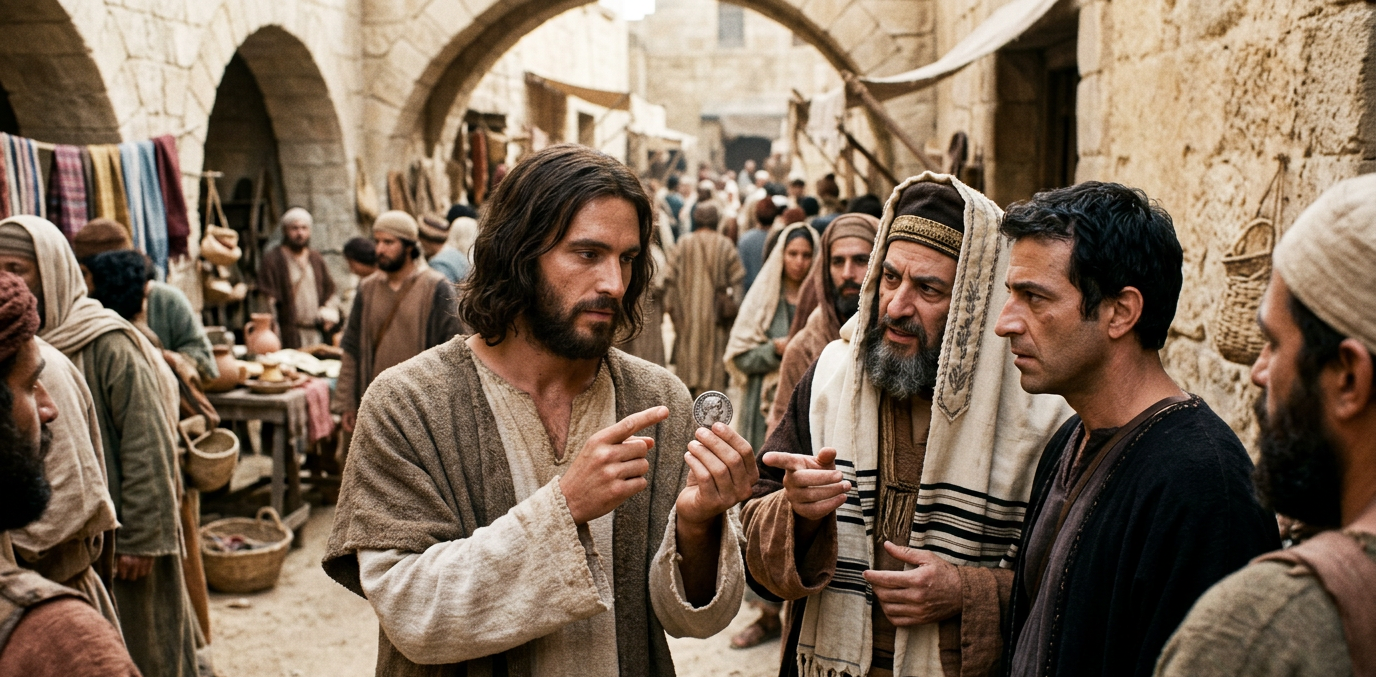
Whose Son is the Messiah? & Warning Against the Teachers of the Law
Introduction and Greeting
Good Tuesday evening, brothers and sisters. May the peace of the Lord Jesus Christ and His abundant blessings be with you as we study His Word together today.
As we move into the final sections of Luke 20, the battleground shifts from earthly politics to eternity. The Sadducees—the wealthy, aristocratic elites who reject the idea of an afterlife—step forward with a ridiculous, hypothetical riddle about a woman with seven dead husbands. They aren't looking for truth; they are trying to make the resurrection look foolish.
What we see throughout these confrontations is a powerful, unshakeable reality: Jesus cannot be handled on human terms. The elites try to trap Him using institutional power, theological trickery, and political leverage—but every single time, their traps collapse on them.
We see this same spirit at work today. Whether on social media or in our own communities, it is so easy for people to get bogged down in bitter arguments over religious rules and traditions. In the process, they completely forget the two greatest commandments: to love God and to love our neighbor. Just like the elites of Jesus' day, we often try to manipulate Scripture to fit our own agendas rather than letting it change our hearts.
A Note to the Seeker and the Lost
The study of history and timelines is beautiful, but it ultimately leads to a single, urgent decision. The reason we anchor in this truth tonight is that tomorrow is not promised. I live with the sobering reality—as we all should—that if I should sleep and not wake up tonight, I must know my soul is saved.
If you are searching tonight, know that the call to action does not require a ceremony, a crowd, or a grand ritual. It is the simple acceptance in the silence of your own heart that Christ is the Son of our Living God. Do not wait. Ask Him to lead you and ask Him to show you the “Way” to His Father’s Kingdom.
As we step into this final part of Luke 20 and look at how Jesus completely silences His critics, let us ask our Lord Jesus Christ to grant us the power of the Holy Spirit, so that we may receive His Word not just with our minds, but with our hearts and souls.
The Resurrection and Marriage
Luke 20:27-40 (NIV)
Some of the Sadducees, who say there is no resurrection, came to Jesus with a question. (^28) “Teacher,” they said, “Moses wrote for us that if a man’s brother dies and leaves a wife but no children, the man must marry the widow and raise up offspring for his brother. (^29) Now there were seven brothers. The first one married a woman and died childless. (^30) The second (^31) and then the third married her, and in the same way the seven died, leaving no children. (^32) Finally, the woman died too. (^33) Now then, at the resurrection whose wife will she be, since the seven were married to her?”
(^34) Jesus replied, “The people of this age marry and are given in marriage. (^35) But those who are considered worthy of taking part in the age to come and in the resurrection from the dead will neither marry nor be given in marriage, (^36) and they can no longer die; for they are like the angels. They are God’s children, since they are children of the resurrection. (^37) But in the account of the burning bush, even Moses showed that the dead rise, for he calls the Lord ‘the God of Abraham, and the God of Isaac, and the God of Jacob.’ (^38) He is not the God of the dead, but of the living, for to him all are alive.”
(^39) Some of the teachers of the law responded, “Well said, teacher!” (_^40) And no one dared to ask him any more questions.
Commentary
The Sadducees, who prided themselves on being the intellectual elites of their day, completely missed the point because they couldn't see past their own self-importance. They designed this bizarre, hyper-legalistic riddle purely to manipulate Jesus and trap Him into saying something foolish. They ask: After seven brothers and one widow die, who belongs to whom in heaven?
It almost sounds like a joke. But notice the massive flaw in their thinking: they are operating under the foolish assumption that eternity is just a carbon copy of earth. They assume that heaven is bound by the same physical rules, property rights, and human limitations we experience here.
But look at how Jesus responds in verse 35: “But those who are considered worthy of taking part in the age to come and in the resurrection from the dead will neither marry nor be given in marriage...”
Jesus uses that word: worthy. It forces us to stop and ask ourselves a sobering question: Are we worthy to step into God’s heavenly realm? On our own merits, by our own intellect or status, the answer is absolutely not. We are only made worthy by the grace of the One standing right in front of them.
Jesus explains that in the resurrection, our spiritual souls will live forever. The earthly constructs we cling to now won't apply. Because we will exist entirely in the spirit of light and truth, the things that divide us here melt away. In heaven, we are all brothers and sisters in the eyes of the Lord. There is no room for envy, no space for grief, and no capacity for anger—we are fully transformed in the spirit.
To completely shatter the Sadducees' argument, Jesus takes them back to the very scriptures they claimed to champion—the books of Moses. He points to the account of the burning bush in Exodus, where God declares Himself to be “the God of Abraham, and the God of Isaac, and the God of Jacob.” Jesus reminds them: He is not the God of the dead, but of the living!
Think back to what we read earlier in the Gospels during the Transfiguration. Who appeared on that mountain talking with Jesus? It was Moses and Elijah! They weren't ghosts, and they weren't non-existent; they were alive, alert, and standing in glory.
This is the ultimate evidence for us. Heaven is not a metaphor, and the resurrection is not a philosophical debate. It is a real, breathing reality. And because it is real, it brings a profound urgency to our faith today. We cannot afford to play intellectual games with God. We have to live with our eyes fixed on eternity.
After Jesus spoke, the area fell silent, and the Sadducees could only say, “Well said, teacher!” Then Jesus asked this question:
Whose Son Is the Messiah?
Luke 20:41-44 (NIV)
Then Jesus said to them, “Why is it said that the Messiah is the son of David? (^42) David himself declares in the Book of Psalms:
“ ‘The Lord said to my Lord:
“Sit at my right hand
(^43) until I make your enemies
a footstool for your feet.” ’
(_^44) David calls him ‘Lord.’ How then can he be his son?”
Commentary
Now, Jesus completely turns the tables on the elites. They spent the entire day trying to trap Him with their riddles, so Jesus poses a question of His own—one that strikes at the very core of who He is. He quotes Psalm 110, where David writes: “The Lord said to my Lord: Sit at my right hand...”
Jesus asks a brilliant, deceptive question: If the Messiah is just a human descendant of King David, why would David call his own grandson "Lord"? In ancient Jewish culture, a father or grandfather would never bow to or call their offspring "Lord." The ancestor was always greater than the descendant.
By asking this, Jesus forces them to realize that the Messiah cannot be understood on purely human terms. He is not just a political heir destined to restore a human kingdom; He is infinitely greater than David. David recognized this in the Spirit, and with profound reverence and love, he looked across time and called his future descendant his Lord.
How is this possible? Human logic can't wrap its head around it, but the Gospel of John explains this divine mystery so eloquently:
"In the beginning was the Word, and the Word was with God, and the Word was God. He was with God in the beginning... The Word became flesh and made his dwelling among us. We have seen his glory, the glory of the one and only Son, who came from the Father, full of grace and truth."
Jesus is the ultimate answer to His own riddle. As a man, born into the lineage of Judah, He is the Son of David. But as the eternal Word of God who existed before creation, He is David’s Lord and King. He is fully man, yet fully God—and He is standing right in front of them.
Warning Against the Teachers of the Law
Luke 20:45-47 (NIV)
While all the people were listening, Jesus said to his disciples, (^46) “Beware of the teachers of the law. They like to walk around in flowing robes, love to be greeted with respect in the marketplaces, and have the most important seats in the synagogues and the places of honor at banquets. ( These men will be punished most severely.”
The Commentary: Religion as a Costume
Jesus closes this entire day of confrontation by pulling His disciples close and issuing a blistering, uncompromised warning. He doesn't whisper it; the text says He speaks it "while all the people were listening." He exposes the religious elites for what they truly are: actors playing a part.
“They devour widows’ houses and, for a show, make lengthy prayers.”“They devour widows’ houses and, for a show, make lengthy prayers.”
This is the ultimate expression of handling God on human terms. They used their holy titles and theological authority as weapons to exploit the most vulnerable people in society, all while putting on an elaborate performance of long, hollow prayers to maintain their reputation.
The Modern Mirror: The Warning for Today
This brings us right back to the urgent warning we felt at the very beginning of our study tonight. The spirit of the scribes didn't die out two thousand years ago. We see it alive and well today, flashing across our screens and infiltrating our own hearts.
It is the temptation to turn our faith into a costume. It’s easy to look righteous on social media, to argue endlessly over religious rules, or to use the right spiritual language to gain influence and praise from others. But Jesus looks past the flowing robes and the eloquent words. He looks straight at how we treat the broken, the lonely, and the vulnerable.
Jesus leaves no room for gray area. He concludes with some of the most terrifying words in the entire New Testament: “These men will be punished most severely.”
True faith is not a performance; it is a matter of eternal life and death. The elites thought they were judging Jesus, but by the end of Luke 20, we see that Jesus is the true Judge over them.
Conclusion & Summary: The Ultimate Reversal
As we look back across the battlefield of Luke 20, a striking theme emerges: The Reversal of Eschatological Status.
The religious elites—the chief priests, scribes, and Sadducees—clung tightly to their earthly status, institutional wealth, and social prestige. They assumed their earthly position guaranteed them a front-row seat in the age to come. Yet, by trying to manipulate God on human terms, they completely blinded themselves to the Savior standing right in front of them. Jesus utterly shatters their assumptions. He reveals that those who are exalted in this age will face the most severe judgment, while those who are deemed worthless by the world are the ones alive to God.
The Bridge to Luke 21: A Tale of Two Motives
This severe warning against the teachers of the law forms an intentional, immediate bridge into the opening verses of Luke 21.
Jesus just finished exposing the scribes who “devour widows’ houses” while wearing expensive, flowing robes. Immediately after saying this, Jesus sits down by the temple treasury and watches the wealthy elite tossing in large, showy donations. But then, a poor, vulnerable widow walks up. She drops in two tiny copper coins—everything she has to live on.
The contrast is breathtaking:
- The Scribes: Give out of their abundance for human applause, while actively exploiting the vulnerable.
- The Widow: Gives out of her poverty for God’s applause, holding nothing back.
The elites treated religion as a transaction and a costume; this widow treats God as her absolute reality. She is the living illustration of what it means to love God with all your heart, soul, mind, and strength. She didn't play intellectual games with Scripture. She anchored her entire life, her survival, and her tomorrow in the living God.
Call to Action
Brothers and sisters, the urgent decision before us tonight is simple: Which kingdom are you investing in?
Are we like the scribes, keeping up appearances on social media and protecting our own comfort? Or are we like the widow, holding nothing back from the Lord because we know our souls are secure in Him?
Tomorrow is not promised. Do not spend another day performing or playing religious games. Surrender your whole heart to Him tonight.
Closing Prayer
Let’s carry this sobering reality into our closing prayer tonight.
Heavenly Father, we thank You for the sharp, piercing truth of Your Word. Lord, protect us from the spirit of the hypocrites. Forgive us for the times we have cared more about looking holy to the world than being holy before You. Cleanse our hearts of pride, vanity, and the desire for human applause.
We pray tonight for every heart listening. For the seeker, for the lost, and for those who are weary of empty religion—reveal Yourself to them as the living, loving Savior. We anchor our souls in You tonight, knowing that tomorrow is not promised, but that our eternity is secure in Christ. May Your Holy Spirit lead us out into this week to love You completely and love our neighbors genuinely.
As children of the living God, we join our voices together to pray the words our Savior taught us:
Our Father, who art in heaven,
hallowed be thy name;
thy kingdom come;
thy will be done;
on earth as it is in heaven.
Give us this day our daily bread.
And forgive us our trespasses,
as we forgive those who trespass against us.
And lead us not into temptation;
but deliver us from evil.
For thine is the kingdom, the power, and the glory,
for ever and ever. Amen.
In His Grace,
Tomas
The-Way.blog Digital Publications
Appendix & Study Resources
I. Comprehensive Biblical References
- Luke 20:27–40: The Sadducees, the resurrection riddle, and the burning bush argument.
- Luke 20:41–44: The Messianic puzzle of David's Son and David's Lord.
- Luke 20:45–47: The public indictment of the scribes and warning against hypocrisy.
- Luke 21:1–4: The historical pivot point—the widow’s offering as the structural counter-point to the corrupt scribes.
II. Critical and Exegetical Footnotes
- Levirate Marriage (v. 28): Grounded in Deuteronomy 25:5-6, this law ensured that a man who died childless would have his lineage and property preserved by his brother. The Sadducees weaponized this protective law into an absurd $reductio\ ad\ absurdum$ argument to mock the Pharisees' literal view of the resurrection.
- "Like the angels" (v. 36): Jesus does not state that humans become angels upon death (a common modern misconception). Rather, they become like angels in terms of status—immortal, unmarrying, and existing in a completely transformed, non-physical mode of life.
- The Burning Bush Tense (v. 37): Jesus exploits the present-tense implication of the Torah (Exodus 3:6). God did not say "I was the God of Abraham," but "I am." Because God is eternally present to them, the patriarchs must fundamentally coexist with Him in a living state.
- Psalm 110:1 (v. 42): In the original Hebrew text, the phrase is: "Yahweh said to my Adonai." Jesus demonstrates that David acknowledges a second divine personality who holds sovereign authority over David himself, shattering the contemporary concept of a purely human, political Messiah.
III. Canonical Cross-References
- John 1:1, 14: Explains the dual nature of Christ as both David's Root (the eternal Word) and David's Offspring (the flesh that dwelt among us).
- Matthew 17:1–3 (The Transfiguration): Provides concrete historical proof of Luke 20:38. Moses and Elijah are seen physically alive and conscious in glory, proving that to God, "all are alive."
- Philippians 2:9–11: The ultimate fulfillment of Psalm 110:1, where every knee will bow and every tongue confess that Jesus Christ is Lord, making His enemies His footstool.
Digital Copyright Notice
Copyright © 2026. All Rights Reserved. This document is protected under international copyright and digital rights management laws.
- Fair Use Citation: Short quotations or excerpts used in blog reviews, theological essays, or academic papers must provide appropriate attribution referencing the author and title of this work.
- Permitted Use: Permission is granted to download, store, electronically view, and print physical copies of this text solely for personal use, private study, small group Bible discussions, or local church ministry settings.
- Prohibited Use: No part of this digital publication may be reproduced, redistributed, resold, hosted on public servers, or transmitted in any form or by any means, including photocopying, digital file sharing, recording, or translation into other languages, for commercial purposes without the prior written permission of the copyright holder.