Luke 16: The Rich Man and Lazarus
If You Do Not Listen to or Heed His Word
Good afternoon, brothers and sisters. Welcome to The-Way.blog! May peace and blessings be with you today.
In our last study, we examined the Parable of the Shrewd Manager and Jesus’ pointed warnings to the Pharisees. The message for us remains clear: we are all stewards, and our time is short. Today, we turn to Luke 16:19–31—the account of the Rich Man and Lazarus—to explore a sobering reality: what happens when we fail to listen or heed God’s Word.
Jesus reminds us that our time, money, talents, and relationships are not our own; they belong to the Master. Ultimately, the question He leaves us with is not, “How much did you accumulate?” but rather, “How did you steward what was entrusted to you?”
These verses serve as a sharp mirror, revealing how easily we become ensnared by life's trappings and the pursuit of worldly wealth. As we dive into Scripture, let us approach it with true humility, leaving all judgment to God’s perfect will. It is within this posture that we discover His precious grace—the very grace we risk missing if we choose the path of the rich man. Let us begin by looking at verses 19–21, where Jesus draws a sharp contrast between worldly luxury and desperate need right at our doorstep.
Before we begin, let us ask our Lord Jesus Christ to grant us the power of the Holy Spirit, so that we may receive His Word not just with our minds, but deep within our hearts and souls."
The Rich Man and Lazarus
Luke 16: 19-21
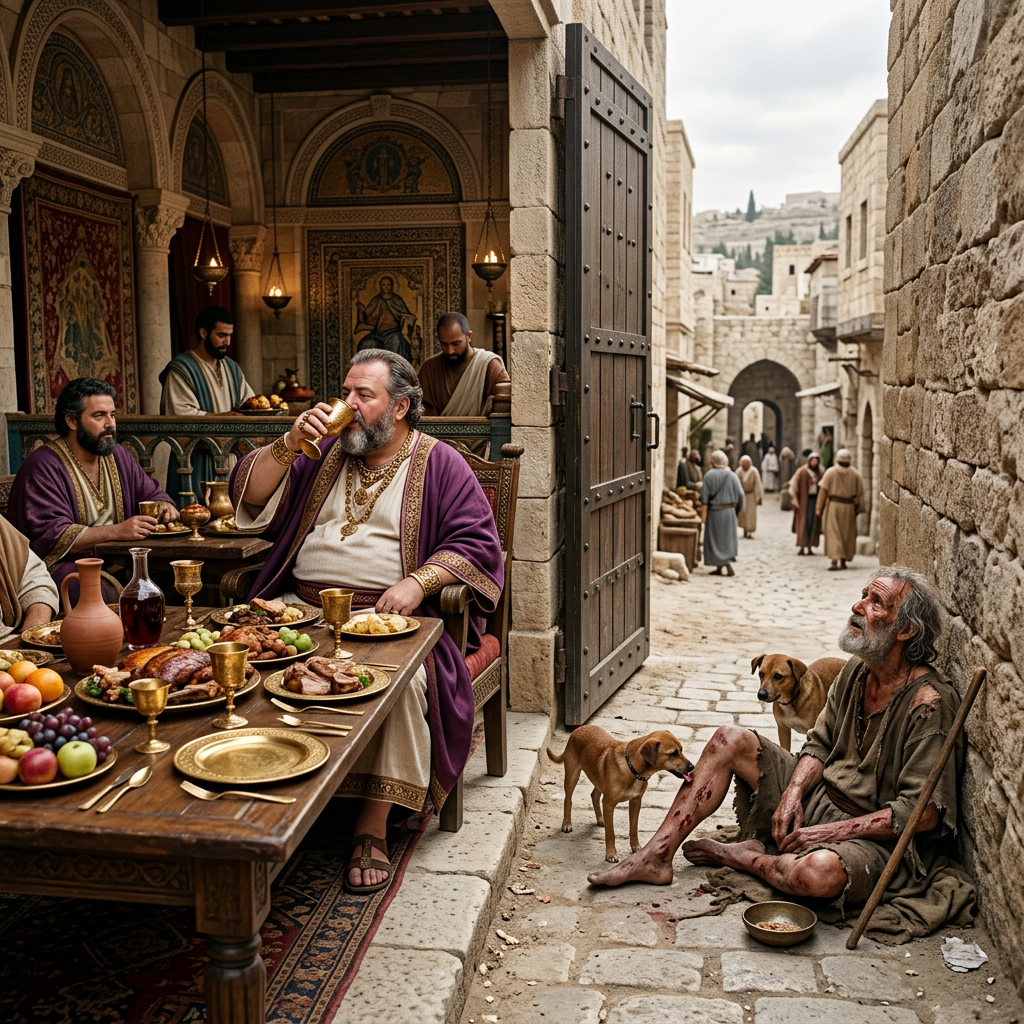
“There was a rich man who was dressed in purple and fine linen and lived in luxury every day. 20 At his gate was laid a beggar named Lazarus, covered with sores 21 and longing to eat what fell from the rich man’s table. Even the dogs came and licked his sores."
How often do we find ourselves acting like this rich man—ignoring the very people we should love, while quietly basking in the glory of our own self-righteousness? How often do we praise outsiders, yet ignore our own family and loved ones right in front of others?
Look closely at the text's description of the Rich Man (v. 19): He is clothed in "purple and fine linen," which was the attire of royalty and extreme wealth. He fares sumptuously every single day. His life is a continuous, self-absorbed feast; he doesn't just possess wealth, he wears it and consumes it daily without a single thought for the suffering just outside his door.
He is "laid at his gate," full of sores. The Greek word for "laid" (eballoto) implies he was dumped or dropped there, completely dependent on others. He longs merely for the crumbs falling from the rich man's table, the scraps used by diners to wipe their hands, then tossed to the floor. Who is my neighbor? Once again, it comes to mind. What scripture comes to your mind and why? Do we ignore the down-and-out, the sickly, or the outcast? So why does judgment radar kick in when we look at someone?
Job 2: 7-10
So Satan went out from the presence of the Lord and afflicted Job with painful sores from the soles of his feet to the crown of his head. 8 Then Job took a piece of broken pottery and scraped himself with it as he sat among the ashes.
9 His wife said to him, “Are you still maintaining your integrity? Curse God and die!”
10 He replied, “You are talking like a foolish[b] woman. Shall we accept good from God, and not trouble?”
Just like the onlookers who likely passed by Lazarus and assumed his poverty was a sign of God's displeasure, Job’s own wife and friends had already passed judgment on his suffering.
Yet, notice a profound detail in Jesus' parable: Lazarus is the only character in any of Jesus' parables given a specific name. The name Lazarus means "God is my help." While the world knew the rich man's name and ignored the beggar, God knew Lazarus by name and chose not to record the rich man's name at all. Let us not ignore the Lazaruses of our world, but actively seek ways to help them.
The final detail of verse 21 underscores just how desperate his situation was. The dogs licking his sores isn't a comfort; it emphasizes his utter helplessness and degradation in the eyes of society. He cannot even muster the strength to brush them away.
Today, if we look outside the lens of the evening news, we will find countless stories like Lazarus's. None of them are deemed "newsworthy" by a world obsessed with politics, crime, and war. But the question Jesus poses to us through this mirror is simple: what is it that sells in your own heart?
Luke 16: 22-26
“The time came when the beggar died, and the angels carried him to Abraham’s side. The rich man also died and was buried. 23 In Hades, where he was in torment, he looked up and saw Abraham far away, with Lazarus by his side. 24 So he called to him, ‘Father Abraham, have pity on me and send Lazarus to dip the tip of his finger in water and cool my tongue, because I am in agony in this fire.’
25 “But Abraham replied, ‘Son, remember that in your lifetime you received your good things, while Lazarus received bad things, but now he is comforted here, and you are in agony. 26 And besides all this, between you and us a great chasm has been set in place, so that those who want to go from here to you cannot, nor can anyone cross over from there to us.’
There is an old saying: once you make your bed, you have to lie in it. God gave us the free will to choose our eternal destiny, and the rich man certainly chose his. He spent his earthly life never needing anything, basking in luxury, and giving zero thought to helping the suffering soul right outside his gate.
Death is the great equalizer; we all will eventually face it. What we do with the talents, opportunities, and resources that God gives us today will make all the difference in where we spend eternity. The chasm becomes fixed. So, what does that mean for you and me right now? It means this: do not waste time storing up fleeting, earthly wealth. Instead, seek the wealth that comes from God—the kind that lasts forever.
The Great Gulf Fixed (Ancient & Spiritual Texts) The phrase "a great wall fixed between two worlds" heavily mirrors classic theological imagery. Most notably, it echoes the Parable of Dives and Lazarus (Luke 16:26), which describes the afterlife:” And besides all this, between you and us a great gulf is fixed, so that those who want to pass from here to you cannot, nor can those from there pass to us. “In ancient cosmology, this 'gulf' (Chasma, in the original Greek) isn't just an empty valley; it is a divinely decreed barrier. It ensures that two distinct states of existence—the realm of comfort and the realm of torment, or the sacred and the profane—can never bleed into one another. It is immutable
Luke 16:27-31
“He answered, ‘Then I beg you, father, send Lazarus to my family, 28 for I have five brothers. Let him warn them, so that they will not also come to this place of torment.’
29 “Abraham replied, ‘They have Moses and the Prophets; let them listen to them.’
30 “‘No, Father Abraham,’ he said, ‘but if someone from the dead goes to them, they will repent.’
31 “He said to him, ‘If they do not listen to Moses and the Prophets, they will not be convinced even if someone rises from the dead.’”
"Throughout their history, the people of Israel were no strangers to the supernatural; they stood as eyewitnesses to the dead being raised. From the ancient miracles of the prophets Elijah and Elisha to the jaw-dropping moment Jesus called Lazarus out of the tomb, these historic events served as undeniable proof of divine power overcoming the grave.
Yet, all of these resurrections were merely arrows pointing to the ultimate event: the Resurrection of Christ Jesus three days after His death on the Cross. Astonishingly, even in the face of this cosmic victory, unbelief prevailed. When Mary Magdalene and the women returned from the garden with the announcement of the empty tomb, the Apostles did not rejoice—they doubted, running to inspect the tomb for themselves rather than trusting the report.
It echoes the heartbreaking cry of God throughout the ages: 'Oh ye of little faith, how many times must I provide you proof?' From the devastating plagues of Egypt to the parting of the sea, miracles have rarely cured doubt. Even Thomas, who walked daily with the Living Word, demanded touching the wounds before he would surrender his skepticism. In a world desperate for signs, Christ’s final words to Thomas stand as a timeless promise to us all: 'Blessed are those who have not seen and yet have believed.'"
The Combined Finale
"In the end, I am reminded that regardless of the differences between the Orthodox, Catholic, or Protestant scriptures, the ultimate purpose remains unchanged. Beyond the debates over canon and tradition, the scriptures exist to point us toward a living reality: allowing the Holy Spirit to guide us in our quest for an eternal relationship with God, through His Son, Jesus Christ—the Way.
This requires a humility that I myself must constantly strive for, remembering not to judge other traditions. I am drawn back to Paul’s letter to the Philippians, written from the dark confines of a prison cell. Even as he watched others preach Christ out of envy and rivalry—hoping to make his chains heavier—Paul looked past their flawed motives and chose to rejoice simply because Christ was being proclaimed. It is a convicting reminder that God has always used imperfect vessels to spread the same Gospel. If Christ is preached, the boundary lines we draw matter very little; His truth still breaks through."
The Conclusion
Call to Action
As we close this reflection, let us look at the walls we have built in our own lives—the chasms of doubt, the barriers of denominational pride, and the quickness with which we judge another servant of the Master. Christ did not conquer the grave so that we would remain locked in rooms of fear or divided by human traditions. He called us out of the tomb to walk in unity.
This week, challenge yourself to lay down judgment. Look past the outward packaging of tradition and look for the fruit of the Spirit. Where you have demanded physical signs before you will step out in faith, dare to trust His voice. Let us break through our self-imposed boundaries and fully rely on the Holy Spirit to guide us along The-Way.
Closing Prayer
Heavenly Father, we thank You that Your voice is powerful enough to shatter the strongest grip of death and bridge the deepest chasms of our doubt. Forgive us for the times we have looked at Your wonders and still chosen skepticism. Forgive us for the times we have small-mindedly judged how Your Gospel is being proclaimed across the world. Pour out Your Holy Spirit upon us, granting us the humility of Paul and the unshakeable faith of those who believe without seeing. Knit our hearts together in the true unity of Jesus Christ. Amen.
The Lord's Prayer
Our Father, who art in heaven, hallowed be thy name; thy kingdom come; thy will be done on earth as it is in heaven. Give us this day our daily bread; and forgive us our trespasses, as we forgive those who trespass against us; and lead us not into temptation but deliver us from evil. For thine is the kingdom, the power, and the glory, forever and ever. Amen.
In His Grace,
Tomas
© 2026 The-Way.blog Digital Publications. All Rights Reserved.
Appendix & Study Resources
I. Comprehensive Biblical References
The Reversal of Physical Death (Prophetic Context):
1 Kings 17:17–24 – Elijah raises the son of the widow of Zarephath.
2 Kings 4:18–37 – Elisha raises the son of the Shunammite woman.
2 Kings 13:20–21 – The posthumous miracle of Elisha’s bones reviving a dead man.
The Crowning Sign and the Apostolic Response:
John 11:1–44 – Jesus raises Lazarus of Bethany after four days in the tomb.
Luke 24:1–12 / John 20:1–10 – The historical account of the women at the empty tomb and the subsequent skepticism and race of Peter and John.
John 20:24–29 – The post-resurrection appearance to Thomas and the declaration of blessing upon unseen faith.
The Call to Ecumenical Grace:
Philippians 1:12–18 – Paul’s reflection on Christ being preached out of partisan rivalry during his Roman imprisonment.
II. Critical and Exegetical Footnotes
The Semantic Range of Chasma: In Luke 16:26, the Greek text employs the noun \chi\alpha\sigma\mu\alpha (Chasma), derived from \chi\alpha\sigma\kappa\omega, meaning "to yawn" or "gape open." In classical antiquity, it denoted an unbridgeable cosmic abyss or volcanic rift. The perfect passive participle $\epsilon\sigma\tau\eta\rho\iota\kappa\tau\alpha\iota$ ("is fixed") denotes a permanent, divinely decreed status that cannot be altered by human or demonic agency.
First-Century Testimony Jurisprudence: The Apostles' initial dismissal of the women's report (Luke 24:11 notes their words seemed like "an idle tale" or \lambda\eta\rho o\varsigma, meaning nonsense) is culturally tied to Greco-Roman and rabbinic legal structures (Mishnah Yevamot 15:4), where the testimony of women was generally inadmissible in court. By appointing Mary Magdalene as the Apostola Apostolorum (Apostle to the Apostles), Christ deliberately upends human social criteria as a prerequisite for spiritual authority.
The Imperfective Proclamation in Philippians: In Philippians 1:18, Paul uses the present passive indicative \kappa\alpha\tau\alpha\gamma\gamma\epsilon\lambda\lambda\epsilon\tau\alpha\iota ("is proclaimed"). The use of this continuous tense emphasizes that the ongoing fact of the proclamation overrides the corrupt subjective motivations (\epsilon\ro\iota\theta\iota\iota\alpha factionalism/selfish ambition) of the preachers.
III. Canonical Cross-References
The theological framework connecting the ancient prophetic resurrections, the signs of Christ, and the ultimate eschatological reality demonstrates a deliberate scriptural progression:
[[Old Testament Foretokens] -----------> [Christ's Johannine Signs] -----------> [The Christological Climax] (Elijah / Elisha: 1 & 2 Kings) (Lazarus: John 11) (The Resurrection) Anticipates limited temporal Demonstrates authority over Inauguration of the restoration. localized decomposition. New Covenant.
The Seed vs. The Harvest: 1 Corinthians 15:20–23 establishes Jesus as the "firstfruits" ($\alpha\pi\alpha\rho\chi\eta$) of those who have fallen asleep. While the individuals raised by Elijah, Elisha, and Jesus (Lazarus) were resuscitated to mortal life and would die again, Christ was raised into an incorruptible, glorified body.
The Wilderness Parallel: Hebrews 3:12–19 cross-references Israel’s chronic unbelief ($\alpha\pi\iota\sigma\tau\iota\alpha$) in the wilderness despite seeing the signs of the Exodus with the danger of a modern hardened heart. The pattern of requiring sensory proof (Exodus 17:7) directly mimics the Johannine portrait of Thomas.
The Reversal of Eschatological Status
The trajectory of your narrative culminates in what theologians call the
Reversal of Eschatological Status.
This is the divine paradigm shift where the boundaries of the present evil age are shattered by the breaking in of the Kingdom of God.
From Separation to Access: The fixed chasm of the underworld (Luke 16) and the unbridgeable gulf created by sin and death are fundamentally altered by the Cross. Through the tearing of the temple veil (Matthew 27:51), access across the cosmic boundary is secured.
The Ultimate Reversal: Death, which historically held absolute dominion over humanity, is reduced to a temporary "sleep" (John 11:11). The final status of believers is completely decoupled from their earthly limitations, national identities, or denominational divides, and is instead anchored in the singular reality of the empty tomb.
Digital Copyright Notice
Copyright © 2026. All Rights Reserved. This document is protected under international copyright and digital rights management laws.
Fair Use Citation: Short quotations or excerpts used in blog reviews, theological essays, or academic papers must provide appropriate attribution referencing the author and title of this work.
Permitted Use: Permission is granted to download, store, electronically view, and print physical copies of this text solely for personal use, private study, small group Bible discussions, or local church ministry settings.
Prohibited Use: No part of this digital publication may be reproduced, redistributed, resold, hosted on public servers, or transmitted in any form or by any means, including photocopying, digital file sharing, recording, or translation into other languages, for commercial purposes without the prior written permission of the copyright holder.
sharing, recording, or translation into other languages, for commercial purposes, without the prior written permission of the copyright holder