
Luke 22: Jesus Arrested
Peter Disowns Jesus
Introduction and Greeting
Good afternoon, and welcome, brothers and sisters! May the peace of our Lord Jesus Christ and His abundant blessings be with you as we study His Word together today.
Before we dive into today’s text, I want to share a quick update on a few new ways you can support this ministry. If The Way has been a blessing to you, I invite you to consider helping us grow by becoming a paid subscriber or simply by “buying me a coffee” through our support links:
Your generosity not only helps us continue this daily journey with Christ, but it also directly supports my family as I dedicate time to this work. Thank you so much for your prayers, your presence, and your partnership.
Devotional Study
Let’s turn our hearts now to Luke 22, where we witness two of the most poignant moments in the Gospels: the arrest of Jesus and Peter’s denial.
When the pressure mounted, fear got the best of Peter, leading him to disown the Savior he had promised to die for. It is a sobering picture of human frailty, a reminder of how quickly our hands shake when our faith grows weak. Yet, Peter’s story doesn’t end in that courtyard. It serves to remind us that even when we stumble, Jesus remains strong in our weakness, ever ready to restore us.
In stark contrast to Peter’s fear stands Christ’s perfect submission. As He faces the agonizing weight of the cross in the garden, He prays:
“Father, if you are willing, take this cup from me; yet not my will, but yours be done.” (Luke 22:42)
Jesus Arrested
Luke 22: 47-53 (NIV)
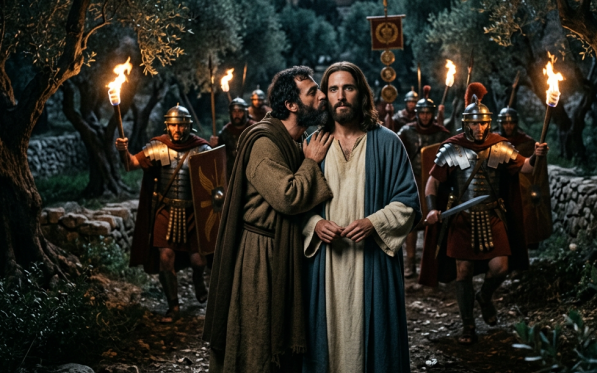
While he was still speaking, a crowd came up, and the man who was called Judas, one of the Twelve, was leading them. He approached Jesus to kiss him, 48 but Jesus asked him, “Judas, are you betraying the Son of Man with a kiss?”
49 When Jesus’ followers saw what was going to happen, they said, “Lord, should we strike with our swords?” 50 And one of them struck the servant of the high priest, cutting off his right ear.
51 But Jesus answered, “No more of this!” And he touched the man’s ear and healed him.
52 Then Jesus said to the chief priests, the officers of the temple guard, and the elders, who had come for him, “Am I leading a rebellion, that you have come with swords and clubs? 53 Every day I was with you in the temple courts, and you did not lay a hand on me. But this is your hour—when darkness reigns.”
Devotional Commentary
The Subtle Trap of Anger
Judas did not become a betrayer overnight; he allowed Satan to cloud his mind over time, nursing grievances until his heart grew completely dark. It is a sobering warning for us today. Think about how easily we snap in anger, fume over a minor interruption, or yell at the TV over a bad call by a referee.
When we let our anger smolder, we give the enemy a foothold. Scripture routinely warns us about the danger of unchecked resentment. We see it all the way back in Genesis when God warned a brooding Cain:
“Why are you angry? Why is your face downcast?” (Genesis 4:6)
Jesus echoed this critical warning in the Sermon on the Mount:
“Anyone who is angry with a brother or sister will be subject to judgment… and anyone who says, ‘You fool!’ will be in danger of the fire of hell.” (Matthew 5:22)
Judas allowed small drops of frustration to turn into a flood of betrayal. What small irritations are we letting smolder in our own hearts today?
The Crowd and the Prearranged Sign
Luke tells us that a massive crowd suddenly fractured the quiet of the garden. By pulling in the other Gospels, we get a vivid picture of who was actually there: a volatile mix of temple guards sent by the chief priests and elders (Matthew 26:47), teachers of the law (Mark 14:43), and even a detachment of Roman soldiers (John 18:3) carrying torches, swords, and clubs.
In the chaotic darkness of Gethsemane, Judas had prearranged a signal to identify Jesus to the authorities: a kiss of greeting (Matthew 26:48-49). Because Jesus was likely of similar height, weight, and dress as His disciples, Judas wanted to ensure they grabbed the right man.
As John’s Gospel points out, the kiss actually proved unnecessary because Jesus boldly stepped forward and identified Himself first. Yet, trapped in his own momentum and clouded mind, Judas went through with his tragic plan anyway.
A Contrast of Focus
While Matthew and Mark describe the mechanics of Judas’s arrangement and execution of the kiss, Luke shifts our focus to the heart of the Savior. Luke focuses intensely on what Jesus asks Judas: “Judas, are you betraying the Son of Man with a kiss?”
Even in the moment of ultimate betrayal, Jesus confronts Judas not with a defensive strike, but with a question designed to pierce the conscience. It highlights Christ’s absolute composure and grace, even as the hour of darkness begins.
22:53 your [plural] hour—when darkness reigns. Satan (see note on v. 3) is the power behind the Jewish religious leaders. Although Satan appears to be in control, Jesus’ death and resurrection is the beginning of their demise. The risen Lord’s commission to Paul reflects this reversal (Acts 26:17–18).
Peter Disowns Jesus
Luke 22: 54-62 (NIV)
Then seizing him, they led him away and took him into the house of the high priest. Peter followed at a distance. 55 And when some there had kindled a fire in the middle of the courtyard and had sat down together, Peter sat down with them. 56 A servant girl saw him seated there in the firelight. She looked closely at him and said, “This man was with him.”
57 But he denied it. “Woman, I don’t know him,” he said.
58 A little later someone else saw him and said, “You also are one of them.”
“Man, I am not!” Peter replied.
59 About an hour later another asserted, “Certainly this fellow was with him, for he is a Galilean.”
60 Peter replied, “Man, I don’t know what you’re talking about!” Just as he was speaking, the rooster crowed. 61 The Lord turned and looked straight at Peter. Then Peter remembered the word the Lord had spoken to him: “Before the rooster crows today, you will disown me three times.” 62 And he went outside and wept bitterly.
Devotional Commentary
Following at a Safe Distance
After the chaos in the garden, the authorities seized Jesus and marched Him to the house of the high priest (Caiaphas). While Mark 14:50 tells us that the other disciples panicked and fled into the darkness, Peter chose a different path: he followed at a distance.
Peter wanted to stay close enough to see what would happen to his Master, but far enough away to avoid being arrested himself. He thought he could find a “safe distance” to follow Christ. But as the text shows us, there is no such thing as a safe distance when it comes to discipleship. Trying to keep one foot in Christ’s world and one foot in the safety of the world only sets us up for a fall.
Willing Body, Weak Mind
Peter’s actions here remind us of another famous moment in his life. Just as he once stepped out of the boat and began to walk on water toward Jesus, a sudden wave caused him to lose focus, panic, and sink. Here in the courtyard, the waves of fear crashed over him again.
Peter’s body was willing—his feet actually carried him right into the enemy’s courtyard while others ran away. But his mind and spirit were weak. Sitting by the fire, trying to blend in with the crowd, he was caught completely off guard. He wasn’t challenged by a squad of Roman soldiers; he was questioned by a servant girl. In that moment of vulnerability, the pressure fractured his resolve, and the three denials spilled out, culminating in his thick Galilean accent giving him away.
The Look of Grace
The climax of this passage is heartbreakingly beautiful. Just as the third denial leaves Peter’s lips, the rooster crows. But it isn’t just the sound that breaks Peter—it is a look.
“The Lord turned and looked straight at Peter.” (Luke 22:61)
From across the courtyard, perhaps through a window or as He was being led through a hallway, Jesus looked straight at Peter. It wasn’t a look of “I told you so,” nor was it a look of hatred. It was a look of profound sorrow, unyielding love, and fulfilled prophecy. Jesus had predicted this exact moment, not to condemn Peter, but to show him that He already knew the depth of his weakness—and loved him anyway.
Remembering the Lord’s words, Peter rushed out into the night and wept bitterly. The breaking of Peter’s pride was agonizing, but it was necessary. Before Peter could become the rock upon which the early Church would be built at Pentecost, he had to realize that his own human strength was not enough.
Reflection for Today
How often do we try to follow Jesus at a “safe distance,” hiding our faith when the environment gets hostile? Like Peter, our spirits may be willing, but our flesh is weak. If you have failed Him, remember that Jesus is still looking at you—not with condemnation, but with an invitation to come outside, weep through the brokenness, and allow Him to restore you.
Conclusion, Summary, and Bridge to Action
In the span of just a few hours in Luke 22, we witness a jarring contrast between the perfect resolve of Jesus and the absolute frailty of His closest followers. Judas allows small seeds of anger to bloom into a catastrophic, premeditated betrayal. Peter tries to engineer a “safe distance” to follow Christ, only to watch his human courage shatter before a servant girl.
Yet, the ultimate message of this chapter is not the failure of man, but the faithful sovereignty of God. Jesus walks into the darkness, fully aware of the cost, healing His enemies, confronting His betrayers with the truth, and looking upon His failing disciples with restorative love.
Call to Action
Brothers and sisters, the courtyard of high priest Caiaphas is a mirror for our own souls. Today, let us step out of the shadows of a “safe distance” relationship with Christ.
- Examine the embers: Are there hidden pockets of anger or resentment, like Judas harbored, that you need to surrender to God before they smolder into sin?
- Close the gap: Where have you been hiding your faith or trying to blend into the world’s crowd? Commit this week to standing boldly for Him in your workplace, your family, and your community.
Closing Prayer
Heavenly Father, thank You for Your unyielding grace. When we are weak, You are strong. Forgive us for the times we have followed You at a distance, or let our anger cloud our minds. Guard our hearts against the enemy’s traps, and grant us the courage of the Holy Spirit to stand boldly for You, even when the world grows hostile. We love You, Lord.
And we join our voices together now in the prayer that Jesus taught us:
Our Father, who art in heaven, hallowed be thy name. Thy kingdom come, thy will be done on earth as it is in heaven. Give us this day our daily bread, and forgive us our trespasses, as we forgive those who trespass against us. And lead us not into temptation but deliver us from evil. For thine is the kingdom, and the power, and the glory, forever and ever. Amen.
Grace and Peace Be with You Always
Tomas
© 2026 The-Way.blog Digital Publications. All Rights Reserved
Study Appendix & Exegetical Notes
I. Comprehensive Biblical References
- The Arrest of Jesus: Luke 22:47–53; Matthew 26:47–56; Mark 14:43–52; John 18:3–12.
- Peter’s Denial: Luke 22:54–62; Matthew 26:69–75; Mark 14:66–72; John 18:15–18, 25–27.
II. Critical and Exegetical Footnotes
- Luke 22:54 (“house of the high priest”): Historically identified as the palace of Joseph Caiaphas (High Priest from AD 18–36). His father-in-law, Annas (High Priest from AD 6–15), also resided there or nearby, which explains why John 18 notes Jesus was brought to Annas first.
- Luke 22:59 (“for he is a Galilean”): Galileans spoke an Aramaic dialect with distinct phonetic gutturals, making them easily identifiable to residents of Judea and Jerusalem.
- Luke 22:61 (“The Lord turned and looked straight at Peter”): The Greek verb used for “looked” is emblepō, meaning to look deeply, intently, or piercingly. This dramatic detail is unique to Luke’s Gospel, emphasizing Christ’s divine awareness and personal pastoral care even during His trial.
III. Canonical Cross-References
- Genesis 4:6–7: God’s warning to Cain regarding brooding anger, illustrating how unmanaged frustration provides a gateway for sin—paralleling the spiritual decline of Judas.
- Matthew 5:22: Jesus’ strict warning regarding the eschatological judgment due to unresolved relational anger and verbal abuse (“Raca”, “You fool!”).
- Proverbs 16:18: “Pride goes before destruction, a haughty spirit before a fall.”—a direct scriptural mirror to Peter’s earlier boast (“Lord, I am ready to go with you to prison and to death”) and his subsequent failure.
IV. The Reversal of Eschatological Status
Throughout Luke’s Gospel, a primary theme is the reversal of statuses in God’s cosmic order—the first will be last, and the last will be first (cf. Luke 1:52-53; 13:30). In this narrative, we see this theme reach an intense peak:
- The religious leaders, who claim to represent divine light, weaponize the dark (“this is your hour—when darkness reigns”).
- Judas, chosen for an elevated apostolic office, abases himself to the status of a traitor.
- Peter, the self-proclaimed strongest pillar among the disciples, is brought low by the simple interrogation of a servant girl.
- Conversely, Jesus, though being stripped of His earthly dignity and freedom, is revealed as the ultimate Sovereign King—knowing all things, healing wounds, and extending grace. True power is redefined through His submissive suffering.
Digital Copyright Notice
Copyright © 2026. All Rights Reserved. This document is protected under international copyright and digital rights management laws.
- Fair Use Citation: Short quotations or excerpts used in blog reviews, theological essays, or academic papers must provide appropriate attribution referencing the author and title of this work.
- Permitted Use: Permission is granted to download, store, electronically view, and print physical copies of this text solely for personal use, private study, small group Bible discussions, or local church ministry settings.
- Prohibited Use: No part of this digital publication may be reproduced, redistributed, resold, hosted on public servers, or transmitted in any form or by any means, including photocopying, digital file sharing, recording, or translation into other languages, for commercial purposes without the prior written permission of the copyright holder.