
Luke 22: Judas Agrees to Betray Jesus
Right there at the Last Supper, sitting around the very table where Jesus was breaking bread and offering His life, sat Judas, whose heart had already surrendered to greed. Sitting nearby was Peter, who swore he would die for Jesus, but was only hours away from denying He even knew Him.
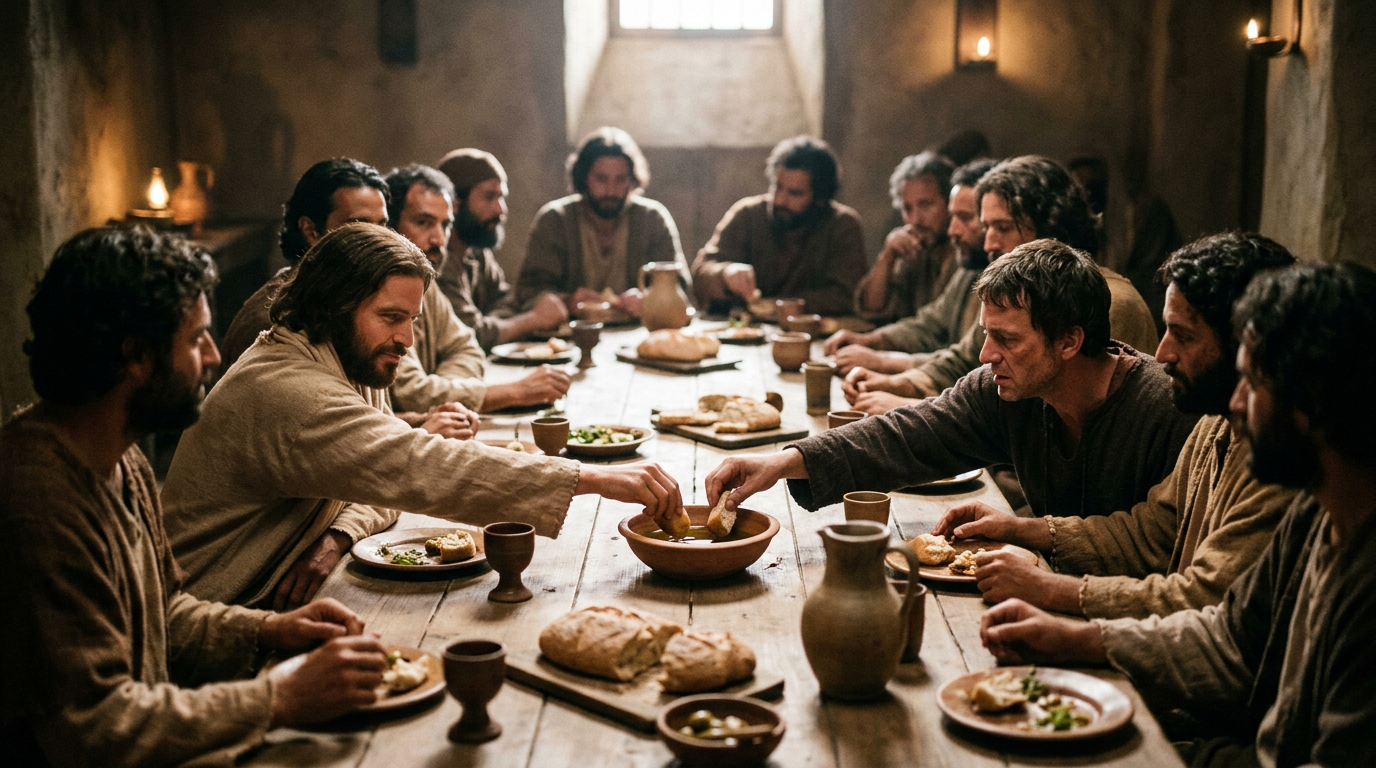
The Last Supper
Greetings
Good afternoon, and welcome, brothers and sisters! May the peace of our Lord Jesus Christ and His abundant blessings be with you as we study His Word together today. To those of you visiting for the first time or returning—greetings!
Before we dive into today’s text, I want to share a quick update and a personal request. This coming weekend, I will be setting up a few new ways for you to support this ministry. If “The-Way” has been a blessing to you, I invite you to consider helping us grow by becoming a paid subscriber or simply by “buying me a coffee” through the support link. Your generosity not only helps us continue this daily journey with Christ, but it also directly supports my family as I dedicate time to this work. Thank you so much for your prayers, your presence, and your partnership.
Devotional Study “The Battle at the Table”
Scripture Focus:
“But behold, the hand of him who betrays me is with me on the table.” — Luke 22:21
Reflection
As we step into Luke 22, the Gospel’s structural landscape shifts drastically. In chapter 21, the warnings were massive, public, and cosmic—Jesus spoke of falling temples, roaring seas, and nations shaking in fear. But now, the camera zooms all the way in. The loud crowds in the temple courts are gone, and the narrative moves into dark, intimate spaces: a secret, conspiratorial meeting (22:1–6) and a quiet upper room (22:7–38).
Jesus pulls His closest friends into this hidden room. The atmosphere is thick with tension, sacrifice, and the creeping shadows of betrayal.
It is incredibly easy to look at the massive problems in our world—the political chaos, the cultural shifts, the global conflicts—and assume the real spiritual battle is “out there” on the world stage. But Luke 22 reminds us that the enemy’s most dangerous work doesn’t happen in the halls of government; it happens in the quiet, unguarded corners of our own hearts.
Right there at the Last Supper, sitting around the very table where Jesus was breaking bread and offering His life, sat Judas, whose heart had already surrendered to greed. Sitting nearby was Peter, who swore he would die for Jesus, but was only hours away from denying He even knew Him.
The deepest spiritual battle you and I will face this week isn’t hitting the evening news. It’s the quiet tug-of-war in our souls when we are tired, frustrated, or tempted to compromise. Jesus knows our weaknesses, yet He still invites us to His table. He doesn’t ask for our perfection; He asks for our absolute surrender.
Prayer
Lord Jesus, as we open Your Word today, we ask You to search our hearts. Cleanse us from any hidden compromise, any quiet pride, or any area where we are tempted to put our own comfort ahead of Your Cross. As we sit at Your table today, give us the grace to stay faithful, even when the shadows fall. Amen.
The Master Timeline
My truest belief is that there are absolutely no accidents in the kingdom of God. As believers, we can easily fall into the habit of viewing the life of Christ as a series of disconnected historical events—a birth here, a teaching there, and an execution at the end. But when you look beneath the surface at the specific timing of the Hebrew calendar, you realize that every single moment of Christ’s life was an unshakeable, meticulously timed appointment dictated by God’s true will.
To truly understand the weight of what happens in the Upper Room in Luke 22, we have to look at how God bookended Christ’s entire earthly mission using His holiest days. It is a masterful framework of a definitive beginning and a definitive end.
Consider the Day of Atonement (Yom Kippur). This is the holiest day of the year on the biblical calendar—the one specific day the High Priest entered the Holy of Holies to offer blood to cover the sins of the nation. I am deeply inclined to believe that this day marks the actual birth of Christ. Think about the profound beauty of that timing: instead of a human high priest entering a physical room once a year to temporarily veil sin, God Himself physically entered our world to dwell among us. From the very moment of His birth, the Incarnation was entirely about ultimate reconciliation. His beginning on Earth was marked by the purpose of wiping away our sins.
Then, we look at the Passover—the celebration of Israel’s national rescue from the death angel in Egypt. Jesus wasn’t just arrested and executed on a random weekend because the authorities finally caught up with Him. He was crucified at the exact hour the Passover lambs were being slaughtered in the Temple. The shadow of the Old Covenant met the perfect Substance of the New. The blood on the wooden doorposts of Egypt perfectly mirrored the blood on the wooden beams of the Cross.
By weaving the Day of Atonement (His arrival to cover sin) together with the Passover (His sacrifice to conquer death), we see a flawless, divine design. God’s true will was operating on an exact timeline that no human plot could alter.
It is with this profound realization—that everything was marching toward a predetermined cosmic hour—that we must approach the opening of Luke 22. Before the betrayal of Judas is set in motion, and before the disciples sit down for the Last Supper, we have to recognize that Jesus was not a victim of circumstance. He was the author of a grand design, stepping intentionally into the hour He had eagerly desired since the foundation of the world.
Scripture Reading
Luke 22:1–6 (NIV) — Judas Agrees to Betray Jesus
Now the Festival of Unleavened Bread, called the Passover, was approaching, and the chief priests and the teachers of the law were looking for some way to get rid of Jesus, for they were afraid of the people. Then Satan entered Judas, called Iscariot, one of the Twelve. And Judas went to the chief priests and the officers of the temple guard and discussed with them how he might betray Jesus. They were delighted and agreed to give him money. He consented and watched for an opportunity to hand Jesus over to them when no crowd was present.
Contextual Note on the Text:
- “Satan entered Judas”: In the Gospels, this terrifying expression is used on two separate occasions: here, before Judas went to the chief priests, and later during the Last Supper itself (John 13:27). Thus, the Gospel writers explicitly depict Satan’s progressive influence and eventual control over Judas (see also John 13:2, John 17:12).
The Illusion of Control: What Pharaoh and Judas Didn’t See Coming
We often look at Pharaoh and Judas Iscariot as history’s ultimate villains—isolated figures driven by pure malice. But if you look closer at their stories, a much deeper, more profound psychological pattern emerges. It isn’t just a story of bad intentions; it is a masterclass in the self-destruction of forced control.
Both men suffered from the same fatal flaw: they felt power slipping through their fingers, panicked, overthought their strategies, and inadvertently engineered their own downfalls.
1. The Fear of Losing Status and Wealth
At the root of both betrayals is a desperate panic over loss.
- Pharaoh looked at the exploding population of Israelites and panicked about losing his massive slave labor force. To secure Egypt’s economic dominance, he opted to crush Israel’s spirit and faith with heavier burdens.
- Judas expected a political Messiah who would overthrow Rome and establish an earthly kingdom—one in which the disciples would hold high status and share a purse. When he realized Jesus was marching toward a cross instead of a throne, Judas likely tried to pivot to protect his own skin and pocketbook.
2. The Overthinking Strategists
Neither man acted on a blind whim; they were meticulous planners. They didn’t just react; they strategized.
- Pharaoh constantly calibrated his cruelty—manipulating midwives, withholding straw, and ordering executions to maintain absolute leverage over his workforce.
- Judas didn’t just walk away in disappointment. He negotiated a specific price, scouted locations away from the volatile crowds, and choreographed the arrest down to a specific sign of affection—a kiss. They both thought they were playing high-stakes chess.
3. The Trap of the Hardened Heart
How does a human being reach this point? It happens through a gradual spiritual erosion.
Pharaoh didn’t become a monster overnight; he repeatedly hardened his own heart during the early plagues until his free will locked into a permanent state of defiance. Similarly, the Gospels note that Judas had been skimming money from the common purse long before Holy Week. By the time Luke 22 tells us that “Satan entered Judas,” his defenses were already entirely gone. He had built the runway; evil just landed the plane.
The moment the trap snapped, both men lost total agency. Pharaoh was blinded by rage, marching his army into a collapsing sea. Judas was seized with immediate, agonizing regret, returning the silver before losing his life in despair.
The Divine Irony
The ultimate takeaway of these twin tragedies is what theologians call divine irony. When human beings try to grip power tighter because they feel it slipping away, their own schemes end up accelerating their ruin.
Pharaoh’s stubbornness didn’t keep his slaves; it triggered the plagues that shattered Egypt and emptied his kingdom. Judas’s betrayal didn’t end Jesus’ movement; it triggered the crucifixion, which became the very mechanism of salvation for the entire world.
In the end, both men thought they were executing a brilliant plan to protect their own kingdoms. In reality, their desperate attempts to maintain control were the exact tools God used to break history open.
A Note on the Text
Scripture References for Deeper Study:
- Luke 22:1–4
- Exodus 7–14
The Last Supper
Luke 22: 7-23 (NIV) Scripture
Then came the day of Unleavened Bread on which the Passover lamb had to be sacrificed. 8 Jesus sent Peter and John, saying, “Go and make preparations for us to eat the Passover.”
9 “Where do you want us to prepare for it?” they asked.
10 He replied, “As you enter the city, a man carrying a jar of water will meet you. Follow him to the house that he enters, 11 and say to the owner of the house, ‘The Teacher asks: Where is the guest room, where I may eat the Passover with my disciples?’ 12 He will show you a large room upstairs, all furnished. Make preparations there.”
13They left and found things just as Jesus had told them. So they prepared the Passover.
14 When the hour came, Jesus and his apostles reclined at the table. 15 And he said to them, “I have eagerly desired to eat this Passover with you before I suffer. 16 For I tell you, I will not eat it again until it finds fulfillment in the kingdom of God.”
17 After taking the cup, he gave thanks and said, “Take this and divide it among you. 18 For I tell you I will not drink again from the fruit of the vine until the kingdom of God comes.”
19 And he took bread, gave thanks and broke it, and gave it to them, saying, “This is my body given for you; do this in remembrance of me.”
20 In the same way, after the supper he took the cup, saying, “This cup is the new covenant in my blood, which is poured out for you. [a] 21 But the hand of him who is going to betray me is with mine on the table. 22 The Son of Man will go as it has been decreed. But woe to that man who betrays him!” 23 They began to question among themselves which of them it might be who would do this.
The Hidden Security Protocol (Verses 7-23)
When the time comes to prepare the Passover meal, a subtle shift occurs. Usually, Jesus calls his “inner three”—Peter, James, and John. But this time, James is left behind. Jesus sends only Peter and John ahead into Jerusalem with highly unusual, almost bizarre instructions: Look for a man carrying a jar of water.
In first-century Jewish culture, fetching water with ceramic jars was almost exclusively women’s work. Men typically transported water in heavy leather skins. (We see a similar cultural exception at the wedding of Cana, where Mary tells the male servants to obey Jesus’ command to fill massive stone water jars). By specifying a man carrying a jar, Jesus was giving them a needle in a haystack—a visual anomaly that would immediately stand out in a crowded city.
This wasn’t just a random display of prophetic insight; it was a tactical countermeasure. By keeping the location secret and using a pre-arranged, silent signal, Jesus ensured that Judas could not slip away early and tip off the temple guard. Jesus fiercely protected this final evening with His disciples, ensuring the trap would not spring until the meal was complete.
The Desire of the Lamb (Luke 22:14–16)
“When the hour came, Jesus and his apostles reclined at the table. And he said to them, ‘I have eagerly desired to eat this Passover with you before I suffer.’” (Luke 22:14–15)
The Greek phrase used here for “eagerly desired” is an intense idiom (epithumia epethumesa), literally meaning “with desire I have desired.” Think about the timing. Jesus knew the betrayal was already set in motion. He knew the abandonment, the mockery, and the physical agony of the Cross were only hours away. Yet, His dominant emotion in this room wasn’t panic or dread—it was a fierce, passionate longing to be intimately present with His disciples at the table.
We naturally understand the desire to gather loved ones around us for major milestones—weddings, the arrival of a child, or a hard-earned achievement. But there is a much deeper, more sacred longing that occurs at the end of life.
I experienced this intimately last July when my mother passed away. She knew she was ready to go, but she held on. She waited until my youngest brother could arrive, ensuring that all her family was present and accounted for before she finally let go.
That is the space Jesus is occupying here. Despite knowing exactly what was coming, He fiercely guarded His final hours so He could spend them with the ones He loved. This wasn’t just a ritual meal; it was a final, intimate gathering of His family before the storm.
The Shadow and the Substance (Luke 22:17–21)
At this moment in the upper room, the traditional elements of the Passover are entirely redefined. For centuries, the unleavened bread reminded Israel of their hurried, midnight escape from Egypt. Now, Jesus breaks it and shifts the cosmos: “This is my body given for you.”
Then, He lifts the cup. In the traditional Passover Seder, this is the third cup—the Cup of Redemption. Rather than pointing backward to the blood of a literal lamb wiped on ancient Egyptian doorposts, Jesus uses it to establish a New Covenant in His own blood. This is the ultimate fulfillment of the promise made through the prophet Jeremiah centuries earlier—a brand-new administration of God’s saving grace, sealed not with the blood of animals, but by the death of Jesus.
The shadow of the old ritual is entirely swallowed up by the Substance of His sacrifice. Just as the original Passover was a constant reminder of Israel’s redemption from physical bondage, this new command serves as a perpetual proclamation of a greater rescue: the deliverance of all believers—both Jew and Gentile—from the spiritual bondage of sin.
Treachery at the Table
Then, the mood shifts violently with verse 21: “But behold, the hand of him who betrays me is with me on the table.”
To fully grasp the weight of this, we have to understand ancient Near Eastern culture. In that world, sharing a meal and breaking bread with someone was the ultimate covenant of peace, loyalty, and safety. To eat a man’s bread and then turn against him was considered the lowest, most despicable form of treachery.
Yet, notice what Jesus does. He doesn’t dismiss Judas before dipping the bread. He doesn’t have the temple guard remove him. He exposes the betrayal not to cast Judas out, but to show that even the absolute worst of human treachery is fully accounted for in God’s sovereign plan.
The Modern Table
The upper room table perfectly models our daily spiritual reality in two profound ways:
- The Proximity of Grace and Failure: Look at who is sitting there. The hands of the betrayer (Judas), the denier (Peter), and the prideful arguers (the rest of the disciples, who immediately begin disputing who is the greatest in verse 24) are all resting on the exact same table. Grace and human brokenness are touching the same wood.
- The Posture of Christ: Jesus doesn’t pull the bread back. He doesn’t flip the table in anger. He offers His life entirely, anyway, fully knowing the frailty and corruption of the hands receiving it.
Sibling Rivalry at the Last Supper (Verses 23-30)
24 A dispute also arose among them as to which of them was considered to be greatest. 25 Jesus said to them, “The kings of the Gentiles lord it over them; and those who exercise authority over them call themselves Benefactors. 26 But you are not to be like that. Instead, the greatest among you should be like the youngest, and the one who rules like the one who serves. 27 For who is greater, the one who is at the table or the one who serves? Is it not the one who is at the table? But I am among you as one who serves. 28 You are those who have stood by me in my trials. 29 And I confer on you a kingdom, just as my Father conferred one on me, 30 so that you may eat and drink at my table in my kingdom and sit on thrones, judging the twelve tribes of Israel.
Right after the ultimate declaration of sacrifice, the mood in the upper room breaks down into something incredibly ordinary and human. A dispute breaks out among the disciples about which of them is the greatest. Anyone who grew up in a house with brothers knows this exact dynamic. No matter how solemn the occasion, sibling rivalries have a way of bubbling to the surface. Even in Christ’s final hours, the disciples are bickering like boys in the backseat.
To correct them, Jesus draws a sharp contrast. He points to the Gentile world, where pagan kings lord their power over people and demand to be called “Benefactors”—buying forced loyalty through top-down authority.
“But you are not to be like that,” Jesus says. “Instead, the greatest among you should be like the youngest…” (Luke 22:26).
By elevating the youngest, Jesus is doing something profound. He is tapping into a recurring pattern that runs all through the book of Genesis. In the ancient Near East, the firstborn naturally held all the status, wealth, and authority. Yet time and again, God bypassed the worldly standard to choose the younger brother: Jacob over Esau, Isaac over Ishmael, Joseph over his older siblings, and eventually David over his older brothers.
Worldly power demands that the younger serve the older, and the weak serve the strong. But in the Kingdom of God, the hierarchy is completely inverted. The true King stands among them not as a “Benefactor” demanding applause, but as the one who serves. Because they stood by Him in His trials, Jesus promises them a place at a table in a new Kingdom—one where status isn’t seized through rivalry but received through humility.
The Sifting of the Rock (Verses 31-34)
“Simon, Simon, Satan has asked to sift all of you as wheat. But I have prayed for you, Simon, that your faith may not fail. And when you have turned back, strengthen your brothers.” But he replied, “Lord, I am ready to go with you to prison and to death.” Jesus answered, “I tell you, Peter, before the rooster crows today, you will deny three times that you know me.”
When Jesus calls out Peter’s impending failure, He isn’t just addressing a first-century fisherman—He is calling us out as well. He is exposing the weaknesses, doubts, and self-preservation instincts that we all carry throughout our lifetimes.
Have you ever wondered why Jesus chose Peter to be the “rock” upon which He would build His Church? Peter was a blue-collar guy. He was tough, impulsive, and intensely loyal, yet deeply fragile. His track record was a roller coaster. We see him bravely step out of a boat to walk on water, only to take his eyes off Jesus and sink in terror. Years after the resurrection, the Apostle Paul would have to publicly call Peter out as a hypocrite for letting fear dictate whom he would sit and eat with.
But of all his failures, the denial in the courtyard stands as the ultimate break. Peter genuinely believed his own hype when he said, “I am ready to go with you to death.” He underestimated his own weakness under pressure.
How many of us, me included, are frozen by that exact same pressure?
We find ourselves in environments where it is uncomfortable, unpopular, or socially risky to claim Christ. Afraid of what people might say, think, or look down on us for, we choose comfort. But by keeping silent to protect ourselves, we effectively put a basket over the light Christ gave us.
The beauty of this passage, however, isn’t Peter’s failure—it’s Jesus’s intercession. Notice that Jesus doesn’t say, “I have prayed that you won’t get sifted.” He says, “I have prayed for you… that your faith may not fail. And when you have turned back, strengthen your brothers.”
Jesus already knew the rock was going to crack. But he also knew that a broken rock, restored by grace, would be exactly what a broken world needed to lean on.
The Changing of the Guard (Verses 35-38)
35 Then Jesus asked them, “When I sent you without purse, bag or sandals, did you lack anything?”
“Nothing,” they answered.
36 He said to them, “But now if you have a purse, take it, and also a bag; and if you don’t have a sword, sell your cloak and buy one. 37 It is written: ‘And he was numbered with the transgressors’[b]; and I tell you that this must be fulfilled in me. Yes, what is written about me is reaching its fulfillment.”
38 The disciples said, “See, Lord, here are two swords.”
“That’s enough!” he replied.
This is easily one of the most misunderstood conversations in the Gospels. The disciples, being literal-minded, immediately pull out two physical weapons. Jesus shuts them down with a blunt, exasperated phrase: “That’s enough!” He wasn’t telling them to launch an armed insurrection—He was trying to prepare them for a massive, structural shift in their mission.
Think about the contrast Jesus sets up. When He first sent them out to preach early in His ministry, He told them to take nothing, no money, no extra sandals, no luggage. Back then, the full wrath of Israel’s religious leaders hadn’t yet surfaced. The cultural law of hospitality was still working in their favor. They lacked nothing because the environment was relatively safe.
But the shadow of the Cross changes everything.
Jesus quotes Isaiah 53:12: “He was numbered with the transgressors.” The moment Jesus is legally classified as a state criminal, the branding extends to His followers. The baseline of cultural hospitality is gone.
By telling them to pack a purse, a traveling bag, and a sword, Jesus is warning them of the immense resistance to come. Once the Holy Spirit falls at Pentecost and they launch into the nations, they will face a world that actively wants them dead.
The “sword” here is a stark metaphor for absolute vigilance, self-sustainability, and spiritual warfare. They were moving from a season of peaceful harvest into a season of fierce, high-stakes survival. They would have to hold the line and proclaim the truth, even at the cost of their own blood.
Jesus’s question echoes down through the centuries to us today: The environment around us is changing, and the comfort of a receptive culture is fading.
Are you equipped? Are you vigilant? Are you ready to fight?
Conclusion & Summary: The Sovereignty Behind the Shadow
Luke 22:1–38 exposes the rawest friction between human panic and divine purpose. We watch Judas and Pharaoh attempt to manipulate reality to secure their own status, only to realize they are characters in a play they do not control. We see the disciples bicker like competitive brothers over earthly thrones, completely blind to the fact that their King is winning a throne by becoming a slave. And we watch Peter mistake his own fragile emotional adrenaline for genuine spiritual endurance.
Yet, across this entire chapter, Jesus remains entirely unruffled. He orchestrates silent security measures with watercarriers to protect His final hours. He takes the ancient shadows of the Exodus—the bread of affliction and the cup of judgment—and transforms them into the Substance of a New Covenant. He sits at a table where grace rubs shoulders with betrayal, denial, and pride, and He offers Himself anyway. He changes the rules of the mission, warning us that the baseline of worldly comfort is gone, and a season of high-stakes vigilance has begun.
The Bridge: From the Table to the Press (Luke 22:39–62)
The sermon in the upper room is over; the agonizing execution of that sermon now begins. Jesus turns His feet away from the safety of the table and walks straight toward the dark, olive-shadowed slopes of the Mount of Olives, entering a garden called Gethsemane—literally, “The Oil Press.”
As we pivot into Luke 22:39–62, the themes we have unpacked in theory will be tried by fire:
- The “eager desire” of Jesus meets the crushing weight of the cup of wrath, causing Him to sweat drops of blood.
- The metaphorical sword of spiritual vigilance is misunderstood yet again as Peter draws a literal blade in the dark, slicing off an ear.
- The blueprint of human frailty reaches its climax in a cold courtyard, where a rooster’s crow shatters the illusions of the blue-collar rock who thought he could never break.
Call to Action
The shifting cultural tides around us mirror the hostile landscape Jesus warned His disciples about. The days of easy, comfortable faith are behind us.
- Examine your table: Are you trying to dictate terms to God like Judas, or are you willing to accept the broken bread of His will?
- Break your silence: Do not let the fear of a modern courtyard keep you from standing for the light you have been given.
- Equip yourself: Buy the sword of spiritual discipline, step out of passive complacency, and prepare to stand firm in a world that is increasingly hostile to the truth.
Closing Prayer
Heavenly Father, we thank You that our greatest failures and the world’s deepest treacheries cannot derail Your sovereign rescue plan. Forgive us for the times we have stayed silent in our own courtyards out of fear. Give us the grit of a blue-collar faith that, even when broken, returns to strengthen the brothers. Equip us for the spiritual battle ahead, and keep our eyes fixed on the Substance, not the shadows.
In the name of the Lamb who serves, Amen.
The Lord’s Prayer
Our Father, who art in heaven,
hallowed be thy name;
thy kingdom come;
thy will be done;
on Earth as it is in heaven.
Give us this day our daily bread.
And forgive us our trespasses,
as we forgive those who trespass against us.
And lead us not into temptation.
but deliver us from evil.
For thine is the kingdom,
the power and the glory,
forever and ever.
Amen.
Grace and Peace Be with You Always
Tomas
© 2026 The-Way.blog Digital Publications. All Rights Reserved.