Luke 23: From Blasphemy to Treason: The Day Jesus Was Put on Trial
When we look closely at the opening of this trial, Pontius Pilate initially appears surprisingly open-minded. He listens, he examines, and he accurately discerns the truth: Jesus is completely innocent, and the religious leaders are acting out of pure jealousy.
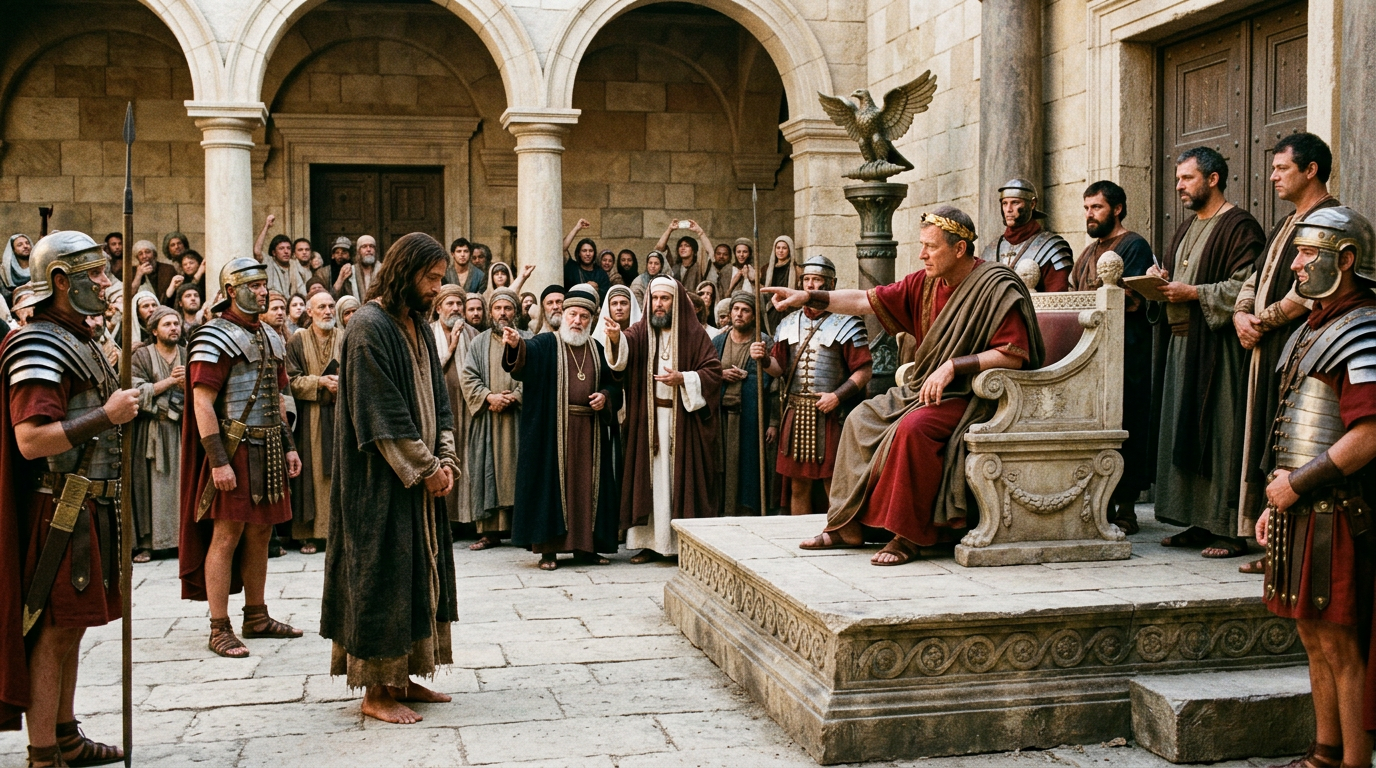
Jesus Before Pilate and Herod
Welcome & Ministry Update
Good afternoon, and welcome, brothers and sisters! May the peace of our Lord Jesus Christ and His abundant blessings be with you as we study His Word together today.
Before we dive into today’s text, I want to share a quick update on how you can support this ministry. If The Way has been a blessing to your walk, I invite you to consider helping us grow by becoming a paid subscriber or simply by “buying me a coffee” through our support links:
The Way Substack
The Way Blog
Your generosity directly helps us continue this daily journey with Christ, and it supports my family as I dedicate time to this work. Thank you so much for your prayers, your presence, and your partnership.
Devotional Preview: The Shift from Blasphemy to Treason
As we open Luke 23, the setting shifts dramatically. The Sanhedrin marches Jesus from their private council chamber straight to the palace of Pontius Pilate, the Roman governor. Notice how quickly their strategy changes: before the high priests, the charge was religious “blasphemy,” but before Rome, they instantly spin it into political treason. They accuse Jesus of misleading the nation, forbidding taxes to Caesar, and claiming to be a rival king.
What we witness in these verses is a heartbreaking clinic in political maneuvering and human weakness:
- Pilate’s Compromise: Pilate openly admits three distinct times that he finds no guilt in Jesus. Yet, threatened by the crowd and terrified of a political riot, he chooses personal survival over absolute justice.
- Herod’s Curiosity: Shuffled off to Herod Antipas, Jesus faces a ruler who only wants to see a miracle performed like a cheap magic trick. When Jesus remains silent, Herod mocks Him and sends Him right back.
- The Crowd’s Choice: In a stunning twist of irony, the crowd demands the release of Barabbas—a man actually guilty of the very insurrection and murder they falsely accuse Jesus of committing.
The Core Truth: Jesus stood silent and resolute through this mockery of justice, fully aware that the earthly authorities spinning these political webs were merely instruments in a much larger, divine plan. He allowed Himself to be traded for a criminal so that we—the truly guilty—could go free.
Heart Check: Questions to Consider Before We Read
This study should be challenging and devotionally deep. To help us look at the text not as detached spectators, but with the sobering realization that we often look just like the crowd, ask yourself:
1. Do we test God’s kingship based on our comfort? When Pilate asks, “Are you the King of the Jews?” it forces us to consider how we treat His authority. Do we only treat Him as King when He does what we want, demanding: “If you are truly God, then heal my illness, fix my finances, or change my circumstances”?
2. Do we pass off our spiritual responsibilities? When a son, daughter, or friend asks you a deep spiritual question, do you pass the buck to a pastor, a church program, or someone else—much like Pilate passed Jesus off to Herod to get the problem off his hands?
3. Are we part of the crowd? When our prayers aren’t answered on our timeline, do we secretly turn on Him?
Let us open our hearts and minds, acknowledging our own brokenness, as we thank God for Jesus Christ’s saving grace
Luke 23: 1-25
1 Then the whole assembly rose and led him off to Pilate. 2, And they began to accuse him, saying, “We have found this man subverting our nation. He opposes payment of taxes to Caesar and claims to be the Messiah, a king.”
3 So Pilate asked Jesus, “Are you the king of the Jews?”
“You have said so,” Jesus replied.
4 Then Pilate announced to the chief priests and the crowd, “I find no basis for a charge against this man.”
5 But they insisted, “He stirs up the people all over Judea by his teaching. He started in Galilee and has come all the way here.”
6 On hearing this, Pilate asked if the man was a Galilean. 7 When he learned that Jesus was under Herod’s jurisdiction, he sent him to Herod, who was also in Jerusalem at that time.
8 When Herod saw Jesus, he was greatly pleased, because for a long time he had been wanting to see him. From what he had heard about him, he hoped to see him perform a sign of some sort. 9 He plied him with many questions, but Jesus gave him no answer. 10 The chief priests and the teachers of the law were standing there, vehemently accusing him. 11 Then Herod and his soldiers ridiculed and mocked him. Dressing him in an elegant robe, they sent him back to Pilate. 12 That day Herod and Pilate became friends—before this they had been enemies.
13 Pilate called together the chief priests, the rulers and the people, 14 and said to them, “You brought me this man as one who was inciting the people to rebellion. I have examined him in your presence and have found no basis for your charges against him. 15 Neither has Herod, for he sent him back to us; as you can see, he has done nothing to deserve death. 16 Therefore, I will punish him and then release him.”(Note: Verse 17 is omitted in modern manuscripts like the NIV, as it is not found in the earliest Greek texts).
18 But the whole crowd shouted, “Away with this man! Release Barabbas to us!” 19 (Barabbas had been thrown into prison for an insurrection in the city, and for murder.)
20 Wanting to release Jesus, Pilate appealed to them again. 21 But they kept shouting, “Crucify him! Crucify him!”
22 For the third time he spoke to them: “Why? What crime has this man committed? I have found in him no grounds for the death penalty. Therefore, I will have him punished and then release him.”
23 But with loud shouts they insistently demanded that he be crucified, and their shouts prevailed. 24 So Pilate decided to grant their demand. 25 He released the man who had been thrown into prison for insurrection and murder, the one they asked for, and surrendered Jesus to their will.
Commentary: The Trial Before the World: Shallow Soil and the Ultimate Choice
Shallow Roots and Passed Responsibilities
When we look closely at the opening of this trial, Pontius Pilate initially appears surprisingly open-minded. He listens, he examines, and he accurately discerns the truth: Jesus is completely innocent, and the religious leaders are acting out of pure jealousy.
But Pilate’s open-mindedness is like the wild seed sown on rocky soil. It flashes with life and looks promising at first, right up until the heat rises. The moment the crowd begins to demand something more—the moment justice requires personal sacrifice or risks a political riot—Pilate’s shallow moral foundation begins to wither under the sun of public pressure.
Faced with the terrifying dilemma of putting an innocent man to death or facing Caesar’s anger, Pilate searches desperately for an escape hatch. The moment he hears the word “Galilee,” you can almost hear his sigh of relief: “Oh, perfect—He falls under King Herod’s jurisdiction. This isn’t my problem anymore.”
Instead of standing firm on the truth he already acknowledged, Pilate passes the buck. He tries to wash his hands of spiritual and moral responsibility by shipping Jesus off to Herod’s court. But as the text shows us, you cannot evade a choice regarding Jesus Christ.
Herod’s Entertainment vs. True Faith
This brings us to Herod’s court in verses 8–12, where we see human blindness on display in a completely different form. Unlike Pilate, who is anxious, Herod is absolutely delighted to see Jesus. But his joy is entirely hollow. Herod is blinded by a desire for entertainment; he wants what so many of us secretly seek at our lowest points—a private miracle performed just for him, a personal sign so that he can finally believe.
It is easy for us to read the Gospels or remember how God provided for the people of Israel in the desert and still find ourselves demanding fresh proof. We ask our questions, present our checklists, and look to God to perform like a magician, validating our faith.
Yet, when plied with many questions, Jesus stands in absolute, heavy silence before Herod.
This silence carries a profound truth for us today. Jesus refused to reduce the kingdom of God to a sideshow for a cynical king. By withholding a miraculous display from Herod, Jesus honors the beauty of authentic faith. For those of us who choose to believe even when we cannot see—who trust His character when the heavens seem silent—He promises that we will inherit His kingdom alongside Him. True faith doesn’t demand a sign; it rests entirely on the Savior.
How often do we act just like these two rulers? We either play the part of Pilate, looking for a loophole or a distraction to shift jurisdictions when a decision gets too costly, or we play the part of Herod, treating God as a transactional tool for our own comfort. This text reminds us that a compromise with the truth is always a surrender to the crowd, and demanding signs only blinds us to the King standing right in front of us.
The Courtyard Crossroads: Choosing a Methodology
Pilate, still trying to keep from having an innocent man’s blood on his hands, returns to give the leaders and the crowd a choice. Let’s look at that choice more closely:
1. Barabbas’s First Name Was Jesus
In the earliest Greek manuscripts of the Gospel of Matthew (Matthew 27:16–17), the figure we know simply as "Barabbas" is actually referred to as Jesus Barabbas (Ἰησοῦν Βαραββᾶν). Many early scribes and later translators likely removed "Jesus" from Barabbas's name because they felt it was irreverent or confusing for a rebel to share a first name with Jesus of Nazareth. However, modern biblical scholars widely agree that "Jesus Barabbas" was his original textual name.
2. “Bar” Means “Son Of”
In Aramaic, the prefix Bar ("בר") means "son of." Therefore, Barabbas translates directly to "Son of the Father" (Bar-Abba).
The Ultimate Historical Mirror
When you put their full names and titles side-by-side, the choice presented to the crowd in Jerusalem becomes a striking, literal mirror image:
| The Rebel / Bandit | The Messiah |
| Jesus Barabbas | Jesus the Messiah (Christ) |
| Translates to: Jesus, Son of the Father | Translates to: Jesus, Son of the Father |
| Chosen by the crowd for physical and political liberation. | Rejected by the crowd for spiritual liberation. |
In short, the crowd was literally asked to choose between Jesus, Son of the Father (a political insurgent) and Jesus, Son of the Father (the spiritual Messiah).
The Way of the World vs. The Way of the Kingdom
While bending to Matthew’s historical naming context, Luke’s account zeroes in heavily on the stark, uncompromising contrast between what these two men represent. It lays out the choice between the ways of the world and the way of Christ with absolute clarity.
In Luke 23, the text explicitly highlights why Barabbas was in prison:
“…a man who had been thrown into prison for an insurrection started in the city and for murder.” (Luke 23:19)
By emphasizing Barabbas’s crimes, Luke frames the choice for the crowd—and for the reader—as a direct crossroads:
- The World’s Way (Barabbas): He represents the violent, political mechanism of the world. He tried to bring about freedom and change through human might, rebellion, and force.
- The Kingdom Way (Jesus): He represents the path of sacrificial love, spiritual transformation, and submission to the Father’s will.
When the crowd shouts, “Away with this man, and release to us Barabbas!” (Luke 23:18), they aren’t just choosing an individual; they are choosing a methodology. They chose the world’s immediate, aggressive response to oppression over Christ’s eternal, spiritual redemption.
It is a powerful literary and spiritual mirror. The narrative forces every one of us, as readers and faithful followers of Christ, to stand in that same courtyard and answer the same question: Are we going to choose the systems and methods of the world to save us, or are we going to choose Christ Jesus?
The Grand Biblical Echoes
When you look closely at Luke’s Gospel, this choice between Jesus and Barabbas functions as the ultimate culmination of two of the oldest stories in scripture.
1. The Mirror of Cain and Abel: The Cycle of Violence
The connection to Cain and Abel is striking because it deals with the two foundational paths of humanity: the path of the murderer and the path of the innocent victim.
- The Mark of Cain: Cain was the original rebel who used violence, blood, and murder to solve his problems. In Luke 23, Barabbas is explicitly defined by those exact same things: insurrection and murder.
- The Blood of Abel: Abel was the innocent brother whose blood cried out from the ground. Jesus is the ultimate “Abel”—the perfectly innocent brother who is envied and handed over to be killed.
By demanding Barabbas, humanity repeated the ancient mistake of Cain. The crowd chose to spare the man of blood and sacrifice the innocent, righteous one. It shows that without Christ, the world naturally defaults right back to the violent way of Cain.
2. The Reinforcement of the Prodigal Son
This is where Luke’s specific Gospel shines brightest. Remember, the Parable of the Prodigal Son (Luke 15) is completely unique to Luke. It features a father with two sons—one who rebels and runs away, and one who stays but is filled with resentment.
In the courtyard of Luke 23, the ultimate Father has two sons standing before the world:
- Jesus Barabbas (The Prodigal Son): He is the ultimate broken, rebellious son. He took life into his own hands, broke the law, and ended up bound in a prison of his own making.
- Jesus the Christ (The Obedient Son): He is the perfect, holy Son who only does what He sees His Father doing.
Here is the beautiful, devastating twist of the Gospel: The Prodigal Son gets to go free, but only because the Righteous Son takes his place.
Barabbas did absolutely nothing to earn his release. He was sitting in the dark, waiting for execution, completely guilty. Suddenly, his cage door opens, his chains are cut, and he is told he is free to go—not because he proved his innocence, but because the perfect Son is going to the cross instead.

The Big Picture: In this single courtroom scene, Luke pulls the whole Bible together. He shows that while the world chooses the violent path of Cain, God uses that exact moment to enact the ultimate redemption of the Prodigal Son. Barabbas is all of us—the guilty child set free because the Elder Brother stepped into the gap.
Conclusion: The Final Verdict of Human Pride
The civil trial before Pilate and Herod exposes the profound bankruptcy of human power systems. A Roman governor compromises justice for political survival, an apostate king demands a magic show, and a religious nation chooses a murderer over their Maker. In this chaotic courtroom, humanity reveals its deepest defect: we will readily bend the knee to Barabbas's violent way if it protects our immediate comfort and avoids the radical demands of the true King.
Yet, rising above this tragic clinic of human weakness is the staggering reality of God’s sovereignty. Pilate didn’t win. The mob didn’t win. In their blind fury, they were unwittingly fulfilling the eternal blueprint of redemption. The innocent Son of the Father stepped into the death sentence of the guilty sons, trading His perfect liberty for our absolute chains.
Bridge to Luke 23:26-43: The Walk to Skull Place
This dramatic exchange marks the point of no return. Now that the world’s verdict has been handed down, the sentence must be carried out immediately.
As we move into the next passage, Luke 23:26-43, the scene shifts from the political palaces of Jerusalem out into the open streets. The heavy Roman crossbar is hoisted onto a battered shoulder, and the long, agonizing procession toward Golgotha begins.
As you read ahead into the next study, keep your eyes on the contrasting reactions of those who walk this road alongside Him:
- Watch for Simon of Cyrene, a random bystander pulled from the crowd, forced to carry the cross behind Jesus.
- Listen to the weeping Daughters of Jerusalem, whom Jesus turns to warn about a coming judgment far heavier than His current suffering.
- Pay close attention to the ultimate crossroads at the summit of the hill: the two criminals crucified on either side of Him. One mocks Him using the same cynical language as the Sanhedrin, while the other recognizes His true majesty through the blood, uttering the immortal plea: “Jesus, remember me when you come into your kingdom.”
The King has been condemned; now, we watch Him conquer.
Call to Action
Brothers and sisters, this text demands a response. We cannot remain neutral spectators in the courtyard.
- Examine Your Heart: Let the mirror of this trial expose any hidden moments where we push Christ’s authority away to preserve our own comfort. Turn back to Him in repentance.
- Submit to the Seated King: Stop trying to fight your own battles using the world’s tactics of power, control, or manipulation. Trust that the Father’s sovereign plan is perfect, just as Jesus did.
- Share the Gospel: Someone in your life right now is carrying the crushing weight of their own shame and brokenness—living like a prisoner in a cage. Tell them about the King who stood in their place so they could go free.
Closing Prayer
Heavenly Father,
We are humbled by the immense grace of Your Son, Jesus Christ. Thank You that when we were lost in our brokenness and guilt, He stood silent before earthly rulers and willingly took our place of condemnation. Forgive us for the times we have chosen the methods of the world over the way of Your Kingdom. Fix our eyes on Jesus, our perfect substitute, who wore a crown of thorns so that we might inherit eternal life. Grant us the courage to stand firm in our faith this week, relying completely on His strength.
In Jesus’ mighty name we pray, Amen.
The Lord’s Prayer
Our Father, who art in heaven, hallowed be thy name. Thy kingdom come, thy will be done, on earth as it is in heaven. Give us this day our daily bread, and forgive us our debts, as we forgive our debtors. And lead us not into temptation, but deliver us from evil. For thine is the kingdom, and the power, and the glory, forever. Amen.
Grace and Peace Be with You Always,
Tomas
© 2026 The-Way.blog Digital Publications. All Rights Reserved
I. Comprehensive Biblical References
- Luke 23:1–25: The Roman civil trial of Jesus, unique for its inclusion of the Herodian intermission and the explicit emphasis on the substitutionary release of Barabbas.
- Psalm 2:1–2: Prophetic psalm detailing how the “kings of the earth rise up and the rulers band together against the Lord and against his anointed”—a text the early church explicitly tied to the alliance of Pilate and Herod (Acts 4:25–28).
- Isaiah 53:7: The definitive Suffering Servant prophecy depicting the Messiah as a lamb led to the slaughter who “did not open his mouth,” directly mirrored in Jesus’ absolute silence before Herod Antipas.
- Leviticus 16:5–10: The Old Testament ritual of the Two Goats on the Day of Atonement. One innocent goat is sacrificed, while the “scapegoat” bearing real guilt is released alive into the wilderness—the ultimate typological blueprint for the exchange of Jesus and Barabbas.
II. Critical and Exegetical Footnotes
- Subverting Our Nation (v. 2): The Greek verb diastrephonta carries the heavy political connotation of perverting, distorting, or turning a populace away from its rightful allegiance. The Sanhedrin deliberately chose this word to flag Jesus as an imminent national security threat to Rome.
- Herod’s Jurisdiction (v. 7): The Greek term exousia refers to legal authority or territorial dominion. Because Jesus was from Nazareth (Galilee), He fell under the regional authority of Herod Antipas. Pilate’s dispatching of Jesus was not a courtesy; it was a strategic attempt to pass off a dangerous political hot potato.
- The Textual Omission of Verse 17: Modern translations remove verse 17 ("Now he was obliged to release one man to them at the festival") because it is completely absent from the earliest and most reliable Greek manuscripts (such as Codex Sinaiticus, Codex Vaticanus, and Codex Bezae). It was likely added by later Western scribes trying to harmonize Luke’s account with Matthew 27:15 and Mark 15:6.
- Surrendered to Their Will (v. 25): Luke uses the technical Greek word paredōken ("handed over" or "surrendered"). This isn't just a description of Pilate giving in to a mob; it is a profound theological keyword used across the New Testament to describe God handing over His Son to death for our sake (e.g., Romans 8:32).
III. Canonical Cross-References
| Historical Event | Luke Passage | Matthew Parallel | Mark Parallel | John Parallel |
| First Trial Before Pilate | Luke 23:1-5 | Matt 27:11–14 | Mark 15:1–5 | John 18:28–38 |
| Interrogation Before Herod | Luke 23:6-12 | Omitted | Omitted | Omitted |
| The Choice of Barabbas | Luke 23:13-25 | Matt 27:15–26 | Mark 15:6–15 | John 18:39–19:16 |
IV. The Ultimate Substitutionary Exchange
The core theological pivot of Luke 23:1–25 hinges on a complete structural swap of legal status between the innocent King and the guilty insurgent.
- The Sinner’s Reality (Barabbas): Bound in darkness, rightfully condemned for violent insurrection and murder, awaiting execution under the full weight of the law.
- The Sovereign’s Reality (Jesus): Bound in meekness, completely innocent of all political and moral charges, possessing absolute cosmic righteousness.
By explicitly contrasting Barabbas’ crimes with Pilate’s repeated declarations of Jesus’ innocence, Luke demonstrates that the Gospel is fundamentally substitutionary. Barabbas does not face a trial, make a confession, or perform a work to earn his freedom. His cage door is unlocked simply because the true Jesus, Son of the Father, walks into his cell’s doom. The historic courtyard of Luke 23 serves as a living, breathing canvas of grace: the guilty rebel walks out alive, and the innocent Righteous One marches to the cross.
Digital Copyright Notice
Copyright © 2026. All Rights Reserved. This document is protected under international copyright and digital rights management laws.
- Fair Use Citation: Short quotations or excerpts used in blog reviews, theological essays, or academic papers must provide appropriate attribution referencing the author and title of this work.
- Permitted Use: Permission is granted to download, store, electronically view, and print physical copies of this text solely for personal use, private study, small group Bible discussions, or local church ministry settings.
- Prohibited Use: No part of this digital publication may be reproduced, redistributed, resold, hosted on public servers, or transmitted in any form or by any means, including photocopying, digital file sharing, recording, or translation into other languages, for commercial purposes without the prior written permission of the copyright holder.