
Luke 23: The Crucifixion of Jesus
The Women who had come with Jesus from Galilee followed Joseph and saw the tomb and how his body was laid in it. Then they went home and prepared spices and perfumes. But they rested on the Sabbath in obedience to the commandment.” (Luke 23:55-56)
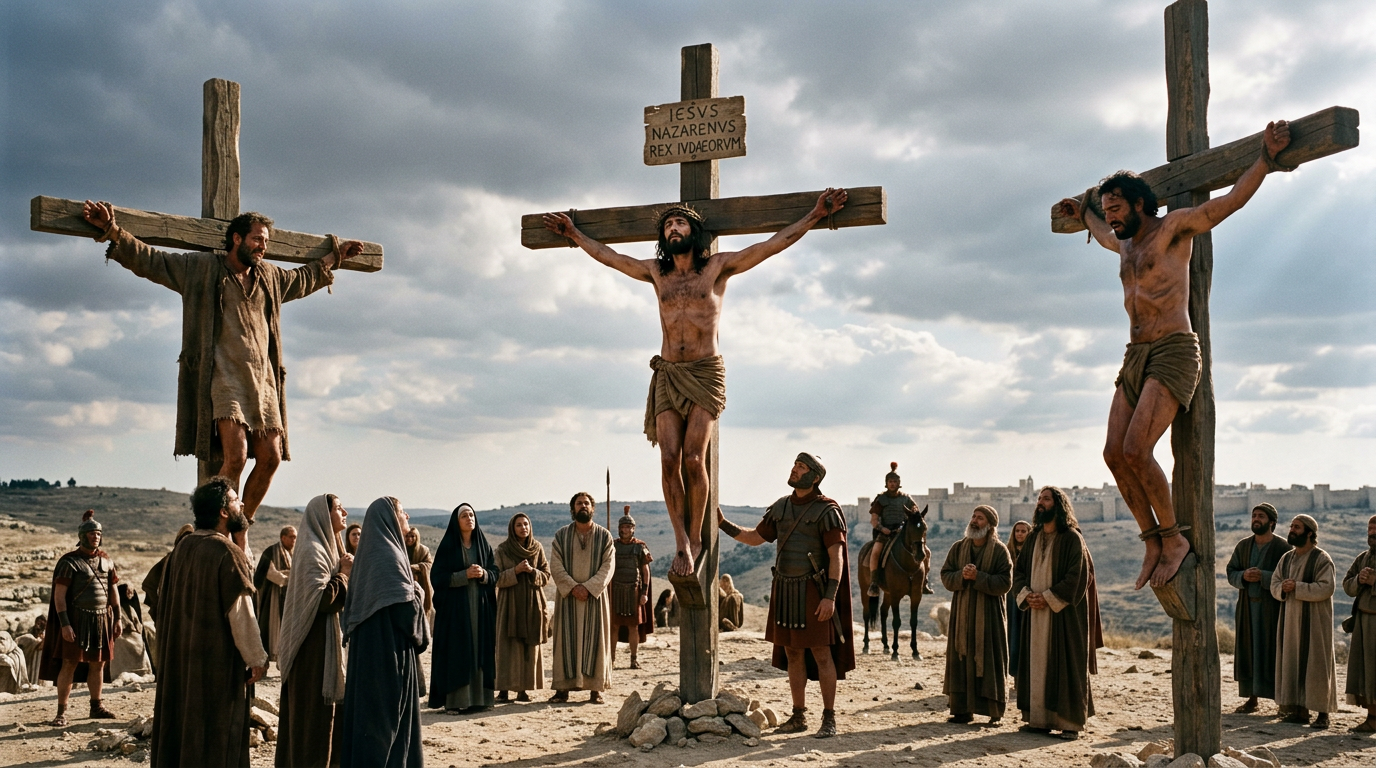
Grace of Jesus from the Cross
Welcome to The-Way Ministry
Good afternoon, and welcome, brothers and sisters! May the peace of our Lord Jesus Christ and His abundant blessings be with you as we study His Word together today.
Before we dive into today’s text, I want to share a quick update on how you can support this ministry. If The Way has been a blessing to your walk, I invite you to consider helping us grow by becoming a paid subscriber or simply by “buying me a coffee” through our support links:
Your generosity directly helps us continue this daily journey with Christ, and it supports my family as I dedicate time to this work. Thank you so much for your prayers, your presence, and your partnership.
Devotional Preview
This dramatic exchange at the end of His trial marks the point of no return. The world has handed down its final verdict, and the sentence must now be carried out immediately.
As we move into our text, Luke 23:26-43, the scene shifts from the political palaces of Jerusalem out into the open streets. The heavy Roman crossbar is hoisted onto a battered shoulder, and the long, agonizing procession toward Golgotha begins.
As you read ahead into this study, keep your eyes on the contrasting reactions of those who walk this road alongside Him:
- Watch for Simon of Cyrene, a random bystander pulled from the crowd, forced to carry the cross behind Jesus.
- Listen to the weeping Daughters of Jerusalem, whom Jesus turns to warn about a coming judgment far heavier than His current suffering.
- Pay close attention to the ultimate crossroads at the summit of the hill: the two criminals crucified on either side of Him. One mocks Him using the same cynical language as the rulers, while the other recognizes His true majesty through the blood, uttering the immortal plea: “Jesus, remember me when you come into your kingdom.”
The King has been condemned; now, we watch Him in His final hour.
Luke 23: 26-56 (NIV)
As the soldiers led him away, they seized Simon from Cyrene, who was on his way in from the country, and put the cross on him and made him carry it behind Jesus. 27 A large number of people followed him, including women who mourned and wailed for him. 28 Jesus turned and said to them, “Daughters of Jerusalem, do not weep for me; weep for yourselves and for your children. 29 For the time will come when you will say, ‘Blessed are the childless women, the wombs that never bore and the breasts that never nursed!’ 30 Then
“‘they will say to the mountains, “Fall on us!”
and to the hills, “Cover us!”’[b]
31 For if people do these things when the tree is green, what will happen when it is dry?”
32 Two other men, both criminals, were also led out with him to be executed. 33 When they came to the place called the Skull, they crucified him there, along with the criminals—one on his right, the other on his left. 34 Jesus said, “Father, forgive them, for they do not know what they are doing.”[c] And they divided up his clothes by casting lots.
35 The people stood watching, and the rulers even sneered at him. They said, “He saved others; let him save himself if he is God’s Messiah, the Chosen One.”
36 The soldiers also came up and mocked him. They offered him wine vinegar 37 and said, “If you are the king of the Jews, save yourself.”
38 There was a written notice above him, which read: " This is the king of the jews.
39 One of the criminals who hung there hurled insults at him: “Aren’t you the Messiah? Save yourself and us!”
40 But the other criminal rebuked him. “Don’t you fear God,” he said, “since you are under the same sentence? 41 We are punished justly, for we are getting what our deeds deserve. But this man has done nothing wrong.”
42 Then he said, “Jesus, remember me when you come into your kingdom.[d]”
43 Jesus answered him, “Truly I tell you, today you will be with me in paradise.”
The Death of Jesus
44 It was now about noon, and darkness came over the whole land until three in the afternoon, 45 for the sun stopped shining. And the curtain of the temple was torn in two. 46 Jesus called out with a loud voice, “Father, into your hands I commit my spirit.”[e] When he had said this, he breathed his last.
47 The centurion, seeing what had happened, praised God and said, “Surely this was a righteous man.” 48 When all the people who had gathered to witness this sight saw what took place, they beat their breasts and went away. 49 But all those who knew him, including the women who had followed him from Galilee, stood at a distance, watching these things.
The Burial of Jesus
50 Now there was a man named Joseph, a member of the Council, a good and upright man, 51 who had not consented to their decision and action. He came from the Judean town of Arimathea, and he himself was waiting for the kingdom of God. 52 Going to Pilate, he asked for Jesus’ body. 53 Then he took it down, wrapped it in linen cloth and placed it in a tomb cut in the rock, one in which no one had yet been laid. 54 It was Preparation Day, and the Sabbath was about to begin.
55 The women who had come with Jesus from Galilee followed Joseph and saw the tomb and how his body was laid in it. 56 Then they went home and prepared spices and perfumes. But they rested on the Sabbath in obedience to the commandment.
The Way of the Cross: A Commentary on Luke 23:26-56
The Burden on the Road
The march to Calvary takes a surprising turn right at the beginning. Driven either by a twisted form of empathy or simply a cold, pragmatic desire to ensure Jesus survived long enough to be publicly executed rather than dying in the street, the Roman soldiers seize an innocent bystander.
When you look at the crowd dynamics in Jerusalem that week, there is a stark contrast between the entrenched religious elite of the city and the common people—particularly those of the Diaspora (Jews living outside Israel). Simon’s background brings this contrast into sharp focus:
- His Name: “Simon” (from the Hebrew Simeon) was one of the most common Jewish names of the Second Temple era.
- His Hometown, Cyrene (located in modern-day Libya, North Africa), was a Greek city, but it was home to a massive, well-documented population of Diaspora Jews.
- The Occasion: Simon was “on his way in from the country” during Passover. The most logical reason for a North African traveler to be outside the walls of Jerusalem at that exact moment is that he was a pilgrim on his way to the Holy City to celebrate the sacred feast.
Forced Service to Devout Faith
Luke notes that Simon was “seized” and “made to carry” the cross. He didn’t volunteer; he was simply minding his own business, coming in from the fields. Yet, notice the specific language Luke uses:
“…and made him carry it behind Jesus.” (Luke 23:26)
To a first-century reader, walking “behind” a rabbi while carrying a burden was the ultimate visual definition of discipleship. Symbolically, while the leaders of Jerusalem are pushing Jesus to His death, this outsider is literally walking in the footsteps of Christ, bearing His cross.
A Faith That Bore Fruit
The religious establishment in Jerusalem rejected Jesus to protect their immediate political power, but this forced encounter on the road to Golgotha completely transformed Simon’s household. As the Gospel of Mark notes, Simon was the father of Alexander and Rufus—names well-known to the early Roman church. Paul even greets Rufus and his mother in Romans 16:13, calling Rufus “chosen in the Lord” and referring to Simon’s widow as a spiritual mother to himself as well. Simon’s accidental detour became the catalyst for a multigenerational legacy of faith.
The Eerie Warning to the Daughters of Jerusalem
As the procession continues, the focus shifts from a lone cross-bearer to the mourning crowds. When Jesus addresses the “Daughters of Jerusalem,” He is speaking to a specific group of local women who are weeping out of natural human sympathy for a man being led to a horrific death.
But Jesus redirects their tears. He is essentially saying, “Don’t weep for my immediate suffering; weep for the systemic devastation that is coming upon this entire society.”
Their lament connects to a heavy, recurring biblical pattern of structural evil and maternal grief:
- The Exodus: Pharaoh orders the Hebrew midwives to kill the baby boys, and later commands the drowning of infants in the Nile. The grief of mothers forms the tragic background noise of Israel’s bitter oppression.
- The Slaughter of the Innocents: When King Herod orders the execution of the baby boys in Bethlehem, Matthew 2:18 quotes Jeremiah to capture the horror: “Rachel weeping for her children and refusing to be comforted, because they are no more.”
- The Fall of Jerusalem: Jesus is directly foreseeing the horrific Roman siege of Jerusalem in 70 AD. The first-century historian Josephus recorded that the starvation and violence inside the city walls during this siege led to the literal destruction of families and unfathomable suffering for mothers and infants.
The Reversal of the Ultimate Blessing
In ancient Jewish culture, barrenness was considered a deep tragedy, and having children was viewed as the ultimate sign of divine favor and future hope.
For Jesus to say, “Blessed are the childless women… the wombs that never bore,” is a radical, terrifying inversion. He is warning that the world is about to become so fractured, so upside-down, and so dominated by institutional cruelty that the absence of life will feel like a mercy compared to bringing a child into the impending collapse.
“When the Tree is Green…”
His final proverb in verse 31 drives this point home with chilling clarity:
“For if people do these things when the tree is green, what will happen when it is dry?”
If the current ruling powers (Rome and the religious establishment) are willing to unjustly execute an innocent, life-giving man right now while things are relatively stable (“green”), what will they do when the fires of judgment, war, and societal decay fully take over (“dry”)?
The haunting reality of His warning is that when human systems rot from the inside out, the most vulnerable—mothers and their children—always bear the heaviest burden of that brokenness. It is entirely understandable why that same heavy realization leads people, both then and now, to look at the state of the world and feel a profound reluctance to bring new life into it.
The Dividing of the Left and the Right
When the procession finally reaches the place called the Skull, the physical geography of the crucifixion serves as the first subtle indicator of a cosmic dividing line. Jesus is crucified between two criminals—one on His right, and one on His left.
While Luke doesn’t explicitly use the words “sheep” and “goats” here, this spatial arrangement creates a powerful visual echo of the famous judgment scene Jesus described just days earlier in Matthew 25:33: “He will put the sheep on his right and the goats on his left.”
Faced with the suffering Savior, humanity is split right down the middle. What makes this so profound is where the judgment takes place. In the ancient world, a king judged from an elevated golden throne. But here, Jesus’ “throne” is a wooden cross, and His coronation title is a mocking sign nailed above His head. Yet, even while pinned to a beam of wood, bleeding and dying, He is still acting as the Judge.
Unconditional, Blanket Forgiveness
Before the two criminals even speak, Jesus delivers one of the most staggering statements in human history: “Father, forgive them, for they do not know what they are doing” (Luke 23:34).
By offering this blanket forgiveness to both the leaders and the common people, Jesus is not waiting for an apology. He is ratifying the New Covenant, both legally and spiritually. Under the Mosaic Law, strict distinctions were made between defiant sins and sins committed in ignorance or blind allegiance (Leviticus 4). By labeling their horrific actions as ignorance, Jesus—acting as the ultimate High Priest—opens the legal door for His sacrifice to cover them.
The placement of this prayer is critical: the forgiveness was spoken first, and the relentless cruelty kept right on going. The religious rulers sneered at His identity; the Roman soldiers mocked Him to assert political dominance while offering Him cheap wine vinegar; and Pilate’s sarcastic notice hung above Him. This proactive, shield-like grace stood between the mockers and divine judgment, even as they continued to hurl insults.
The Two Responses to Grace
Against this backdrop of blanket forgiveness, the two criminals reveal their hearts. They perfectly mirror the two categories of people Jesus described throughout His ministry:
- The Left (The Mocking Goat): The first criminal hurls insults, demanding, “Aren’t you the Messiah? Save yourself and us!” (Luke 23:39). He wants an escape from his earthly punishment without any inner repentance. His heart remains hardened, self-centered, and blind to who is hanging next to him.
- The Right (The Repentant Sheep): The second criminal models the path of true humility. He rebukes the first, accepts the reality of his own brokenness, and states plainly, “We are punished justly, for we are getting what our deeds deserve. But this man has done nothing wrong” (Luke 23:41).
The dying thief’s next words contain arguably the most immense, pure flash of spiritual insight in the entire New Testament: “Jesus, remember me when you come into your kingdom” (Luke 23:42). When every disciple had fled and the crowds were mocking a dying, bleeding man, this criminal looked to his right and saw a King with an eternal Kingdom.
Jesus answers him in the immediate, absolute present tense: “Truly I tell you, today you will be with me in paradise” (Luke 23:43). The thief asked to be remembered in some far-off, future realm, but Jesus offers immediate reconciliation. This man had contributed absolutely nothing but crime to the world, yet he became the very first companion of Christ in Paradise.
The Climactic Finish: Darkness and Certainty
At noon, the spiritual weight of the scene manifests physically as darkness falls over the whole land for three hours. The sun stops shining, and the massive curtain of the temple—the physical barrier separating humanity from the Holy of Holies—is torn in two from top to bottom. The old systemic barriers are shattered; the way to God is wide open.
With a loud voice, Jesus calls out His final words: “Father, into your hands I commit my spirit” (Luke 23:46). He does not die as a helpless victim of a broken system; He voluntarily surrenders His life, breathing His last as the perfect, unblemished sacrifice.
The immediate aftermath proves that the light of Christ cannot be snuffed out by the darkness of the world:
- The Centurion: A Roman soldier—the very symbol of the violent, pagan empire—witnesses the manner of Jesus’ death, praises God, and declares, “Surely this was a righteous man” (Luke 23:47).
- The Crowds: The local people who had gathered to watch the spectacle are overcome with sudden conviction. They beat their breasts in deep grief and walk away, completely changed by what they witnessed.
The Faithful Remnant at a Distance
Standing at a distance are those who knew Him, including the devoted women who had followed Him all the way from Galilee. While the male disciples scattered to hide, these women—who had quietly funded, supported, and sustained the daily operations of Jesus’ ministry—refused to leave His side.
Drawing from the collective witness of the Gospels, this tight-knit circle of faithful women keeping watch included:
- Mary, the Mother of Jesus: Standing at the foot of the cross, watching the fulfillment of the prophecy that a sword would pierce her own soul also.
- Mary Magdalene: Delivered by Jesus from seven demons, whose fierce loyalty kept her there until the very end.
- Mary the Mother of James and Joseph (the “other Mary”): A constant disciple throughout the Galilean ministry.
- Salome: The mother of the apostles James and John, who followed Jesus to the end of the road.
- Joanna: The wife of Chuza, the manager of King Herod’s household—a woman of high social status who used her resources to serve the kingdom.
They stood watching, holding onto a quiet hope that the darkness would not have the final word.

The Burial of Jesus: Eyewitnesses to the Tomb
As evening approaches, Luke introduces a sudden contrast to the Sanhedrin’s corruption: Joseph of Arimathea. Though a member of the political council that condemned Jesus, Joseph was a good and upright man who had not consented to their decision. He boldly approaches Pilate to request the body of Jesus.
Joseph wraps the body in fine linen and places it in a brand-new, rock-hewn tomb where no one had ever been laid. It was Preparation Day, and the Sabbath was just hours away from beginning at sundown.
The chapter closes by highlighting the quiet, unwavering devotion of the Galilean women:
The Women who had come with Jesus from Galilee followed Joseph and saw the tomb and how his body was laid in it. Then they went home and prepared spices and perfumes. But they rested on the Sabbath in obedience to the commandment.” (Luke 23:55-56)
To make this moment even more profound, notice who is missing. With the sole exception of John, who stood near the cross earlier to receive Jesus’ mother, the male disciples were entirely absent. The very men who had boldly promised to die for Him just hours earlier were now hiding behind locked doors, consumed by fear and defeat.
In a culture where a woman’s testimony was not even legally recognized in a court of law, God chose these women to be the exclusive eyewitnesses to the burial. They marked the exact location, noted how the body was laid, and immediately went to work preparing the spices. They became the courageous bridge between the tragedy of Friday and the glory of Sunday.
By capturing this moment, Luke ensures we understand that the story doesn’t end in blind tragedy. These women knew exactly where the body was placed, setting the stage perfectly for the dawn of the first day of the week, where their fierce loyalty would soon meet an empty tomb.
Summary and Bridge to Luke 24: The Reversal of Eschatological Status
Luke 23 leaves us in the quiet stillness of the Sabbath. It is a moment of profound, apparent defeat that contains the hidden seeds of the ultimate cosmic reversal. Throughout this chapter, Luke has turned the world’s power structures completely upside down: an outsider pilgrim carries the cross, a condemned criminal inherits the Kingdom, Roman soldiers unknowingly proclaim the King, and marginalized women become the ultimate guardians of divine truth.
This is the great reversal of eschatological status—God bypassing the proud, entrenched centers of earthly power to establish His covenant through the broken, the humble, and the forgotten.
But the silence of the tomb is merely a pause. The Sabbath rest prepares us for the breaking of a new dawn. In Luke 24, the darkness of Calvary will be shattered by the light of the resurrection. The spices prepared in grief will become unnecessary, the weeping of the women will turn to wonder, and the hidden King will be revealed as the Lord of Life.
Call to Action: Walking in the Way
The cross of Luke 23 demands a response from our own lives today. We are called to:
- Embrace True Humility: Like the repentant thief, stop hiding behind self-righteous excuses. Realize your need for grace, confess your brokenness, and trust completely in the King.
- Step Out of the Crowd: Do not be swept away by the blind allegiance of the mockers or the fearful silence of the hiding disciples. Stand firm in faith, even when walking in the way of Jesus means bearing a cross behind Him.
- Receive and Extend Blanket Forgiveness: Let the words “Father, forgive them” settle deep into your soul. Because His grace fully covers your imperfections, you are now empowered to lay down your offenses and extend that same radical, unmerited grace to a broken world.
Closing Prayer
Heavenly Father, we thank You for the boundless masterpiece of Your grace displayed on the cross. We thank You that when we were blind in our sins, You chose forgiveness over condemnation. Give us the raw courage of the women who stood by You, the deep humility of the thief who turned to You, and the faithful endurance of Simon who walked behind You. Wash away our imperfections in Your perfect love, and prepare our hearts to walk boldly into the light of Your resurrection power. We lay our fears, our burdens, and our lives at Your feet.
In the holy name of Jesus Christ, we pray the words He taught us to say:
Our Father, who art in heaven,
hallowed be thy name;
thy kingdom come;
thy will be done;
on earth as it is in heaven.
Give us this day our daily bread.
And forgive us our trespasses,
as we forgive those who trespass against us.
And lead us not into temptation;
but deliver us from evil.
For thine is the kingdom,
the power, and the glory,
for ever and ever.
Amen.
Grace and Peace Be with You Always,
Tomas
© 2026 The-Way.blog Digital Publications. All Rights Reserved
Appendix: Study Tools & Resources
I. Comprehensive Biblical References
- The Parallel Narratives: Matthew 27:32-61; Mark 15:21-47; John 19:17-42.
- The Mosaic Law of Ignorance: Leviticus 4:1-35; Numbers 15:22-31 (Context for Jesus’ priestly prayer of forgiveness).
- The Suffering Servant: Isaiah 53:12 (“…because he poured out his life unto death, and was numbered with the transgressors.”).
- The Great Separation: Matthew 25:31-46 (The prophetic framework for the Right and Left alignment).
II. Critical and Exegetical Footnotes
- Luke 23:26 (Simon of Cyrene): The Greek text utilizes the verb epilabomenoi (“to seize or lay hold of”), highlighting the forced, compulsory nature of Roman military conscription (angaria).
- Luke 23:34 (Father, forgive them): While some ancient manuscripts omit this verse, its inclusion is strongly supported by early witnesses (including Marcion, Justin Martyr, and Irenaeus) and perfectly aligns with Luke’s unique theological emphasis on unconditional grace and Jesus as the righteous, forgiving Martyr (cf. Stephen’s echo in Acts 7:60).
- Luke 23:43 (Paradise): Derived from the Persian loanword paradeisos (meaning an enclosed garden or royal park). In intertestamental Jewish theology, it referred to the righteous compartment of Sheol/Hades, where souls awaited resurrection—a reality Jesus redefined as immediate, conscious fellowship with Him.
III. Canonical Cross-References
- The Devastation of Jerusalem: Luke 19:41-44; Hosea 10:8 (The direct source of Jesus’ quotation: “Then they will say to the mountains, ‘Cover us!’ and to the hills, ‘Fall on us!’”).
- The Torn Veil: Exodus 26:31-33; Hebrews 10:19-22 (The theological reality that the flesh of Jesus opens direct access into the heavenly Holy of Holies).
- The Legacy of Simon’s Family: Mark 15:21; Romans 16:13 (The external historical verification of the transformation of Simon’s household within the ear
Digital Copyright Notice
Copyright © 2026. All Rights Reserved. This document is protected under international copyright and digital rights management laws.
- Fair Use Citation: Short quotations or excerpts used in blog reviews, theological essays, or academic papers must provide appropriate attribution referencing the author and title of this work.
- Permitted Use: Permission is granted to download, store, electronically view, and print physical copies of this text solely for personal use, private study, small group Bible discussions, or local church ministry settings.
- Prohibited Use: No part of this digital publication may be reproduced, redistributed, resold, hosted on public servers, or transmitted in any form or by any means, including photocopying, digital file sharing, recording, or translation into other languages, for commercial purposes without the prior written permission of the copyright holder.