
Luke 24: Jesus Has Risen
Key Words to Remember: Freedom of choice. He has given that to all of us. When you are at a crossroads, what will you choose? Will you let Him walk on by, or will you invite Him into your home?
On the Road to Emmaus, Jesus Appears to the Disciples, The Ascension of Jesus
Welcome to The-Way Ministry
Good afternoon, and welcome, brothers and sisters! May the peace of our Lord Jesus Christ and His abundant blessings be with you as we study His Word together today.
Before we dive into today’s text, I want to share a quick update on how you can support this ministry. If The Way has been a blessing to your walk, I invite you to consider helping us grow by becoming a paid subscriber or simply by “buying me a coffee” through our support links:
Your generosity directly helps us continue this daily journey with Christ, and it supports my family as I dedicate time to this work. Thank you so much for your prayers, your presence, and your partnership.
When we start pulling back those layers of translations—moving past centuries of traditional formatting to see the raw human emotions of people like Peter, James, and John through the writings of Paul and the New Testament—the Bible becomes so much more alive. It stops feeling like an ancient text and starts feeling like a mirror.
Devotional Preview: The Ultimate Journey
Today, we reach the stunning conclusion of the Gospel of Luke. Instead of rushing through a full review of everything we’ve learned over the last few months, we are going to focus purely on the breathtaking events of Luke 24.
This chapter takes us from the grief of an empty tomb to the burning hearts on the Road to Emmaus, and finally to the glorious Ascension of our Lord. Next article, we will step back and look at the entire landscape of Luke’s writing—specifically how he beautifully illustrates God’s love and mercy by giving us the freedom of choice. But today, let’s walk the road to Emmaus together.
The Three Movements of Luke 24
· The Empty Tomb: From Grief to Confusion (Luke 24:1–12)
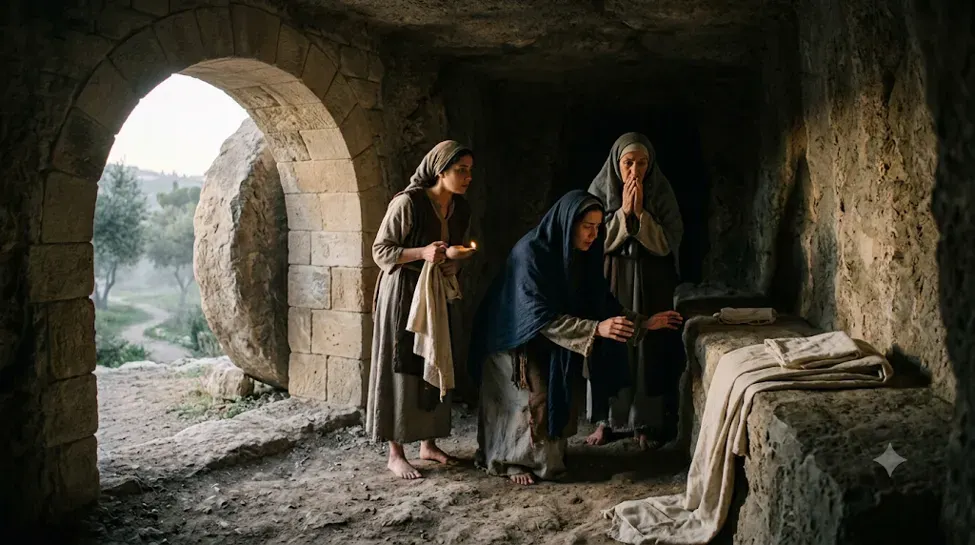
The chapter opens in the gray twilight of early morning. A group of faithful women arrives at the tomb to care for a dead body, only to find the massive stone rolled away and the tomb empty. Instead of immediate celebration, there is deep confusion. Two angels gently rebuke them with a question that still echoes today: “Why do you look for the living among the dead? He is not here; he has risen!” When the women rush back to tell the apostles, their words are initially dismissed as “nonsense.”
· The Road to Emmaus: From Blinded Eyes to Burning Hearts (Luke 24:13–35)
Later that same day, two downcast disciples are walking seven miles to the village of Emmaus, trying to make sense of the crucifixion. Jesus joins them, but their eyes are supernaturally kept from recognizing Him. As they walk, Jesus patiently untangles their disappointment by walking them through the entire Old Testament, showing how the Messiah had to suffer before entering His glory. The climax comes at the dinner table: as Jesus breaks the bread, their eyes are opened, He vanishes, and they realize their hearts had been “burning within them” the entire time.
· The Appearance and Ascension: From Fear to Great Joy (Luke 24:36–53)
The Emmaus disciples race back to Jerusalem to share the news, and suddenly Jesus appears right in their midst. To calm their terrified doubts, He invites them to touch His hands and feet, and He even eats a piece of broiled fish to prove He isn’t a ghost. After opening their minds to fully understand the Scriptures one last time, He leads them out to Bethany. As He lifts His hands to bless them, He ascends into heaven. The Gospel ends not with mourning, but with the disciples returning to Jerusalem filled with great joy, continually praising God in the temple.
Movement 1: The Empty Tomb: From Grief to Confusion
Luke 24:1-12
On the first day of the week, very early in the morning, the women took the spices they had prepared and went to the tomb. 2 They found the stone rolled away from the tomb, 3 but when they entered, they did not find the body of the Lord Jesus. 4 While they were wondering about this, suddenly two men in clothes that gleamed like lightning stood beside them. 5 In their fright the women bowed down with their faces to the ground, but the men said to them, “Why do you look for the living among the dead? 6 He is not here; he has risen! Remember how he told you, while he was still with you in Galilee: 7 ‘The Son of Man must be delivered over to the hands of sinners, be crucified and on the third day be raised again.’ ” 8 Then they remembered his words.
9 When they came back from the tomb, they told all these things to the Eleven and to all the others. 10 It was Mary Magdalene, Joanna, Mary the mother of James, and the others with them who told this to the apostles. 11 But they did not believe the women, because their words seemed to them like nonsense. 12 Peter, however, got up and ran to the tomb. Bending over, he saw the strips of linen lying by themselves, and he went away, wondering to himself what had happened.
Devotional Breakdown: Heart, Soul, and Choice
The Power of a Faithful Choice
Luke explicitly names Mary Magdalene, Joanna, Mary the mother of James, and the other women who walked alongside them. These women led completely with their hearts and souls. While Luke initially refers to them as “the women,” he later identifies them individually to ensure we don’t miss the profound choice they made that morning.
Why is it so important for us to recognize this? We have to look all the way back to the beginning. Think of Eve, and the devastating price humanity paid for her choice in the Garden. Now, at the dawn of the New Covenant, it is women who are chosen to be the very first witnesses and messengers of the Resurrection. Acknowledging their courage and devotion is vital to understanding the true Way of Christ and what it means to journey with Him.
A Legacy Restored: Where a choice in a Garden once brought death, the faithful choice of these women at a garden tomb brings the first announcement of eternal life.
Face-to-Face with Holiness
Imagine the raw emotion of that morning. If you were to visit a cemetery today and discover that the resting place of a beloved family member was an open, completely empty gravesite, the shock would be overwhelming. Yet, notice that these women did not hesitate; they boldly stepped inside to investigate.
When the two angels suddenly appeared, the women bowed their faces to the ground. This wasn’t merely a reaction of human fright. The blinding, lightning-bright radiance of the angels’ clothes was a manifestation of divine glory. Just like Moses at the burning bush or Isaiah in the temple throne room, these women knew they could not look directly into the unshielded Holiness of God.
It is in this moment of awe that the angels deliver the ultimate reminder: “Why do you look for the living among the dead?” Christ Jesus had risen, exactly as He had promised.
Peter’s Urgent Race: Running Toward Hope
When the women return with the incredible news, the rest of the room is stagnant. Luke tells us that the words seemed like “nonsense” to the apostles. But Peter refuses to stay seated. He gets up and breaks into a run.
While the Gospel of John fills in the detail that John ran alongside him and arrived first, Peter’s response reveals something deeply moving about the human heart. Think about where Peter was mentally and spiritually at that exact moment. His heart and soul were heavily burdened with the crushing guilt of his recent denial. Just days earlier, he had wept bitterly after looking into the eyes of the Jesus he had just disowned three times. He was likely trapped in a prison of regret, wondering if he had disqualified himself from the kingdom entirely.
When the news of the empty tomb reaches the room, the others dismiss it as impossible. But Peter cannot afford to be passive. He was not going to make the mistake of turning away or staying silent again. Instead of letting skepticism lock him in place, he decides to go and verify the truth for himself.
A Run for Restoration: Peter wasn’t just running to investigate a crime scene; he was running toward the possibility of forgiveness. He needed the news to be true because his entire restoration depended on it.
When he bends down and sees only the empty linen clothes, Luke notes that he goes away “wondering to himself what had happened.” The fog of guilt hadn’t fully cleared yet, but the seed of hope had been planted. Peter chose to look, and that choice changed everything.
If you are hurting today, if you are in a place of despair, or if you are simply confused by the circumstances of life, follow Peter’s lead. It is time to stop sitting in stagnation. It is time to run toward Christ Jesus, accept Him, and trust Him to lead the way.
Movement 2: The Road to Emmaus: From Blinded Eyes to Burning Hearts on the Road to Emmaus
Luke 24: 13-35
13 Now that same day, two of them were going to a village called Emmaus, about seven miles[a] from Jerusalem. 14 They were talking with each other about everything that had happened. 15 As they talked and discussed these things with each other, Jesus himself came up and walked along with them; 16 but they were kept from recognizing him.
17 He asked them, “What are you discussing together as you walk along?”
They stood still, their faces downcast. 18 One of them, named Cleopas, asked him, “Are you the only one visiting Jerusalem who does not know the things that have happened there in these days?”
19 “What things?” he asked.
“About Jesus of Nazareth,” they replied. “He was a prophet, powerful in word and deed before God and all the people. 20 The chief priests and our rulers handed him over to be sentenced to death, and they crucified him; 21 but we had hoped that he was the one who was going to redeem Israel. And what is more, it is the third day since all this took place. 22 In addition, some of our women amazed us. They went to the tomb early this morning 23 but didn’t find his body. They came and told us that they had seen a vision of angels, who said he was alive. 24 Then some of our companions went to the tomb and found it just as the women had said, but they did not see Jesus.”
25 He said to them, “How foolish you are, and how slow to believe all that the prophets have spoken! 26 Did not the Messiah have to suffer these things and then enter his glory?” 27 And beginning with Moses and all the Prophets, he explained to them what was said in all the Scriptures concerning himself.
28 As they approached the village to which they were going, Jesus continued on as if he were going farther. 29 But they urged him strongly, “Stay with us, for it is nearly evening; the day is almost over.” So he went in to stay with them.
30 When he was at the table with them, he took bread, gave thanks, broke it and began to give it to them. 31 Then their eyes were opened and they recognized him, and he disappeared from their sight. 32 They asked each other, “Were not our hearts burning within us while he talked with us on the road and opened the Scriptures to us?”
33 They got up and returned at once to Jerusalem. There they found the Eleven and those with them, assembled together 34 and saying, “It is true! The Lord has risen and has appeared to Simon.” 35 Then the two told what had happened on the way, and how Jesus was recognized by them when he broke the bread.
Were they kept, or were they just blinded by grief?
In verse 16, Luke writes that “their eyes were kept from recognizing him.” The original Greek word used here implies a divine holding or restraint. However, their hearts were so easily restrained because they were completely consumed by the past.
When you lose a loved one, your world shrinks. You stare at the ground. You replay the final moments over and over. They were so engrossed in the tragedy of the crucifixion and their own shattered expectations that they couldn’t conceive of a living Jesus walking next to them. Their spiritual blindness matched their emotional exhaustion.
Devotional Breakdown: Blinded by the Past
1. Retelling the Past Instead of Remembering the Promise
Notice what Cleopas and his companion do when Jesus asks them what they are talking about. They stand still, their faces downcast, and they give a perfect historical report of the last three days. They repeat the facts of the trial, the execution, and the empty tomb.
But notice what is entirely missing: the promise.
Jesus had told them repeatedly that He would rise on the third day. Yet, they were so sad and focused on their immediate disappointment that they completely forgot the future they had been promised. How often do we do the exact same thing? When a crisis hits, we spend all our energy replaying the problem to anyone who will listen, entirely forgetting the promises God has already given us for our future.
2. Looking for an Earthly Kingdom
The root of their disappointment comes out in verse 21: “but we had hoped that he was the one who was going to redeem Israel.”
Like so many others at the time, these two disciples were looking for a political, physical kingdom, something they could touch, feel, and see. They wanted a Messiah who would overthrow the Roman occupiers with military power. Jesus had spent His entire ministry explaining that His kingdom was not of this world, but their faith was weak, and they couldn’t see past their immediate cultural desires. When the physical structure failed, they assumed the entire mission had failed.
3. The Danger of a Blind Soul
Perhaps the most tragic part of their conversation is how they view the news of the resurrection. They tell this “Stranger” about how the women “amazed” (or astonished) them, but they treat the report almost like a delusion. Even though Peter and John had gone to the tomb and confirmed it was empty, Cleopas and his companion still chose to walk away from Jerusalem.
How blind can a soul get? They are actively dismissing the first-hand testimonies of their closest friends, completely blind to the fact that the very Messiah they are mourning is matching them step-for-step on the dirt road. Like Job’s wife and friends, when life got hard, their perspective shifted from faith to cynicism.
The Warning for Us: When our faith wavers and we focus solely on what we can see, we risk missing Christ right next to us in the middle of our journey.
The Turning Point: From Rebuke to Revelation
Jesus then launches into a necessary rebuke, whose rationale becomes clearer as the events move on. He tells them plainly how slow they are to believe, pointing them right back to the truth: “Did not the Messiah have to suffer these things and then enter his glory?”
Imagine the sheer weight of what happened next. Imagine listening to Jesus explain His own work in the world, “beginning with Moses and all the Prophets.” What a profound, unrepeatable discourse that must have been! He untangles centuries of hidden scripture right there on the road.
As the three near their stop in the village, it appears that Jesus will journey on, honoring their freedom of choice.
Key Words to Remember: Freedom of choice. He has given that to all of us. When you are at a crossroads, what will you choose? Will you let Him walk on by, or will you invite Him into your home?
These two disciples made the right choice—they persuaded Him to stay. Sitting down at the table, in a move deeply reminiscent of the Last Supper, Jesus takes the bread, gives thanks, breaks it, and hands it to them.
In that exact fraction of a second, the divine restraint drops. Their eyes are open. Despair instantly becomes delight as the reality of Jesus’ resurrection finally sinks in. Cleopas and his friend don’t even wait for morning; they get up and run seven miles back to Jerusalem to join the Eleven.
If that hits hard and makes you think, the next section will bring the hope, light, and Grace of Christ straight into our hearts.

Movement 3: The Appearance and Ascension
Luke 24: 36-50
36 While they were still talking about this, Jesus himself stood among them and said to them, “Peace be with you.”
37 They were startled and frightened, thinking they saw a ghost. 38 He said to them, “Why are you troubled, and why do doubts rise in your minds? 39 Look at my hands and my feet. It is I myself! Touch me and see; a ghost does not have flesh and bones, as you see I have.”
40 When he had said this, he showed them his hands and feet. 41 And while they still did not believe it because of joy and amazement, he asked them, “Do you have anything here to eat?” 42 They gave him a piece of broiled fish, 43 and he took it and ate it in their presence.
44 He said to them, “This is what I told you while I was still with you: Everything must be fulfilled that is written about me in the Law of Moses, the Prophets and the Psalms.”
45 Then he opened their minds so they could understand the Scriptures. 46 He told them, “This is what is written: The Messiah will suffer andrise from the dead on the third day, 47 and repentance for the forgiveness of sins will be preached in his name to all nations, beginning at Jerusalem. 48 You are witnesses of these things. 49 I am going to send you what my Father has promised; but stay in the city until you have been clothed with power from on high.”
The Ascension of Jesus
50 When he had led them out to the vicinity of Bethany, he lifted up his hands and blessed them. 51 While he was blessing them, he left them and was taken up into heaven. 52 Then they worshiped him and returned to Jerusalem with great joy. 53 And they stayed continually at the temple, praising God.
Devotional Breakdown: From Awe to Action
Real Flesh, Real Blood, Real Proof
As the disciples from Emmaus are passionately recounting their story to the Eleven, a familiar voice cuts through the room. Suddenly, their Teacher is standing right in their midst. Notice that He does not just return as a floating spirit or a vision; He is there in flesh and blood. He rose both physically and spiritually.
Even as a wave of awe and happiness floods the room, human doubt still tries to creep in. They are startled, wondering if they are looking at a ghost. So, Jesus challenges their doubts directly: “Look at my hands and my feet. It is I myself! Touch me and see…”
Yet the true acknowledgment or proof is that he was hungry, which opened up their minds, and in the fulfillment of the prophets and what was written. As they watch Him take a piece of broiled fish and physically eat it in their presence, any lingering fog of disbelief is completely shattered. This tangible act opens their minds to finally grasp the fulfillment of everything written about Him in the Law of Moses, the Prophets, and the Psalms.
The Blueprint for the Future
Once their minds are opened, Jesus shifts their gaze from the miracle of the moment to the mission of the future. He reminds them of what has happened and what has been done for all, and what they will end up doing in the future days and weeks. They are no longer just followers tracking a teacher; they are official witnesses.
He promises them the comfort of the Holy Spirit, instructing them to wait in the city until they are clothed with power from on high. Then, leading them out to Bethany, He lifts His hands, blesses them, and ascends into heaven. The Gospel of Luke closes with a complete reversal of how the chapter began: fear, grief, and confusion have been entirely replaced by worship, praise, and great joy.
Final Thoughts: The Crossroads of Chapter 24 Summary
We have walked from the early morning twilight of an empty tomb, down a seven-mile dirt road of disappointment, and straight into a room flooded with the resurrected glory of Christ.
Throughout this ultimate journey, one reality stands out above all else: God’s grace always leaves room for your choice.
- The women chose to investigate the tomb and remember His words.
- Peter chose to get up and run toward hope despite the crushing weight of his guilt.
- Cleopas and his companion chose to open their home and invite the “Stranger” inside.
As we close out this look at Luke 24, the question rests with us. Christ is alive, He has absolute authority over every dark force in your path, and He is walking right alongside you.
What will you choose today?
Will you stay frozen in the disappointments of the past, or will you run toward the hope, light, and grace of the resurrection?
In our next article, we will step back and look at the sweeping landscape of Luke’s Gospel, his brilliant writing style, his emphasis on the outcasts, and how he masterfully illustrates God’s endless mercy through human choice.
See you then, brothers and sisters! May God bless you on the journey
The Bridge: From Luke to John
As we step out of the temple courts of Luke’s Gospel, where praise and great joy are ringing, we stand on the threshold of a completely new literary landscape. Luke took us on an orderly, historical journey from the dust of Galilee straight to the resurrection room in Jerusalem. But where Luke builds a bridge from history to faith, the Gospel of John takes us somewhere entirely different.
In our upcoming series, we leave the dirt roads for a moment to step into eternity. John doesn’t begin with a birth narrative, a stable, or an empty tomb. He begins before time itself: “In the beginning was the Word, and the Word was with God, and the Word was God.” Get ready, brothers and sisters, because if Luke showed us the humanity and mercy of the Savior walking among us, John will show us the blinding, uncreated divinity of the Son of God.
A Call to Action
The resurrection room was never meant to be a hiding place; it was a launching pad. The disciples didn’t stay locked behind closed doors—they went out.
Today, your dirt road is waiting for you. God’s grace has given you the freedom of choice. Do not leave this page unchanged. Look around your neighborhood, your workplace, or your family today. Who is walking in disappointment? Who needs to hear that the grave is empty? Choose to be the witness Christ called you to be. Go open up a conversation, share your hope, and invite someone into the light.
Closing Prayer
Heavenly Father, we thank You for the living reality of the resurrected Christ. We thank You that when we are blinded by our past, our grief, or our broken expectations, You match us step for step on our journey. Open our eyes today. Give us the courage to make the faithful choice to run toward hope, to invite You deep into our hearts, and to live as bold witnesses of Your grace. We surrender our choices to You today, and we lift our voices together in the words Your Son taught us to pray:
Our Father, who art in heaven,
hallowed be thy name;
thy kingdom come;
thy will be done;
on earth as it is in heaven.
Give us this day our daily bread.
And forgive us our trespasses,
as we forgive those who trespass against us.
And lead us not into temptation;
but deliver us from evil.
For thine is the kingdom,
the power, and the glory,
forever and ever.
Amen.
Grace and Peace Be with You Always,
Tomas
© 2026 The-Way.blog Digital Publications. All Rights Reserved
Study Appendix: Depth & Context
I. Comprehensive Biblical References
To deepen your personal study of the final movements of Luke 24, use these foundational tracking passages:
- The Physical Resurrection: Luke 24:36–43 | Parallel passages: John 20:19–23, Mark 16:14–18.
- The Post-Resurrection Commission: Luke 24:44–49 | Parallel passages: Matthew 28:16–20, Acts 1:4–8.
- The Ascension: Luke 24:50–53 | Parallel passages: Mark 16:19–20, Acts 1:9–11.
II. Critical and Exegetical Footnotes
- Luke 24:37 (pneuma vs. phantasma): When the disciples suspected they were looking at a ghost, the Greek text uses pneuma (spirit/breath). In similar fearful storms (such as Matthew 14:26), the writers use the term phantasma (apparition). Luke uses this specific vocabulary to highlight that Jesus is addressing a deeply theological confusion about the nature of the afterlife and bodily resurrection.
- Luke 24:41 (The Broiled Fish): In ancient Near Eastern literature and Hellenistic philosophy, divine phantoms or spiritual manifestations could speak or project imagery, but they could not consume physical matter. By tracking the consumption of the fish (ichthyn opoton), Luke provides an empirical, historical baseline to prove the biological reality of the glorified resurrection body.
- Luke 24:44 (The Tripartite Canon): Jesus’ reference to “the Law of Moses, the Prophets and the Psalms” is the only explicit mention in the New Testament of the traditional three-part division of the Hebrew Bible (the Tanakh: Torah, Nevi’im, and Ketuvim). This underscores that the entirety of salvation history was explicitly designed to point toward Christ’s suffering and vindication.
III. Canonical Cross-References: The Reversal of Eschatological Status
The closing movements of Luke deliberately invert humanity’s spiritual status by mirroring key historical markers in the Old Testament.
1. The Garden Reversal (Genesis 3:6 vs. Luke 24:1–10)
- Old Testament Shadow: Eve makes a choice in a Garden that leads to spiritual blindness, broken fellowship, and death.
- New Testament Fulfillment: A group of faithful women make a choice to investigate a garden tomb, becoming the very first human beings to see the evidence and proclaim the resurrection.
- The Eschatological Reversal: Status Restored. The spiritual agency of women is fully vindicated by Christ. The gender first associated with the introduction of the fall is intentionally chosen by God to announce the ultimate victory over death.
2. The Ascension Reversal (2 Kings 2:11–12 vs. Luke 24:50–52)
- Old Testament Shadow: Elijah ascends to heaven in a whirlwind, leaving a grieving Elisha tearing his clothes, mourning a loss, and facing a fractured nation alone.
- New Testament Fulfillment: Jesus departs and ascends to heaven, lifting His hands to bless the disciples, leaving them standing in absolute joy.
- The Eschatological Reversal: Mourning into Joy. While Elijah’s departure caused an immediate crisis of leadership and grief, Jesus’ departure acts as a heavenly coronation. It does not orphan the disciples; it empowers the church to begin its global mission.
3. The Nations Reversal (Genesis 11:1–9 vs. Luke 24:47–49)
The closing movements of Luke deliberately invert the spiritual status of humanity by mirroring key Old Testament historical markers:
- Old Testament Shadow: At the Tower of Babel, humanity tries to build a kingdom in their own prideful strength. God judges and scatters them across the earth by confusing their language.
- New Testament Fulfillment: Jesus promises the gathering of the broken world, commanding that repentance and forgiveness be preached in His name to “all nations, beginning at Jerusalem,” backed by power from on high.
- The Eschatological Reversal: The Holy Gathering. Babel divided humanity through language and pride. The commission in Luke 24 initiates the divine reversal (fully realized at Pentecost), in which every language, nation, and tribe is brought back home into a single family under Christ.
Digital Copyright Notice
Copyright © 2026. All Rights Reserved. This document is protected under international copyright and digital rights management laws.
- Fair Use Citation: Short quotations or excerpts used in blog reviews, theological essays, or academic papers must provide appropriate attribution referencing the author and title of this work.
- Permitted Use: Permission is granted to download, store, electronically view, and print physical copies of this text solely for personal use, private study, small group Bible discussions, or local church ministry settings.
- Prohibited Use: No part of this digital publication may be reproduced, redistributed, resold, hosted on public servers, or transmitted in any form or by any means, including photocopying, digital file sharing, recording, or translation into other languages, for commercial purposes without the prior written permission of the copyright holder.