
The Gospel of John 6
One of His disciples, Andrew, Simon Peter’s brother, said to Him, “There is a lad here who has five barley loaves and two small fish, but what are they among so many?”
Feeding the Five Thousand
Introduction and Welcome to The-Way Ministry!
Before we begin today, I want to express our deep gratitude to our supporting organizations: Sowers Church of Christ in San Antonio, Texas, and the Christian Community Church of Ministry in Bangladesh. Thank you so much for standing with us on this mission.
May the grace of our Lord Jesus Christ, the love of God the Father, and the communion of the Holy Spirit be with you all as we gather today.
Please open your Bibles with me to John 6:1–14:
"In this chapter, we stand on the threshold of John 6. Here, Jesus moves from defending His authority before the religious leaders to feeding the five thousand and revealing Himself as the Bread of Life. Having proven who He is, He now invites us to feast upon Him and be satisfied forever."
Chapters
Scripture Reading: John 6:1–14 (NKJV)
After these things, Jesus went over the Sea of Galilee, which is the Sea of Tiberias. Then a great multitude followed Him, because they saw His signs which He performed on those who were diseased. And Jesus went up on the mountain, and there He sat with His disciples.
Now the Passover, a feast of the Jews, was near. Then Jesus lifted up His eyes, and seeing a great multitude coming toward Him, He said to Philip, “Where shall we buy bread, that these may eat?” But this He said to test him, for He Himself knew what He would do.
Philip answered Him, “Two hundred denarii worth of bread is not sufficient for them, that every one of them may have a little.”
One of His disciples, Andrew, Simon Peter’s brother, said to Him, “There is a lad here who has five barley loaves and two small fish, but what are they among so many?”
Then Jesus said, “Make the people sit down.” Now there was much grass in the place. So the men sat down, in number about five thousand. And Jesus took the loaves, and when He had given thanks, He distributed them to the disciples, and the disciples to those sitting down; and likewise of the fish, as much as they wanted. So when they were filled, He said to His disciples, “Gather up the fragments that remain, so that nothing is lost.” Therefore they gathered them up, and filled twelve baskets with the fragments of the five barley loaves which were left over by those who had eaten. Then those men, when they had seen the sign that Jesus did, said, “This is truly the Prophet who is to come into the world.”
Section I: Different Writers and the Meaning of the Same Passage
The feeding of the 5,000 is the only miracle recorded in all four Gospels (Matthew 14, Mark 6, Luke 9, John 6). In Jewish law, a matter is established on the evidence of two or three witnesses (Deuteronomy 19:15)—so four independent attestations serve as the ultimate biblical testimony that this event truly occurred.
While the core facts remain identical (5 loaves, 2 fish, 5,000 men, 12 baskets of fragments left over), each Gospel writer highlights distinct angles that fit their overarching message.
Comparison: The Four Perspectives
- Matthew 14
- Core Perspective: Jesus as the King/Messiah
- Unique Narrative Details: Notes explicitly that the 5,000 counted were besides women and children (likely 15,000+ total). Connects the event directly to Jesus grieving over John the Baptist’s death.
- Mark 6
- Core Perspective: Jesus as the Shepherd Servant
- Unique Narrative Details: Mentions Jesus having compassion because the crowd was “like sheep without a shepherd.” Describes them sitting on “green grass” in organized groups of 50s and 100s.
- Luke 9
- Core Perspective: Jesus as the Universal Provider & Teacher
- Unique Narrative Details: Sets the scene in Bethsaida. Frames the miracle as training for the Twelve right after their first mission trip, immediately preceding Peter’s famous confession of Christ.
- John 6
- Core Perspective: Jesus as the Bread of Life / Divine Logos
- Unique Narrative Details: Notes: Passover is near. Names specific disciples (Philip testing math, Andrew finding the boy). Mentions barley loaves (poor man’s bread) and the crowd’s attempt to force Him to be King.
What Makes Luke and John Stand Out?
When you look at how Luke and John structure their narratives—especially in relation to their previous chapters—two crucial theological pivots emerge:
1. Luke 9: The Pivot to Discipleship
In Luke 8 and early Luke 9, Jesus demonstrates power over nature, demons, disease, and death. But in Luke 9:10–17, Jesus forces the Twelve to participate:
- The Shift: When the disciples want to send the crowd away, Jesus says, "You give them something to eat."
- The Meaning: Luke uses this miracle to shift the Gospel's focus from what Jesus does alone to how He equips His apostles to feed His people. Right after this event, Luke transitions into Jesus turning His face toward Jerusalem for the cross.
2. John 6: The Pivot from Legal Defense to Spiritual Feast (Connecting Chapters 5 to 6)
John’s inclusion of the miracle creates a powerful structural contrast with John Chapter 5:
- John 5 (Legal Testimony & Authority): Jesus is in Jerusalem defending His deity before the Jewish leaders who want to kill Him. He calls witnesses to prove who He is—John the Baptist, His miracles, the Father, and Moses' writings. It is a formal, courtroom-style defense of His legal and divine authority.
- John 6 (Experiential Fulfillment): Jesus moves to Galilee and stops merely defending His authority—He demonstrates it. He doesn't just claim to fulfill Moses; He acts as the New Moses in the wilderness, providing manna.
The Key Connection: In Chapter 5, Jesus proves who He is legally and scripturally. In Chapter 6, He invites the crowd to feast upon Him spiritually. The feeding of the 5,000 serves as the real-world setup for His declaration: "I am the Bread of Life."
Why Four Historical "Witnesses" Matter
In ancient literature, variations in minor details (such as naming specific disciples in John or describing the grass in Mark) are signs of authentic eyewitness accounts rather than fabricated collusion. If the four Gospels matched word-for-word, a legal scholar would suspect pre-arranged fraud.
Because each writer preserves the exact core miracle while retaining their distinct perspective, the fourfold narrative presents a unified testimony: Jesus is the true Provider, the New Moses, and the Living Bread who satisfies forever.
Section II: Jesus Shows Empathy Toward the Hungry
Verses 4–6
The connection to the Passover is significant because the crowd traveling through the region likely included a diverse mix of people—both Jews making their pilgrimage to Jerusalem and local Gentiles.
Yet, when Jesus looks out and sees this massive, weary crowd approaching Him, He doesn't see an inconvenient interruption, a political threat, or an anonymous mass of strangers. He sees hungry individuals in need of a Shepherd.
Rather than turning them away or insulating Himself with His inner circle, Jesus immediately takes initiative:
- Empathy in Action: Where the disciples see an impossible logistical problem, Jesus sees an opportunity to reveal God’s generous care. His first thought is not self-preservation, but feeding the crowd.
- Testing Faith, Not Catching Flaws: In verse 6, John explicitly notes that Jesus asked Philip, "Where shall we buy bread for these people to eat?"—not because He was caught unprepared, but to test Philip's faith. Jesus already knew what He was going to do.
In this moment, Jesus bridges the gap between divine authority and human tenderness. The same God who defended His cosmic power before the religious elites in John 5 now bends down to care for the practical, physical needs of ordinary people in John 6. He demonstrates that His kingdom is not merely about correct doctrine, but about compassionate provision.
Section III: Testing Faith with Just a Little Money and Food
Verses 7–9
“Philip answered Him, ‘Two hundred denarii worth of bread is not sufficient for them, that every one of them may have a little.’ One of His disciples, Andrew, Simon Peter’s brother, said to Him, ‘There is a lad here who has five barley loaves and two small fish, but what are they among so many?’”
When faced with an impossible situation, Philip and Andrew react with human calculation rather than spiritual discernment. They look with the eyes of the flesh:
- Philip’s Financial Calculation (v. 7): Philip quickly runs the numbers. Two hundred denarii represented roughly eight months' wages for a common laborer. Philip realizes that even a massive sum of money would only yield a tiny bite for each person. He focuses on the scarcity of their resources.
- Andrew’s Material Calculation (vv. 8–9): Andrew finds a young boy with a small lunch—five cheap barley loaves (the staple food of the poor) and two small dried fish. Yet, as soon as Andrew brings the food forward, his faith falters: "But what are they among so many?" He focuses on the magnitude of the problem.
Both disciples fall into the trap of measuring divine possibilities using human limitations.
Remembering the Manna in the Wilderness
Philip and Andrew forgot the history of their own people. As the Israelites journeyed from Egypt to the Promised Land, they faced a similar crisis in the wilderness. When they complained of hunger, God did not rely on human markets or deep pockets; He rained down manna from heaven (Exodus 16) and provided meat in abundance (Numbers 11).
By bringing five small loaves to Jesus, the stage is set for a dramatic revelation: Jesus does not need abundant resources to perform an abundant work. What human eyes dismiss as insufficient, the Creator of the universe transforms into more than enough.
This miracle in John 6 reflects a pattern seen from Genesis to the Gospels:
- Abraham’s Sacrifice (Genesis 22): Abraham was asked to surrender Isaac—his only son, the sole vehicle of God's promise. From a human standpoint, losing Isaac meant the total end of the covenant. Yet, when Abraham offered what little he had in complete trust, God provided a ram in the thicket and multiplied His promise beyond measure (Jehovah-Jireh, "The Lord Will Provide").
- The Widow’s Mite (Luke 21:1–4): In the Temple, wealthy donors gave large sums, but a poor widow dropped in just two tiny copper coins (lepta). Jesus declared that she gave more than all the rest because she offered out of her poverty, not her surplus. It was not the size of her gift that moved heaven, but the size of her faith.
Whether it is Abraham’s single son, a widow’s two small coins, or a boy’s five barley loaves, God never asks us to bring what we don't have. He asks us to surrender what we do have—no matter how small—and watch Him transform it.
Section IV: Setting the Foundation for His Disciples & Gathering the Lost
Verses 10–12
“Jesus said, ‘Make the people sit down.’ Now there was much grass in the place. So the men sat down, in number about five thousand. And Jesus took the loaves, and when He had given thanks, He distributed them to the disciples, and the disciples to those sitting down; and likewise of the fish, as much as they wanted.”
Careful reading of this passage reveals a masterful spiritual progression. Often in life, we cannot see what God is orchestrating in the moment. Yet, those seasons of waiting and listening are precisely how Jesus prepares us for something far greater. All will be revealed in His perfect time.
1. Order in the Wilderness
Notice Jesus' first command: "Make the people sit down." John highlights that "there was much grass in the place." Before Jesus performs the miracle, He creates order out of potential chaos. He rests the weary crowd in a green pasture—evoking the imagery of Psalm 23 ("He makes me lie down in green pastures").
2. Echoes of the Last Supper
The actions Jesus performs here mirror the foundational sacrament of the faith:
- He takes the bread.
- He gives thanks (eucharistēsas).
- He breaks and distributes it.
While the Last Supper in the Upper Room was an intimate meal shared only with the Twelve, here in John 6, Jesus extends this sacred table to the masses. He demonstrates that His salvation and life-giving grace are not reserved for an exclusive elite, but are freely offered to a hungry world.
3. From Distribution to the Book of Acts
After blessing the food, Jesus hands it to His disciples to distribute to the crowd. This establishes a vital biblical pattern of stewardship and ministry: Jesus provides the life-giving bread, but He chooses human hands to carry it to the hungry.
We see this exact spiritual principle fulfilled later in the Book of Acts:
- In the Upper Room, the Holy Spirit falls upon the disciples (Acts 2).
- Empowered by Christ, they do not keep the grace to themselves—they go out into the streets, preaching the Way of Christ.
- Just as they distributed physical loaves to the 5,000, the apostles in Acts distribute the gospel to a spiritually starving world, gathering lost souls into the kingdom of God.
As followers of Christ today, our calling remains the same: we are not the source of the bread, but we are called to be the hands that carry it to a lost and hungry world.
Section V: The Gathering of Twelve & Divine Zeal
Verses 12–13
“So when they were filled, He said to His disciples, ‘Gather up the fragments that remain, so that nothing is lost.’ Therefore they gathered them up, and filled twelve baskets with the fragments of the five barley loaves which were left over by those who had eaten.”
1. Abundance Without Waste
After thousands of people ate until they were completely satisfied, Jesus gave a specific command: "Gather up the fragments that remain, so that nothing is lost."
This act highlights two profound truths:
- The Heart of the Father: God is a God of extravagant abundance, yet He values every single piece of His creation. Nothing provided by Christ is meant to be discarded or wasted.
- Total Provision: The miracle did not merely meet the crowd's baseline need—it overflowed.
2. The Covenantal Weight of Twelve
The collection of twelve baskets is not an accidental detail; the number twelve echoes across the entire arc of Scripture as a symbol of divine order, governmental perfection, and covenant completeness:
- Old Testament Foundations: Twelve sons of Jacob forming the 12 tribes of Israel, as well as the 12 chieftains descended from Ishmael (Genesis 17:20).
- New Testament Fulfillment: The 12 Apostles appointed by Jesus to represent the restored, true Israel.
Each of the twelve apostles carried back a full basket—a tangible, heavy reminder that Christ's provision was sufficient to feed and restore every tribe of Israel and beyond.
3. Divine Election and Zeal: Judas, Matthias, and Paul
Reflecting on the Twelve brings to light the mystery of God’s sovereignty and human passion:
When Judas fell away, the early church cast lots to choose Matthias to fill his place (Acts 1:26). Yet, when looking at the broader narrative of redemption, we see Christ’s direct hand in calling Saul of Tarsus (Paul)—a man whose trajectory reveals a striking contrast in divine election and zeal:
- Misguided Zeal: Both Judas and Saul possessed intense zeal. Judas was zealous for a worldly, political kingdom—misguidedly pursuing a path that led to betrayal. Saul was fiercely zealous for the traditions of his ancestors—misguidedly persecuting the early Church.
- Transformed Zeal: While Judas let his misguided expectations lead him to destruction, Saul met the risen Christ on the Road to Damascus. His eyes were opened, his heart was cleansed, and his raw, misdirected passion was converted into an unwavering holy zeal to preach the Bread of Life to the Gentile world.
God does not destroy our passion; He redeems and redirects it. Just as Jesus took five small loaves and turned them into twelve overflowing baskets, He takes a life surrendered in faith—no matter how flawed or zealous—and uses it to feed a starving world.
Section VI: Bringing It Home—The Choice Before Us Today
Transition & Crossing the Threshold: John 6:14–15
As we conclude this exploration of Christ’s miraculous provision, verses 14 and 15 stand as a pivotal bridge:
“Then those men, when they had seen the sign that Jesus did, said, ‘This is truly the Prophet who is to come into the world.’ Therefore, when Jesus perceived that they were about to come and take Him by force to make Him king, He departed again to the mountain by Himself alone.”
The crowd recognized the sign, but they misunderstood the Savior. They wanted a political deliverer who would provide free bread king-made in their own image. Yet Jesus refused to be shaped by human agendas. He withdrew to the mountain in solitude, inviting those who would truly follow Him to move beyond physical desire and seek the Bread of Eternal Life.
Questions for Private Meditation & Points of Reflection
- Calculating Resources vs. Trusting Divine Power: Like Philip, do you find yourself looking at life's challenges through human arithmetic, or are you willing to bring your "five loaves and two fish" to Christ in faith?
- Surrendering Insufficiency: What small gift, talent, or effort are you currently withholding because you feel it is "too little" among so many needs?
- Distribution in Action: Just as Jesus passed the broken bread through the hands of the Twelve, how is God calling you to be a distributor of His grace to a hungry world today?
- Seeking the King, Not Just the Bread: Are you seeking Jesus for who He is, or simply for what He can provide in the moment?
Call to Action & Partnership
"Gather up the fragments that remain, that nothing be lost."
— John 6:12
The ministry of Christ has never been about passive observation—it is a call to active stewardship. Just as the apostles gathered the remaining fragments so that nothing would be lost, we are called today to gather lost souls into the Kingdom of God.
We invite you to partner with The-Way Ministry as we continue to:
- Proclaim the uncompromised Word of God.
- Equip believers and strengthen the Church.
- Carry the Bread of Life into our surrounding communities.
Let us stand together on the unwavering truth of God’s Word and walk the narrow path side-by-side. Your prayers, engagement, and support allow us to produce deep, scripture-focused teachings for all who seek Him.
Thank you for your prayers, your presence, and your partnership in the Gospel!
Ways to Connect & Support
- Join The Way Substack — Subscribe for free updates or choose a paid subscription to support ongoing work.
- Support via The Way Blog — Partner with us through a one-time gift.
Closing Prayer
Lord Jesus, You are the Living Bread that satisfies the deepest longings of our souls. Forgive us for the times we measure Your infinite capacity against our finite resources. Take what little we have—our lives, our faith, our gifts—bless them, break them, and use them for Your glory. Teach us to walk by faith, not by sight, and lead us daily in Your truth. Amen.
The Lord's Prayer
Our Father, who art in heaven, hallowed be Thy name.
Thy kingdom come, Thy will be done, on earth as it is in heaven.
Give us this day our daily bread,
and forgive us our trespasses, as we forgive those who trespass against us.
And lead us not into temptation, but deliver us from evil.
For Thine is the kingdom, and the power, and the glory, forever and ever. Amen.
Blessings in Christ's Grace and Truth,
Tomas
The-Way Ministry
Standing on Truth, Walking the Narrow Way
Technical Study Annex & Exegetical Appendix
I. Comprehensive Biblical References
- The Fourfold Witness: Matthew 14:13–21; Mark 6:30–44; Luke 9:10–17; John 6:1–15
- Legal Requirement of Witnesses: Deuteronomy 17:6; Deuteronomy 19:15; 2 Corinthians 13:1
- The Wilderness Provision & Manna: Exodus 16:1–36; Numbers 11:4–9; Psalm 78:23–25
- The "Prophet to Come": Deuteronomy 18:15–18
- Surrender of Faith: Genesis 22:1–19 (Abraham & Isaac); Luke 21:1–4 (The Widow’s Mite)
- The Call & Apostolic Mandate: Acts 1:21–26; Acts 2:42–47; 1 Corinthians 11:23–26
II. Critical and Exegetical Footnotes
- John 6:4 (Passover Setting): John explicitly anchors this miracle near the Jewish Passover (Pascha). This detail establishes an inescapable Exodus typology: Jesus acts as the New Moses dispensing heavenly bread in the wilderness.
- John 6:7 (200 Denarii): A denarius represented a full day's wage for an agricultural or manual laborer. Philip’s calculation of "two hundred denarii" underscores that nearly eight months of labor would still fall short of buying a minimal bite for such a vast assembly.
- John 6:9 (Barley Loaves): The Greek term krithinos specifies bread made from barley—the cheapest grain available in 1st-century Palestine, typically eaten by the destitute and lower classes, emphasizing the humble nature of the provision.
- John 6:11 (Giving Thanks): The verb eucharistēsas is the direct root of "Eucharist." John’s narrative phrasing deliberately mirrors liturgical patterns found throughout early Christian worship.
- John 6:13 (Twelve Baskets): The term kophinos refers to heavy wicker traveling baskets used by Jewish travelers. Twelve full baskets symbolically signify the total restoration of the covenant for the twelve tribes of Israel.
III. Canonical Cross-References: The Reversal of Eschatological Status
1. Hunger to Fullness: The Messianic Promise Realized
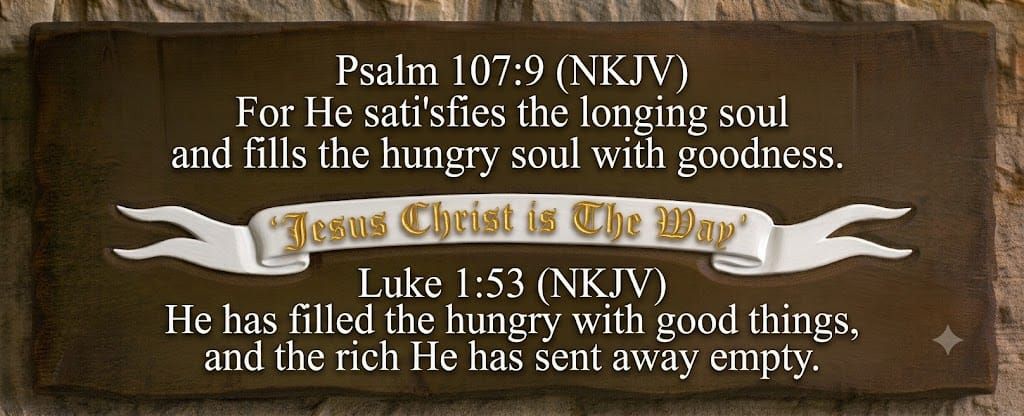
- Psalm 107:9
"For He satisfies the longing soul and fills the hungry soul with goodness."
David records God's foundational character as the direct responder to human spiritual and physical bankruptcy. God’s nature is not merely to alleviate distress, but to saturate the longing heart with divine good.
- Luke 1:53
"He has filled the hungry with good things, and the rich He has sent away empty."
In the Magnificat, Mary proclaims the prophetic reversal accompanying the incarnation. The kingdom of God upends human social and spiritual structures: those who recognize their poverty are filled, while those who are self-sufficient in earthly wealth inherit emptiness.
- John 6:35
"And Jesus said to them, 'I am the bread of life. He who comes to Me shall never hunger, and he who believes in Me shall never thirst.'"
The Old Testament longing and the Lukan prophetic promise find their ultimate fulfillment in Christ’s first major "I AM" statement. Jesus shifts the paradigm from temporal food that leaves one hungry again to an eternal, indwelling satisfaction found exclusively through faith in His person.
2. Scarcity to Overflow: The Typological Pattern of Divine Provision
- 2 Kings 4:42–44
"Then a man came from Baal-Shalisha and brought the man of God bread of the firstfruits, twenty loaves of barley bread, and newly ripened grain in his knapsack. And he said, 'Give it to the people, that they may eat.' But his servant said, 'What? Shall I set this before one hundred men?' He said again, 'Give it to the people, that they may eat; for thus says the Lord: "They shall eat and have some left over."' So he set it before them; and they ate and had some left over, according to the word of the Lord."
Elisha’s miracle serves as a direct prophetic prototype. A small offering of barley bread is brought, the servant questions its sufficiency against a massive crowd, and God’s word turns scarcity into abundance, with leftovers remaining.
- John 6:12–13
"So when they were filled, He said to His disciples, 'Gather up the leftover fragments so that nothing will be lost.' Therefore, they gathered them up and filled twelve baskets with fragments from the five barley loaves that were left over by those who had eaten."
Jesus performs what Elisha foreshowed, but on a vast, divine scale. Where Elisha fed 100 men with 20 loaves, Jesus fed over 5,000 with 5 loaves. The 12 baskets of leftover barley fragments demonstrate that Christ does not merely match Old Testament miracles—He exponentially surpasses them, proving Himself to be the Master of Creation.
3. Earthly Bread to Heavenly Reality: The Evolution of Divine Manna
- Nehemiah 9:15
"You gave them bread from heaven for their hunger and brought them water out of the rock for their thirst, and promised them to go in to possess the land which You had sworn to give them."
Looking back on the Exodus, Nehemiah records manna as God’s physical intervention to sustain a physical nation on a physical journey toward an earthly inheritance.
- Isaiah 55:1–2
"Ho! Everyone who thirsts, come to the waters; and you who have no money, come, buy and eat. Yes, come, buy wine and milk without money and without price. Why do you spend money for that which is not bread, and your wages for what does not satisfy? Listen carefully to Me, and eat what is good, and let your soul delight itself in abundance."
Isaiah elevates the Old Testament concept of food from literal provision to an open evangelical invitation. He exposes the futility of human labor seeking ultimate satisfaction in created things and offers divine grace as a free, unearned spiritual feast.
- John 6:51
"I am the living bread which came down from heaven. If anyone eats of this bread, he will live forever; and the bread that I shall give is My flesh, which I shall give for the life of the world."
Jesus connects the wilderness manna of Nehemiah and the free prophetic banquet of Isaiah directly to His upcoming sacrifice on the Cross. Physical manna sustained physical life temporarily, but Christ—the Living Bread—surrenders His own body so that whoever partakes of Him through faith receives eternal life.
Digital Copyright Notice
Copyright © 2026. All Rights Reserved.
This document is protected under international copyright and digital rights management laws.
- Fair Use Citation: Short quotations or excerpts used in blog reviews, theological essays, or academic papers must provide appropriate attribution referencing the author (Tomas) and title of this work (The-Way Digital Publications).
- Permitted Use: Permission is granted to download, store, electronically view, and print physical copies of this text solely for personal use, private study, small group Bible discussions, or local church ministry settings.
- Prohibited Use: No part of this digital publication may be reproduced, redistributed, resold, hosted on public servers, or transmitted in any form or by any means, including photocopying, digital file sharing, recording, or translation into other languages, for commercial purposes without the prior written permission of the copyright holder.