
The Gospel of John Chapter 1: 1–28 (NKJV)
The Eternal Word Becomes Flesh, a Voice in the Wilderness
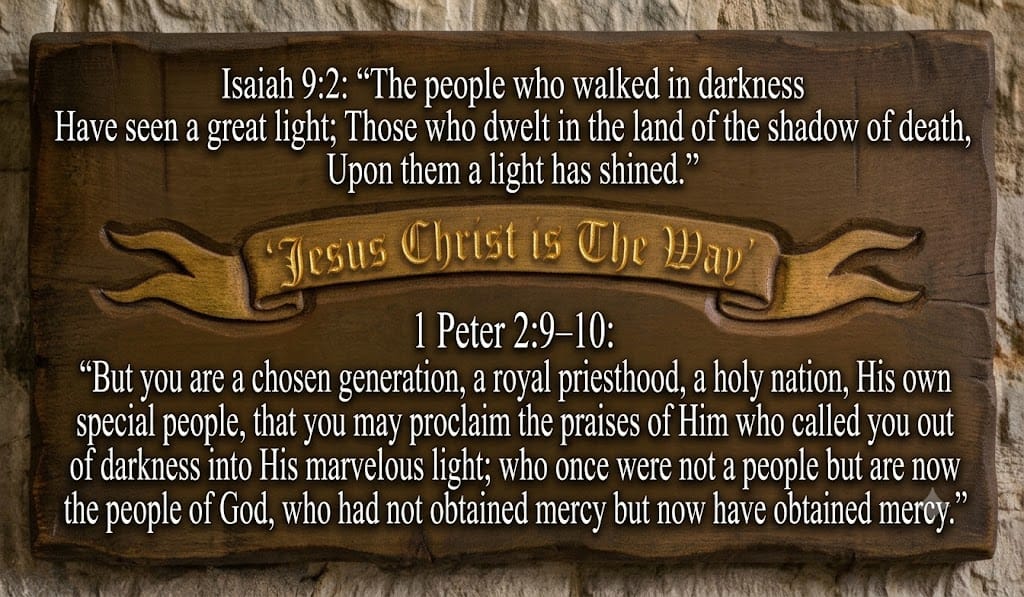
Welcome to The-Way Ministry! Good afternoon, brothers and sisters. May the peace of our Lord Jesus Christ and His abundant blessings rest upon you today.
As we open the Gospel of John, we step into the testimony of the ‘beloved disciple’—a man who walked beside Jesus, leaned against His chest at the Last Supper, and stood faithfully at the foot of the cross. John gives us an intimate, eyewitness account of both the deity and glory of Christ.
Today, as we begin this spiritual journey, let us take time to read and reflect on the text in solitude and prayer.”
Part 1: The Eternal Word
Scripture Reading: John 1:1–5 (NKJV)
1 In the beginning was the Word, and the Word was with God, and the Word was God.
2 He was in the beginning with God.
3 All things were made through Him, and without Him nothing was made that was made.
4 In Him was life, and the life was the light of men.
5 And the light shines in the darkness, and the darkness did not comprehend it.
Deepening Our Understanding
Notice how John intentionally repeats core themes right out of the gate: Word, God, Him, and Life (repeated 3 times), alongside Light and Darkness (repeated twice).
To truly grasp what John is communicating, we have to look at the Greek word he uses for “Word”—Logos.
- To the Greek Mind: Logos wasn’t just a spoken word; it referred to reason—the underlying rational principle that governs and holds the universe together.
- To the Jewish Mind: Logos pointed directly to the creative power of God. By His “Word,” God created the heavens and the earth (Psalm 33:6). Rabbinic tradition even taught that God’s Law existed before creation, sat on His throne of glory, and brought light and life to the world.
John masterfully bridges these two worlds to reveal something astonishing: the Logos is not an abstract force or a cold set of rules—He is a Person.
Jesus Christ is God’s ultimate self-revelation. He is the true Light (v. 9) and the life-giving presence (v. 4) who brought all creation into existence. He came to dwell among us so that we might become children of God.
When we read in verse 5 that “the light shines in the darkness, and the darkness has not overcome it,” it is easy to picture a world cleanly divided into spiritual insiders and outsiders—those who hold the map and those who are hopelessly lost. But the Gospel doesn’t leave room for our neat little boundaries.
Think back to the storm in Jonah: while the prophet—the ultimate spiritual insider—slept in the belly of the ship, it was the pagan sailors, completely ignorant of Israel’s God, who cried out into the gale and were met by His sudden, unearned mercy. They didn’t have the theology or the lineage, yet the light found them in international waters.
That is precisely the scandalous scope John unveils just a few verses later in verse 9: Jesus is “the true light that gives light to everyone coming into the world.” God isn’t sitting back on a technicality, waiting to disqualify people who grew up in the shadows without a fair shot at knowing Him. His light actively invades the darkest corners, meeting us in our ignorance before we even know how to ask for the way.
Biblical Harmony: Colossians 1:15–18
The Apostle Paul echoes John’s revelation in his letter to the Colossians, affirming Christ’s eternal authority over all creation:
15 He is the image of the invisible God, the firstborn over all creation.
16 For by Him all things were created that are in heaven and that are on earth, visible and invisible, whether thrones or dominions or principalities or powers. All things were created through Him and for Him.
17 And He is before all things, and in Him all things consist.
18 And He is the head of the body, the church, who is the beginning, the first born from the dead, that in all things He may have the preeminence.
The Unbroken Thread: Jesus in the Old Testament
When we look back across the pages of the Old Testament, we see that Jesus’ hand was there from the very beginning.
When God spoke light into existence in Genesis, when He stretched out the heavens, and when He led Israel through the wilderness as a pillar of cloud and fire—Christ was not an afterthought in the history of redemption. The Logos was actively working, sustaining, and shaping creation long before He was born in Bethlehem. From Genesis to Revelation, the Bible tells one unified story: the story of Jesus Christ.
Part 2: John Witnesses the True Light
Scripture Reading: John 1:6–13 (NKJV)
6 There was a man sent from God, whose name was John.
7 This man came for a witness, to bear witness of the Light, that all through him might believe.
8 He was not that Light but was sent to bear witness of that Light.
9 That was the true Light which gives light to every man coming into the world.
10 He was in the world, and the world was made through Him, and the world did not know Him.
11 He came to His own, and his own did not receive Him.
12 But as many as received Him, to them He gave the right to become children of God, to those who believe in His name:
13 who were born, not of blood, nor of the will of the flesh, nor of the will of man, but of God.
Analysis & Key Insights
1. The Courtroom Witness
As we read, several key terms jump out: Witness, Light, Man, World, and God.
Here, John introduces the Greek word family for “witness” (martyria) for the very first time. The Gospel of John functions almost like a heavenly trial, laying out evidence to establish who Jesus truly is. John the Baptist is the first witness called to the stand, and his role is strictly defined:
- He is not the Light (v. 8).
- He was sent by God to point directly to the Light so that all might believe through his testimony (v. 7).
(Note: In this Gospel, standalone references to “John” always refer to John the Baptist. The author humbly conceals his own name, referring to himself throughout as the “disciple whom Jesus loved.”)
2. Divine Identity: Children of God
Verse 12 stands as the glorious heart of this section: by receiving Christ and believing in His name, believers receive the legal right and spiritual authority to be called children of God.
This new birth isn’t physical (“of blood”), nor is it earned through human desire (“will of the flesh”) or achieved by human effort (“will of man”)—it is a supernatural, direct act of God.
New Testament Affirmation: Acts 13:24–25
Decades later, the Apostle Paul directly confirmed John the Baptist’s witness while preaching in Antioch:
24 …after John had first preached, before He came, the baptism of repentance to all the people of Israel.
25 And as John was finishing his course, he said, ‘Who do you think I am? I am not He. But behold, there comes One after me, the sandals of whose feet I am not worthy to loose.’
This echoes the heart of John 1:8—John was never the Light; he was simply the voice preparing the way for the True Light.
Part 3: The Word Became Flesh & Glory Revealed
Scripture Reading: John 1:14–18 (NKJV)
- In the wilderness, God’s physical presence and glory (Shechinah) rested inside the Tabernacle at the center of Israel’s camp (Exodus 40:34–35).
- In Jesus, God didn’t pitch a tent made of goat skins or linen—He tabernacled in real human flesh. As an eyewitness, John proclaims, “we beheld His glory”—pointing to Christ’s life, His miracles, and His Transfiguration.
2. “Grace for Grace” (v. 16)
- Moses brought the shadow and the standard—the Law.
- Jesus brings the substance and personification—Grace and Truth.
In Exodus 33:18–20, Moses begged God,
- Hebrews 1:1–3: “God… has in these last days spoken to us by His Son… who being the brightness of His glory and the express image of His person…”
- Colossians 2:9: “For in Him dwells all the fullness of the Godhead bodily.”
Exodus 34:6: When God revealed His back to Moses, He proclaimed Himself as “abounding in goodness and truth”—the precise Old Testament equivalent of John’s phrase “full of grace and truth.”
Part 4: John’s Witness Before the Religious Delegation
Scripture Reading: John 1:19–28 (NKJV)
Analysis & Key Insights
1. The Delegation: Priests, Levites, and Pharisees (vv. 19, 24)
- “I am not the Christ” (v. 20): He clears away any messianic speculation right out of the gate.
- “Are you Elijah?” — “I am not” (v. 21): Malachi 4:5 prophesied Elijah would return before the Lord’s coming. While Jesus noted John ministered “in the spirit and power of Elijah” (Luke 1:17; Matthew 11:14), John denies being the literal reincarnated Elijah.
- “Are you the Prophet?” — “No” (v. 21): Refers to the singular, Moses-like Prophet promised in Deuteronomy 18:15–18.
3. The Lone Voice in the Wilderness (v. 23)
- “There stands One among you whom you do not know” (v. 26): Jesus was already present in Israel, unrecognized by the religious elite.
- Unworthy to untie His sandal strap (v. 27): In ancient Jewish tradition, a disciple would perform almost any service for their teacher—except untying their sandals, which was considered too lowly and reserved strictly for non-Jewish slaves. John declares that compared to Christ, he isn’t even worthy to perform the lowest slave’s task.
5. The Setting: Bethabara Beyond the Jordan (v. 28)
Conclusion & Transition: Crossing the Threshold
Up to this point in John’s Prologue and initial witness, we have been standing in expectation:
- Verses 1–18 revealed the eternal identity of the Logos—the Word who was with God, who was God, and who tabernacled among us full of grace and truth.
- Verses 19–28 showed us the humble voice in the wilderness, John the Baptist, who refused personal titles and pointed away from himself to prepare the way for the Lord.
John declared to the religious delegation:
- The Lamb of God (vv. 29–34): John the Baptist points directly to Jesus and declares His primary mission to the world: “Behold! The Lamb of God who takes away the sin of the world!”
- The First Disciples (vv. 35–42): John’s followers leave him to follow Jesus, demonstrating the ultimate purpose of any true witness—leading people straight to the Master. Andrew brings his brother Simon, and Jesus gives Peter a new identity.
- “Come and See” (vv. 43–50): Philip finds Nathanael, showing us the organic, personal way the message of Christ spreads. When Nathanael questions if anything good can come from Nazareth, he encounters the One who sees the human heart before a word is ever spoken.
Reflection for The-Way Ministry
Call to Action & Partnership
This daily journey through the Scriptures is a labor of love, and it directly sustains my family as I dedicate my time to writing and teaching. If
- Subscribe: Join our community for free to receive these daily devotionals or select a paid subscription to help us expand this work.
- One-Time Gift: If you would prefer to leave a single blessing in the pot, you can support us directly using the link below.
Thank you for your prayers, your presence, and your partnership in the Gospel!
Closing Prayer
Heavenly Father,
We thank You for revealing Your eternal Word, Jesus Christ, who came to tabernacle among us full of grace and truth. Grant us the heart of John the Baptist—to decrease so that Christ may increase in all that we do. Let Your light shine through us to clear the way for others to know Him.
As our Savior taught us, so we pray:
Our Father in heaven,
Hallowed be Your name.
Your kingdom come,
Your will be done on earth as it is in heaven.
Give us this day our daily bread.
And forgive us our debts, as we forgive our debtors.
And do not lead us into temptation but deliver us from the evil one.
For Yours is the kingdom and the power and the glory forever.
Amen.
Blessings In Christ’s Grace and Truth,
Tomas
The-Way Ministry
Standing on Truth, Walking the Narrow WayTechnical Study Annex & Exegetical AppendixI. Comprehensive Biblical ReferencesJohn 1:1–5, 6–13, 14–18, 19–28 (NKJV)Colossians 1:15–18; 2:9Exodus 33:18–20; 34:6; 40:34–35Isaiah 40:3Deuteronomy 18:15–18Malachi 3:1; 4:5–6Acts 13:24–25Hebrews 1:1–3II. Critical and Exegetical Footnotes1. Logos (λόγος): In Johannine theology, Logos bridges Hellenistic philosophical concepts of cosmic order with the Hebrew understanding of God’s active, creative word (Dabar).2. Skēnoō (σκηνόω): Translated as “dwelt” (v. 14), literally “to pitch a tent” or “tabernacle,” establishing a direct typology between Christ’s physical body and the Old Testament Tabernacle (Exodus 40).3. Martyria (μαρτυρία): Legal/courtroom language (“witness” or “testimony”) utilized throughout the Gospel of John to construct a judicial case for the divinity of Jesus Christ.4. Exēgēsato (ἐξηγήσατο): Root of “exegete” (v. 18); translated as “declared” or “made Him known,” indicating that Christ is the definitive and exhaustive exposition of God the Father.III. Canonical Cross-References: The Reversal of Eschatological StatusGentile Inclusion & Sovereign Grace: The light shining in the darkness (John 1:5, 9) mirrors God’s unexpected mercy extended outside covenant boundaries, typified in the rescue of pagan sailors during Jonah’s rebellion (Jonah 1:14–16).
Digital Copyright Notice
Copyright © 2026 The-Way Digital Publications. All Rights Reserved.
This document is protected under international copyright and digital rights management laws.Fair Use Citation: Short quotations or excerpts used in blog reviews, theological essays, or academic papers must provide appropriate attribution referencing the author and title of this work.Permitted Use: Permission is granted to download, store, electronically view, and print physical copies of this text solely for personal use, private study, small group Bible discussions, or local church ministry settings.Prohibited Use: No part of this digital publication may be reproduced, redistributed, resold, hosted on public servers, or transmitted in any form or by any means, including photocopying, digital file sharing, recording, or translation into other languages, for commercial purposes without the prior written permission of the copyright holder.
True Israel vs. Biological Lineage: Sonship defined not by human lineage or effort (”born, not of blood, nor of the will of the flesh”), but by divine regeneration (John 1:12–13; cf. Romans 9:6–8).