
The Gospel of John Chapter 4(II)
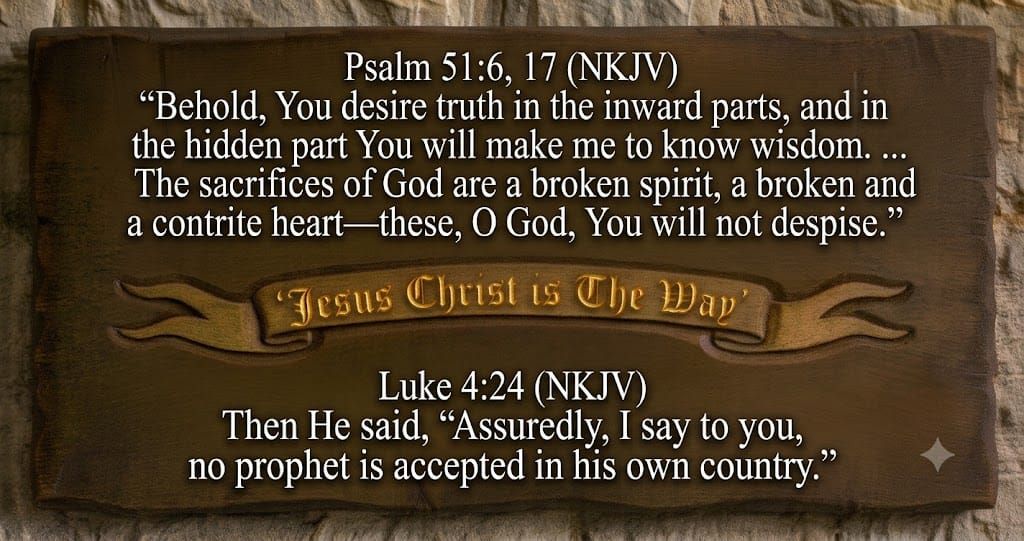
Contrast of Faith
Welcome back to The-Way Ministry!
Good evening, brothers and sisters. I invite you to take my personal journey through the Scriptures with me. May the grace of our Lord Jesus Christ, the love of God the Father, and the communion of the Holy Spirit be with you all as we gather for the second half of our study in John 4.
We like to think that proximity creates belief—that the closer you are to the truth, the easier it is to trust it. But as we read the Gospel of John, we quickly realize that the people who should have had the strongest faith were often the ones demanding the biggest performance.
At the end of John 4, Jesus crosses a geographical border that also serves as a spiritual mirror.
Behind him lie the dust-covered roads of Samaria. The people there were religious outcasts—barricaded from Jerusalem’s temple, dismissed as theological half-breeds, and excluded from the covenant promises by the religious establishment of the day. Yet, when Jesus sat by a well and spoke, the seeds sown in conversation (vv. 1–38) bore immediate, abundant fruit. An entire village ran out to meet Him. They didn’t demand a spectacular display. They didn’t ask for a miraculous sign. They listened to His words, welcomed Him into their community for two days, and arrived at a radical conclusion: “We know that this is indeed the Savior of the world” (John 4:42).
No miracles recorded. No wonders performed. Just the authority of His word.
Then Jesus steps back into His home region of Galilee—and the atmospheric pressure changes instantly.
The Galileans welcome Him, but not because of who He is. John adds a subtle, almost tragic caveat: they welcomed Him because “they had seen all that he had done in Jerusalem at the feast” (John 4:45). They weren’t looking for a Savior; they were looking for a show. They were spiritual “insiders” who insisted on seeing a spectacle before they would extend their trust, prompting Jesus’ sharp diagnosis:
“Unless you people see signs and wonders, you will never believe.” — John 4:48
It’s one of the most striking ironies in the Gospels: the excluded outcasts needed only His word, while the favored insiders demanded a sign.
Standing in the middle of this divide is a desperate royal official whose son is dying fifteen miles away in Capernaum. He comes to Jesus expecting a house call, but he leaves with something far greater—an invitation to step out of the sign-seeking crowd and into a faith that takes God at His bare word.
If you’ve ever found yourself waiting on a visible sign before stepping out in trust, this passage is a quiet, powerful reminder of what true faith actually looks like. True faith doesn’t demand that God show His work before we take the next step. It trusts that His word carries the full weight of His power, even across the 15-mile gap between where we stand and where our anxiety lies.
Let us turn together to God’s Word.
Scripture Reading: John 4: 39-54 (NKJV)
The Savior of the World
39 And many of the Samaritans of that city believed in Him because of the word of the woman who testified, “He told me all that I ever did.” 40 So when the Samaritans had come to Him, they urged Him to stay with them; and He stayed there two days. 41 And many more believed because of His own word.
42 Then they said to the woman, “Now we believe, not because of what you said, for we ourselves have heard Him and we know that this is indeed [a]the Christ, the Savior of the world.”
Welcome at Galilee
43 Now after the two days, He departed from there and went to Galilee. 44 For Jesus Himself testified that a prophet has no honor in his own country. 45 So when He came to Galilee, the Galileans received Him, having seen all the things He did in Jerusalem at the feast; for they also had gone to the feast.
A Nobleman’s Son Healed
46 So Jesus came again to Cana of Galilee, where He had made the water wine. And there was a certain [b]nobleman whose son was sick at Capernaum. 47 When he heard that Jesus had come out of Judea into Galilee, he went to Him and implored Him to come down and heal his son, for he was at the point of death. 48 Then Jesus said to him, “Unless you people see signs and wonders, you will by no means believe.”
49 The nobleman said to Him, “Sir, come down before my child dies!”
50 Jesus said to him, “Go your way; your son lives.” So the man believed the word that Jesus spoke to him, and he went his way. 51 And as he was now going down, his servants met him and told him, saying, “Your son lives!”
52 Then he inquired of them the hour when he got better. And they said to him, “Yesterday at the seventh hour the fever left him.” 53 So the father knew that it was at the same hour in which Jesus said to him, “Your son lives.” And he himself believed, and his whole household.
- This again is the second sign Jesus did when He had come out of Judea into Galilee.
Section I: A Transformation Seen & Shared
“Then they said to the woman, ‘Now we believe, not because of what you said, for we ourselves have heard Him and we know that this is indeed the Savior of the world.’” — John 4:42
Notice the progression here.
The Samaritan woman’s testimony was the spark: “He told me all that I ever did” (v. 39). But what made her word so compelling wasn’t just her vocabulary; it was her dramatic visual transformation.
This was a woman who previously came to the well at the hottest hour of the day to avoid the stares and whispers of her neighbors. Yet here she is, running back into the city—unashamed, unburdened, and calling everyone to come meet the man who knew everything about her. Her posture had changed. Her boldness had replaced her shame. Her presence carried the unmistakable weight of someone who had truly encountered living water.
When the townspeople saw her, they didn’t just hear a story; they witnessed a resurrection of spirit. Like withered plants receiving their first long-awaited rain, their own souls thirsted to see this Man and hear His word for themselves.
Yet her transformed life served as an invitation, not the final destination. She brought them to Jesus, but their faith ultimately rested on His word. They moved from a borrowed faith—resting solely on someone else’s experience—to a living, conviction-filled faith of their own: “We know that this is indeed the Savior of the world.”
Section II: The Galilean Pivot & The Trap of Sign-Seeking (John 4:43–48)
After two days of quiet, profound belief among the Samaritans, the scene shifts abruptly. Jesus packs His belongings and crosses the border back north into His home region of Galilee.
On the surface, His arrival looks like a triumphant homecoming:
“So when he came to Galilee, the Galileans welcomed him, having seen all that he had done in Jerusalem at the feast.” (John 4:45)
At first glance, this sounds like a victory. The local crowds are cheering, opening their doors, and rolling out the red carpet for the hometown prophet. But John inserts a subtle, sobering detail that completely changes how we read their excitement. They welcomed Him—not because they recognized Him as the Savior of the world—but because they had watched Him work miracles down in Jerusalem during the Passover.
They were fans, not followers. They were drawn to the marvels, not the Messiah.
The Contrast of Expectations
Consider the two crowds standing on opposite sides of the Samaritan border:
- In Samaria, Outcasts gather around Jesus simply to hear Him speak. They ask for no miracles and receive no physical signs, yet they declare Him the Savior of the world based purely on the truth of His word.
- In Galilee, Religious “insiders” swarm around Him because He put on a show in Jerusalem. Their welcome is conditional—it depends entirely on whether He continues to perform for them.
The Galileans treated Jesus like an entertainer. As long as the bread was multiplied, the sick were healed on command, and the religious establishment was put in its place, they were happy to applaud. But their enthusiasm was rooted in what Jesus could do for them, rather than who He was to them.
Jesus’ Sharp Diagnosis
Jesus cuts right through the superficial cheering with a stinging rebuke:
“Unless you people see signs and wonders, you will never believe.” (John 4:48)
In English, it looks like Jesus is speaking solely to the royal official who just approached Him, asking for a miracle. But in the original Greek text, the word “you” is plural (hymeis). Jesus isn’t just addressing the man in front of Him—He is issuing a collective diagnosis over the entire Galilean culture.
He is calling out the trap of sign-seeking: a spiritual posture that demands continuous, visible proof before offering an ounce of trust.
Why “Sign-Seeking” Is a Fragile Faith
Signs and wonders are not inherently bad—John’s entire Gospel is built around seven specific “signs” designed to point us toward Jesus. But a sign is meant to be a finger pointing at a landmark, not the landmark itself.
When your faith depends entirely on seeing the miraculous:
- Your trust becomes conditional. God is only “good” or “real” as long as your prayers are answered exactly the way and within the timeframe you demand.
- You miss the Speaker for the Spectacle. You end up worshipping the thrill of the miracle rather than resting in the character of the One who speaks.
We see this exact pattern play out elsewhere in the Gospels. In Luke, King Herod was eager to see Jesus—not to repent or listen, but because he hoped to see Him perform a sign or miracle like a court magician. Meanwhile, Pontius Pilate, a Gentile ruler completely outside the covenant, hesitated to condemn Jesus, and his wife—prompted by a disturbing dream—warned him to have nothing to do with this righteous man.
The desire for a “spectacle” can blind the closest insider, while quiet discernment can awaken an outsider.
The Samaritans showed us a faith that stands on the solid ground of Christ’s word. The Galileans showed us a fragile faith suspended on the high wire of constant visual proof.
And right into the middle of this sign-seeking culture walks a high-ranking nobleman with a dying child—forced to decide which kind of faith he will choose.
Section III: The Nobleman’s Breakthrough (John 4:49–54)
Standing in the shadow of Jesus’ critique of Galilee is a man who represents everything the local culture valued: position, wealth, and proximity to power. He is a basilikos—a royal official in the court of Herod Antipas.
Yet, for all his influence, he is entirely helpless. Fifteen miles away in Capernaum, his son is taking his final breaths.
Desperation drives him from Capernaum up to Cana. When he finds Jesus, his initial plea reflects the exact mindset of the region:
“Sir, come down before my child dies.” (John 4:49)
He assumes two things: first, that Jesus’ power is bound by geography (He has to physically travel to the house); and second, that His power is bound by time (once the boy dies, it’s over). His faith is real enough to make the 15-mile journey, but it is still fragile, conditional, and desperate for a visible presence.
The Pivot: Testing the Word
Instead of gathering His robes and walking back to Capernaum, Jesus gives the official no physical sign, no dramatic prayer, and no promise of a visit. He simply speaks a single sentence:
“Go; your son will live.” (John 4:50)
This is the decisive fork in the road. In this split second, the nobleman has to choose between two kinds of faith. Will he demand a sign, insist that Jesus walk with him, and act like the rest of sign-seeking Galilee? Or will he step onto the firm ground of the Samaritans and trust the bare word of Christ? What would you do if you were in this man’s shoes?
John records his choice in one of the most magnificent lines in his Gospel:
“The man believed the word that Jesus spoke to him and went on his way.” (John 4:50)
He turned his back on Cana and started walking home—with no visual proof, no doctor’s report, and no miracle to verify on the spot. All he had in his pocket was a promise spoken by a Galilean carpenter.
The Maturation of Faith
The 15-mile trek from Cana down to Capernaum takes hours. As he travels, his faith moves from an initial gamble to an undeniable reality.
On the road, his servants meet him with incredible news: the boy is alive and well. But notice the official’s immediate reaction. He doesn’t just celebrate; he asks a calculated question:
“So he asked them the hour when he got better. And they said to him, ‘Yesterday at the seventh hour the fever left him.’ The father knew that was the hour when Jesus had said to him, ‘Your son lives.’” (John 4:52–53)
It wasn’t a gradual recovery or a fortunate coincidence. At 1:00 PM—the exact minute Jesus said “Your son lives” across fifteen miles of dusty terrain—the fever broke instantly.
John marks the progression of the official’s faith in three distinct stages throughout this narrative:
- Seeking Faith: He comes to Jesus driven by desperation and a need for help.
- Obedient Faith: He takes Jesus at His word and walks home without a physical sign.
- Resting, Household Faith: He confirms the word, and “he himself believed, and his whole household” (John 4:53).
Like Nicodemus—another high-ranking leader who approached Jesus in the dark with questions—this nobleman starts with a limited understanding of who Jesus is. But by being willing to risk everything on a single spoken word, he breaks free from the sign-seeking trap of his peers and emerges with a mature, unshakable trust that transforms his entire home.
(For another powerful look at authority over distance, the story of the Roman Centurion’s faith in Luke 7 is a wonderful companion read that underscores this exact same truth.)
When we read this story, it’s easy to judge the sign-seeking Galileans and cheer for the nobleman. But how often do we do the exact same thing? We tell God, “I’ll trust You, BUT You have to show me the plan first. You have to fix the bank account, heal the relationship, or give me a clear sign before I’ll take a step.”
The nobleman shows us that true faith doesn’t wait for circumstances to change before it begins to walk. It takes Jesus at His word in the dark, turns toward home, and trusts that His voice carries authority across every mile of our fear.
Questions for Private Meditation (John 4)
- Where am I bringing “empty jars” to the well? The Samaritan woman left her water jar behind once she found living water. What temporary fixes, status symbols, or routine habits am I relying on to satisfy a spiritual thirst that only Christ can fill?
- What cultural or personal boundaries am I hesitant to cross for the Gospel? Jesus intentionally passed through Samaria—a place His culture avoided—to reach one broken person. Who in my life or community feels like an “outsider,” and how can I actively extend Christ’s grace across those barriers?
- Is my worship anchored in outward ritual or inward reality? Jesus told the woman that true worshipers worship “in spirit and truth,” not bound by a specific mountain or temple. When I approach God, am I going through religious motions, or am I engaging Him with an honest, surrendered heart?
- Am I waiting for a sign, or am I walking on His word? Looking at the spectrum of faith across John 4—from the sign-seeking Galileans to the Samaritan town and the nobleman—where does my own faith currently sit? Am I demanding visible proof before I obey, or am I willing to turn toward home on His word alone?
Points of Reflection (John 4:39–54)
1. The Quiet Power of Unforced Faith
The Samaritans believed without witnessing a single physical miracle. They simply sat with Jesus, listened to His word, and recognized Him as the Savior of the world. True, mature faith does not require a grand emotional spectacle or constant visual proof; it rests securely in the character and truth of the One who speaks.
2. The Trap of Treating Jesus as a Spectacle
The Galileans welcomed Jesus, but only because they wanted a front-row seat to His miracles. It is dangerously easy to become a “fan” of God’s blessings rather than a follower of His person. When our relationship with God depends entirely on getting the answers and outcomes we demand, our faith becomes fragile and conditional.
3. Faith Is Demonstrated in the Walking
The royal official came to Jesus asking for a house call, but Jesus gave him only a spoken promise: “Go; your son will live.” The turning point of the miracle was not when the fever broke in Capernaum, but when the father chose to turn around and walk home with nothing in his hands but a word. Real faith is proved in the steps we take between the promise spoken and the promise seen.
Conclusion & Application: Walking on the Bare Word
When we step back and view John 4 as a whole, we witness a profound spiritual spectrum. On one end stand the religious “insiders” of Galilee—blessed with heritage, Scripture, and proximity, yet trapped in a conditional faith that demands constant signs and wonders. On the other end stand the excluded outcasts of Samaria and a desperate royal official—people who had every reason to feel distant yet chose to take Jesus at His bare word.
The nobleman faced the ultimate test of faith in a single, quiet moment. When Jesus told him, “Go; your son will live,” he had no physical proof, no medical report, and no visible sign. He had to make a choice: demand a spectacle or turn around and start the 15-mile walk home with nothing in his hands but a promise.
He chose to walk. And in the walking, his faith matured from desperate seeking to household conviction.
True faith does not wait for the circumstances to change before it begins to obey. It hears the voice of Christ, rests in His authority, and takes the next step in the dark.
Transition: Crossing the Threshold from John 4 to 5
As we turn the page from John 4 to John 5, the narrative momentum builds. In John 4, we witnessed a physical miracle performed at a distance through the sheer power of Jesus’ spoken word. In John 5, Jesus returns to Jerusalem for a feast and encounters a man who has been paralyzed for thirty-eight years by the Pool of Bethesda.
Where John 4 showed us the nature of faith—resting on Christ’s word—John 5 will thrust us directly into the conflict over His authority. When Jesus heals on the Sabbath and declares Himself equal with God, the quiet faith of outcasts will stand in stark contrast to the fierce opposition of the religious establishment.
Call to Action & Partnership
As followers of The Way, we are called to embody the same word-centered faith we see in John 4:
- Move Beyond the Spectacle: Examine your daily walk. Are you trusting God only when circumstances look good, or are you resting securely on the promises in His Word?
- Share the Living Water: Just as the Samaritan woman ran back to her village with unashamed joy, look for opportunities this week to share your personal story of transformation with those around you.
- Stand on Truth: Reject the temptation of superficial religion or conditional faith. Realign your entire heart around the person, voice, and authority of Jesus Christ.
- Pass It Along: If this teaching has blessed your walk or challenged your spirit, consider sharing The-Way Ministry with a brother, sister, or friend who needs encouragement today.
Let us stand together on the unwavering truth of God’s Word and walk the narrow path side-by-side. Your prayers, engagement, and support allow us to continue producing deep, scripture-focused teaching for all who are seeking Him.
Thank you for your prayers, your presence, and your partnership in the Gospel!
- Join The Way Substack (Free or Paid Subscription)
- Support via The Way Blog (One-Time Gift)
Closing Prayer
Lord Jesus, give us the grace to trust Your voice above our sight. Forgive us for the times we demand signs rather than resting in Your character. Teach us to walk in the quiet confidence of Your promises, knowing Your word never fails.
The Lord’s Prayer
Our Father, who art in heaven, hallowed be Thy name.
Thy kingdom come, Thy will be done, on earth as it is in heaven.
Give us this day our daily bread,
And forgive us our trespasses, as we forgive those who trespass against us.
And lead us not into temptation, but deliver us from evil.
For Thine is the kingdom, and the power, and the glory, forever and ever.
Amen.
Blessings in Christ’s Grace and Truth,
Tomas
The-Way Ministry
Standing on Truth, Walking the Narrow Way
Copyright © 2026 The-Way Digital Publications, All Rights ReservedTechnical Study Annex & Exegetical AppendixI. Comprehensive Biblical ReferencesJohn 4:1–42: Jesus, the Samaritan Woman, and the Harvesting of Outcasts.John 4:43–48: The Return to Galilee and the Diagnosis of Sign-Seeking (hymeis).John 4:49–54: The Second Sign at Cana; Healing of the Royal Official’s (basilikos) Son.Isaiah 49:6 & 60:1–4: The Prophetic Gathering of the Nations / Gentile Light.Luke 7:1–10 / Matthew 8:5–13: The Healing of the Centurion’s Servant (Comparative Text).Luke 23:8–12: Herod’s Desire for Miracles vs. Gentile Caution (Pilate/Wife).II. Critical and Exegetical FootnotesThe Royal Official (Basilikos): The term denotes a court officer or civil servant in the administrative service of Herod Antipas (Tetrarch of Galilee and Perea). Unlike the military hekatontarchos (centurion) of Luke 7, this official was likely a Jewish elite serving the regional government.The Plural Rebuke (Hymeis): In John 4:48, the verb “see” (idēte) and the pronoun “you” (hymeis) are second-person plural in the Greek text. Jesus is diagnosing the broader regional dependency on physical spectacles rather than addressing the official in isolation.The Seventh Hour (Hōran Hebdomēn): Corresponding to 1:00 PM in Jewish time calculations (or 7:00 PM by Roman reckoning), marking the precise moment Jesus declared the child healed across a 15-to-20-mile geographical span between Cana and Capernaum.III. Canonical Cross-References: The Reversal of Eschatological StatusThe literary framing of John 4 presents a deliberate reversal of expected spiritual standing. The Samaritans (religiously excluded half-breeds in historical Jewish theology) demonstrate immediate, unforced reception of the Word (Logos), echoing the eschatological gathering of nations in Isaiah 49. Conversely, the Galileans (covenant insiders) exhibit a conditional faith bound to visual verification (John 2:23–25; 1 Corinthians 1:22). The narrative trajectory reinforces John’s foundational thesis: true covenant inclusion is granted not by lineage or status, but to those who receive Him through faith in His word (John 1:11–13).Digital Copyright NoticeCopyright © 2026. All Rights Reserved.
This document is protected under international copyright and digital rights management laws.Fair Use Citation: Short quotations or excerpts used in blog reviews, theological essays, or academic papers must provide appropriate attribution referencing the author (Tomas) and title of this work (The-Way Digital Publications).Permitted Use: Permission is granted to download, store, electronically view, and print physical copies of this text solely for personal use, private study, small group Bible discussions, or local church ministry settings.Prohibited Use: No part of this digital publication may be reproduced, redistributed, resold, hosted on public servers, or transmitted in any form or by any means, including photocopying, digital file sharing, recording, or translation into other languages, for commercial purposes without the prior written permission of the copyright holder.