
The Gospel of John Chapter 5
A Man Healed at the Pool of Bethesda
Welcome & Introduction
Good evening, brothers and sisters, and welcome back to The-Way Ministry. May the grace of our Lord Jesus Christ, the love of God the Father, and the communion of the Holy Spirit be with you all as we gather for the first part of our study in John Chapter 5.
In John 4, we saw rapid-fire breakthroughs. Jesus met the Samaritan woman at the well—a story defined by water, dynamic faith, and immediate transformation. He then went on to heal the royal official’s son from afar, demonstrating a sign where faith was exercised before the miracle was even seen.
It is easy to trust God when the water is moving, the answers are coming fast, and faith feels electric. But what happens when the clock keeps ticking—when days bleed into years, and years harden into decades?
Here in John 5, Jesus walks away from the crowds and steps into the quietest, heaviest corner of Jerusalem: the Sheep Gate. There, He meets a man trapped in a 38-year holding pattern. This story isn’t just about a physical healing; it is a profound wake-up call for anyone who feels stuck in a long silence, looking in every direction for a miracle except up.
Scripture Reading: John 5:1–15 (NKJV)
1 After this there was a feast of the Jews, and Jesus went up to Jerusalem. 2 Now there is in Jerusalem by the Sheep Gate a pool, which is called in Hebrew, Bethesda, having five porches. 3 In these lay a great multitude of sick people, blind, lame, paralyzed, waiting for the moving of the water. 4 For an angel went down at a certain time into the pool and stirred up the water; then whoever stepped in first, after the stirring of the water, was made well of whatever disease he had.
5 Now a certain man was there who had an infirmity thirty-eight years. 6 When Jesus saw him lying there, and knew that he already had been in that condition a long time, He said to him, “Do you want to be made well?”
7 The sick man answered Him, “Sir, I have no man to put me into the pool when the water is stirred up; but while I am coming, another steps down before me.”
8 Jesus said to him, “Rise, take up your bed and walk.” 9 And immediately the man was made well, took up his bed, and walked.
And that day was the Sabbath. 10 The Jews therefore said to him who was cured, “It is the Sabbath; it is not lawful for you to carry your bed.”
11 He answered them, “He who made me well said to me, ‘Take up your bed and walk.’ ”
12 Then they asked him, “Who is the Man who said to you, ‘Take up your bed and walk’?” 13 But the one who was healed did not know who it was, for Jesus had withdrawn, a multitude being in that place.
14 Afterward Jesus found him in the temple, and said to him, “See, you have been made well. Sin no more, lest a worse thing come upon you.”
15 The man departed and told the Jews that it was Jesus who had made him well.
Section I: At the Pool
The Shepherd at the Gate of Suffering
It is no accident that John notes the exact location: the Sheep Gate. Long before Jesus explicitly declares Himself the Good Shepherd in John 10, He acts like one right here.
The Sheep Gate was where animals were brought into the city to be prepared for sacrifice. Right beside it sat the Pool of Bethesda—a place overflowing with human brokenness. While everyone else passed by the desperate and the discarded, Jesus marched straight into the middle of their suffering. He didn’t wait for the paralyzed man to find Him in the Temple or seek Him out in a crowd; the Shepherd went looking for the one who had been lost the longest.
The Trap of Stagnant Expectations
When Jesus approaches the man, He asks a question that seems almost absurd on the surface: “Do you want to be made well?”
Instead of a simple “Yes,” the man responds with a list of his limitations: “Sir, I have no man to put me into the pool when the water is stirred.”
After 38 years—a stretch of time longer than many people lived in the ancient world—the man had become entirely conditioned by his surroundings. He was looking at the pool, calculating his distance, envy-watching others get there first, and mourning his lack of human help. He was praying for an answer, but he had pre-scripted how that answer had to arrive: through the water.
How often do we do the exact same thing? We spend years staring at a specific “pool”—a career breakthrough, a specific relationship, a human solution—expecting God to move through that exact channel. When that pool stays still, we assume God is absent. But the problem isn’t that God isn’t moving; it’s that our eyes are locked on the water while the Creator of the universe is standing right beside us.
The Theology of 38 Years
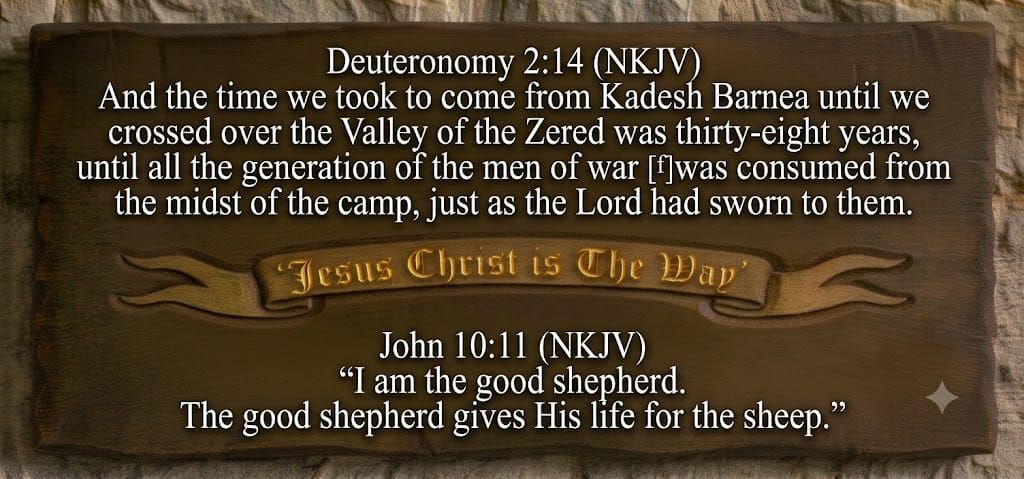
That 38-year figure is not a random detail. For any first-century Jewish reader, 38 years immediately carried a distinct biblical echo: it was the exact amount of time Israel spent wandering in the wilderness after Kadesh Barnea before entering the Promised Land (Deuteronomy 2:14).
It was a season of waiting, stripping away self-reliance, and dying to an Egyptian mindset. Like Israel in the desert, or Sarah and Rachel waiting through decades of barrenness, or even the 400 years of divine silence before John the Baptist, long seasons of waiting are rarely empty space in God’s design.
God is never in a hurry, because He isn’t just interested in delivering us from a situation; He is shaping us through it. The 38 years were not forgotten time. They were the backdrop for a revelation: that healing doesn’t come from a system or a pool, but from the voice of the King.
Looking at the King, Not the Pool
When Jesus speaks, He completely bypasses the pool, the water, and the crowd: “Rise, take up your bed and walk.”
Immediately, 38 years of paralysis vanished—not because the water stirred, but because the Word spoke.
If you find yourself in a long season of unanswered prayer, don’t mistake God’s silence for His absence. Never stop measuring His faithfulness by whether or not the pool is moving. Shift your gaze away from the circumstances you’re waiting on and seek the One who holds the timeline in His hands.
Section II: The Sabbath
Breaking the Mold: The Sabbath Controversy
No sooner had the man rolled up his bed and taken his first steps in nearly four decades than the religious establishment intervened. But they weren’t celebrating a life restored; they were auditing a rule book.
“It is the Sabbath,” the religious leaders scolded him. “It is not lawful for you to carry your bed.”
Throughout the Gospels, Jesus repeatedly collides with the religious elite over the Sabbath, and John 5 brings this battle line into sharp relief. To the critics, the Sabbath was a rigid, ceremonial checklist tied to a specific system, place, and set of humanly defined restrictions. But Jesus was exposing a fundamental flaw in their entire paradigm: they had become so consumed with guarding the external architecture of their religion that they missed the God who stood right in front of them.
From External Temple to Internal Truth
This confrontation cuts to a core spiritual reality that reaches far beyond first-century Jerusalem. The Sabbath was never meant to be a cold, mechanical obligation or a prison of legalism. It was instituted as divine rest, liberation, and life.
By commanding the man to carry his mat on the Sabbath, Jesus was declaring that true Sabbath is not found in an external building, an elaborate ritual, or the performance of religious duty. True Sabbath is found in Him.
We often fall into the exact same trap today. We tend to confine our faith within specific physical boundaries—a church building, a Sunday morning service, or an exterior routine—as if God only resides within four walls or operates on a scheduled program. But Jesus challenges us to look deeper, past the external mechanics and into our own souls.
- Faith is not a location; it is a relationship.
- Worship is not a building; it is a spirit-and-truth reality (John 4:24).
- Rest is not mere physical inactivity; it is soul-level surrender to the Prince of Peace.
When Jesus responded to His critics by saying, “My Father is working until now, and I am working” (John 5:17), He revealed that God’s redemptive work doesn’t shut down on a calendar day. His grace is continuously active, searching hearts, breaking chains, and renewing souls from the inside out.
The True Mirror of the Soul
The religious leaders had the Temple, the scripture scrolls, and the tradition, yet their hearts were spiritually dead. The healed man had spent 38 years sitting on a dirty mat, yet an encounter with the living Word transformed his entire existence in a single moment.
Honoring Christ doesn’t begin when we walk through the doors of a physical sanctuary; it begins when we allow His Spirit to inspect the sanctuary of our own hearts. It requires us to stop evaluating our spiritual life by external metrics—how often we attend, how well we follow religious conventions, or how polished we appear—and instead look into the mirror of our soul:
- Are we resting in His finished work, or still trying to earn our righteousness?
- Are we seeking authentic, internal truth, or just maintaining an external appearance?
Jesus didn’t come to preserve a set of rigid institutional rules. He came to set captives free, break down artificial barriers, and establish His throne inside the human heart. True Sabbath rest begins when we stop searching for God in the structure and start surrendering to Him in our spirit.
Conclusion & Transition: Crossing the Threshold
Looking Ahead to Part 2
When Jesus declared that He and His Father were working together, the religious leaders didn’t just miss the point—they actively sought to kill Him. They recognized what many today still overlook: Jesus wasn’t just claiming to be a good teacher or a miraculous healer. He was claiming equality with God.
In Part 2 of our study through John 5, we will dive into Jesus’ bold response to His accusers—unpacking the fivefold witness to His divine authority, the shift from spiritual death to eternal life, and what it truly means to hear the voice of the Son of God.
Questions for Private Meditation & Points of Reflection
1. The Long Wait: Transitioning from John 4 to John 5
- Point of Reflection: In John 4, God moves swiftly and dramatically. In John 5, we enter a 38-year waiting room. It is easy to sustain faith during seasons of rapid breakthroughs, but prolonged disappointment can cause us to settle into spiritual stagnation. Over time, we can normalize our brokenness and stop expecting God to move.
- Private Meditation Questions:
- Have you allowed a long season of unanswered prayer or delay to turn into spiritual resignation?
- Where in your life have you gradually shifted from waiting on God with expectation to simply accepting staying stuck?
- How does your heart respond when you see others receiving breakthroughs while your situation remains unchanged?
2. The Diagnostic Question: “Do you want to be made well?”
- Point of Reflection: Jesus asks a seemingly obvious question to a man who had been sick for almost four decades. Healing brings change, responsibility, and the end of familiar coping mechanisms. Sometimes, we cling to our “mats,” our familiar comfort zones, victim mindsets, or routines of pain—because staying where we are feels safer than stepping into the unknown demands of being made whole.
- Private Meditation Questions:
- If Jesus were to ask you right now, “Do you want to be made well in this area of your life?”—what area immediately comes to mind?
- What dynamic, pattern, or bad habit (“mat”) have you become comfortable carrying because change feels too risky or difficult?
- Are you truly ready to trade the familiar comfort of your condition for the responsibilities that come with freedom?
3. Excuses vs. Obedience: Looking at Circumstances vs. Looking at Christ
- Point of Reflection: When Jesus asks the man if he wants to be made well, the man doesn’t answer “Yes.” Instead, he explains why it hasn’t happened yet: “Sir, I have no man…” He was looking horizontally—at human systems, physical limitations, and competitive timing—rather than looking directly at the Creator standing in front of him. Jesus sidesteps all his logistical excuses with a direct command: “Rise, take up your bed and walk.”
- Private Meditation Questions:
- What “I have no one to help me” or “The timing is never right” excuses have you been telling God?
- In what ways have you been looking to human solutions, spiritual systems, or other people to do what only Christ can do?
- Is there a specific command Jesus has already spoken to your heart that you need to obey without waiting for circumstances to align first?
4. The Temple Encounter: Living in Transformed Wholeness
- Point of Reflection: When Jesus finds the man later in the temple, He tells him, “See, you have been made well. Sin no more, lest a worse thing come upon you.” Physical restoration was only the entry point; Jesus was concerned with the man’s eternal state. True spiritual healing requires us to abandon the old patterns that held us captive and walk forward in holy gratitude.
- Private Meditation Questions:
- How are you actively protecting the spiritual breakthroughs and freedom God has already given you?
- Are there lingering habits or old patterns from your “pre-healed” season that you need to surrender completely to God today?
- Does your daily walk reflect a person who has stepped up off the mat and into the abundant life Christ provides?
Conclusion & Transition: Crossing the Threshold (John 5:16–30)
When Jesus declared, “My Father is working until now, and I am working” (John 5:17), the religious leaders did not merely take offense at a Sabbath violation—they sought to put Him to death because He was explicitly making Himself equal with God.
In verses 16–30, Jesus does not retreat from this confrontation. Instead, He doubles down on His divine identity. He reveals that the Son does nothing of Himself, but only what He sees the Father do. The Father has committed all judgments to the Son, granting Him the authority to execute judgment and give life to whomever He wills.
The threshold of John 5 moves us from physical restoration to eternal confrontation. The same voice that commanded a paralyzed man to pick up his bed and walk is the sovereign voice that will one day call all who are in the graves to come forth—some to the resurrection of life, and others to the resurrection of condemnation. We cannot remain neutral at the Pool of Bethesda; we must either cling to our self-reliant systems or surrender completely to the divine authority of the Son.
Call to Action & Partnership
If this study has challenged your heart to step off the mat of spiritual stagnation and place your complete trust in Christ, we invite you to take the next step with us:
- Share the Message: Pass this study along to someone who feels trapped in a long season of waiting or spiritual silence.
- Join the Fellowship: Connect with The-Way Ministry community online as we walk line-by-line through the Gospel of John.
- Partner in the Mission: Stand with us in prayer and support as we continue delivering uncompromising, scripture-centered teaching to seeking hearts around the world.
Let us stand together on the unwavering truth of God’s Word and walk the narrow path side-by-side. Your prayers, engagement, and support allow us to continue producing deep, scripture-focused teaching for all who are seeking Him.
Thank you for your prayers, your presence, and your partnership in the Gospel!
- Join The Way Substack (Free or Paid Subscription)
- Support via The Way Blog (One-Time Gift)
Closing Prayer
Heavenly Father, we thank You for Your Word that speaks life into our darkest and most stagnant seasons. Forgive us for looking to human pools and worldly solutions rather than keeping our eyes fixed on Your Son, Jesus Christ. Grant us the faith to hear His voice, the courage to pick up our mats, and the grace to walk in true Sabbath rest. Strengthen us to honor Him in spirit and in truth every day of our lives.
The Lord’s Prayer
Our Father, who art in heaven, hallowed be Thy name.
Thy kingdom come, Thy will be done, on earth as it is in heaven.
Give us this day our daily bread,
and forgive us our trespasses, as we forgive those who trespass against us.
And lead us not into temptation but deliver us from evil.
For Thine is the kingdom, and the power, and the glory, forever and ever.
Amen.
Blessings In Christ’s Grace and Truth,
Tomas
The-Way Ministry
Standing on Truth, Walking the Narrow Way
Copyright © 2026 The-Way Digital Publications, All Rights ReservedTechnical Study Annex & Exegetical AppendixI. Comprehensive Biblical ReferencesJohn 5:1–15 – The healing at the Pool of Bethesda on the Sabbath.John 5:16–30 – The divine authority of the Son and His unity with the Father.Deuteronomy 2:14 – The 38-year wandering of Israel in the wilderness before entering Canaan.John 4:24 – True worship in spirit and truth.John 10:11–14 – Jesus as the Good Shepherd who lays down His life for the sheep.Leviticus 23:1–3 – Divine institution of the Sabbath as a holy convocation.II. Critical and Exegetical FootnotesThe Textual Variant of John 5:3b–4:The phrase “waiting for the moving of the water” and the entirety of verse 4 (referencing the angel stirring the pool) are absent from the earliest and most reliable Greek manuscript traditions (e.g., $\mathfrak{P}^{66}$, $\mathfrak{P}^{75}$, Codex Sinaiticus, and Codex Vaticanus). Scholars widely agree this was an early scribal gloss added to explain local folklore regarding the intermittent natural spring that fed the pool.Topography of Bethesda (Beth-zatha):Archaeological excavations near St. Anne’s Church in Jerusalem have verified the presence of a double pool featuring five distinct porticos (porches)—four surrounding the perimeter and one central portico dividing the two pools. This confirms the precise historical and geographical detail recorded in John 5:2.· The Legalism of the Mat (Mishnah Shabbat 7:2):Carrying a sleeping mat on the Sabbath was strictly prohibited under rabbinic traditions (Halakha), which classified moving an object from a private domain to a public domain as one of the 39 primary categories of forbidden labor (Melakha). Jesus intentionally commanded the man to carry his bed to directly confront these rabbinic additions with His supreme Messianic authority over the Sabbath.III. Canonical Cross-References: The Reversal of Eschatological StatusWilderness WanderingHistorical / Old Covenant Context: Deuteronomy 2:14 — 38 years of physical wandering due to unbelief under Moses.Johannine Realized Fulfillment: John 5:5–9 — 38 years of physical paralysis ended instantly by the voice of Christ.The Sabbath RestHistorical / Old Covenant Context: Exodus 20:8–11 — Physical cessation from labor as a memorial of Creation.Johannine Realized Fulfillment: John 5:17 — Spiritual rest and eternal life through the continuous redemptive work of the Father and Son.Resurrection & LifeHistorical / Old Covenant Context: Ezekiel 37:12–14 — Breath entering the dry bones in the valley.Johannine Realized Fulfillment: John 5:25, 28–29 — The voice of the Son raising the dead to eternal life and judgment.Digital Copyright Notice
Copyright © 2026. All Rights Reserved.
This document is protected under international copyright and digital rights management laws.Fair Use Citation: Short quotations or excerpts used in blog reviews, theological essays, or academic papers must provide appropriate attribution referencing the author (Tomas) and title of this work (The-Way Digital Publications).Permitted Use: Permission is granted to download, store, electronically view, and print physical copies of this text solely for personal use, private study, small group Bible discussions, or local church ministry settings.Prohibited Use: No part of this digital publication may be reproduced, redistributed, resold, hosted on public servers, or transmitted in any form or by any means, including photocopying, digital file sharing, recording, or translation into other languages, for commercial purposes without the prior written permission of the copyright holder.