
The Gospel of John Chapter 8:13-20 (II)
Physical vs. Spiritual Vision: The accusers were blind because they relied strictly on physical paperwork, rules, and surface-level consensus. In doing so, they missed the living Truth standing right in front of them.
Jesus Defends His Self-Witness
Welcome to The-Way Ministry
Before we dive into God's Word today, we want to express our deep gratitude to our supporting ministry partners:
- Luminous Church — San Antonio, TX
- Sowers Church of Christ — San Antonio, TX
- Christian Community Church of Ministry — Bangladesh
- Victory Group Bible Study
Thank you for standing faithfully alongside us as we proclaim the grace, truth, and light of Jesus Christ.
Introduction
In our previous study, Jesus revealed Himself as the true Light of the World—shining into the dark corners of hypocritical judgment and illuminating a path of grace for the repentant.
Yet, as we turn to John 8:13–20, the religious leaders do not remain silent. The Pharisees immediately challenge Jesus’ declaration, questioning His authority, His identity, and the validity of His testimony. In this passage, we will watch Jesus stand firm against their unbelief as He defends His divine truth.
In today’s study, we will examine three key themes:
- My Witness is True (vv. 13–14)
- A Second Witness (vv. 15–18)
- My Father’s Son (vv. 19–20)
Scripture Reading: John 8:13–20 (NKJV)
13 The Pharisees therefore said to Him, “You bear witness of Yourself; Your witness is not true.”
14 Jesus answered and said to them, “Even if I bear witness of Myself, My witness is true, for I know where I came from and where I am going; but you do not know where I come from and where I am going. 15 You judge according to the flesh; I judge no one. 16 And yet if I do judge, My judgment is true; for I am not alone, but I am with the Father who sent Me. 17 It is also written in your law that the testimony of two men is true. 18 I am One who bears witness of Myself, and the Father who sent Me bears witness of Me.”
19 Then they said to Him, “Where is Your Father?”
Jesus answered, “You know neither Me nor My Father. If you had known Me, you would have known My Father also.”
20 These words Jesus spoke in the treasury, as He taught in the temple; and no one laid hands on Him, for His hour had not yet come.
Section I: My Witness is True (John 8:13–14)
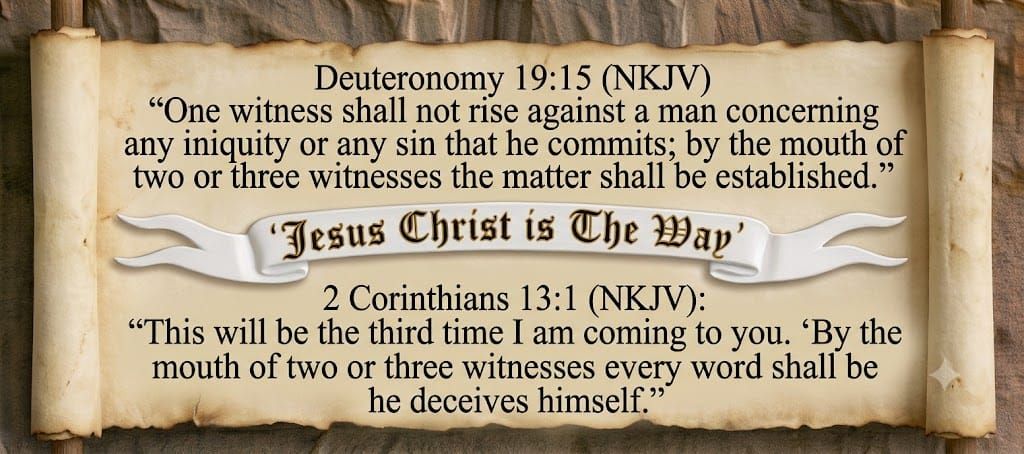
The Pharisees’ immediate reaction to Jesus declaring Himself the “Light of the World” is a legal challenge. Citing Deuteronomy 19:15, which required at least two witnesses to establish a matter, they attempt to dismiss His divine claims on a procedural technicality, declaring His self-testimony invalid.
Jesus answers by placing His witness above standard human legal constraints:
- Absolute Self-Knowledge: Human courts require cross-examination because human knowledge is limited, fallible, and biased. Christ’s testimony is intrinsically true because He possesses complete knowledge of His divine origin (“where I came from”) and His eternal destiny (“where I am going”).
- Spiritual Blindness of the Accusers: The Pharisees are disqualified from evaluating His claim because they lack heavenly perspective. Judging “according to the flesh” (John 8:15), they see only a carpenter’s son from Nazareth, entirely blind to His eternal origin and His return to glory.