
The Gospel of Luke Review Chapter 15
The Father isn’t waiting for us—or our children—to get it all together before He loves us. He is standing at the edge of the property, scanning the horizon, ready to run the moment a heart turns toward home. Drop the defenses, stop running, wash the dishes of grace, and let yourself be found.
The Relentless Pursuit: What a Gentile Doctor, Two Thieves, and an Unruly Child Teach Us About Grace
Welcome to The-Way Ministry
Good afternoon, and welcome, brothers and sisters! May the peace of our Lord Jesus Christ and His abundant blessings be with you as we study His Word together today.
Before we open up today’s text, I want to invite you to lock arms with us as a regular partner in this ministry. This daily journey through the Word is a labor of love, and it directly sustains my family as I dedicate my time to writing and teaching. If The Way has been a breath of fresh air for your walk with Christ, would you consider subscribing?
You can join our community completely free to receive these devotionals or choose a paid subscription to help us fund and expand this work. If you’d rather just throw a one-time blessing into the pot, you can also “buy me a coffee” below. Every bit of your partnership matters.
- Join The Way Substack (Free or Paid Subscription)
- Support via The Way Blog (One-Time Gift)
Thank you so much for your prayers, your presence, and your financial partnership. It means the world to us.
When we peel back the layers of translation and look at centuries of traditional formatting, we finally meet the real people behind the pages. The raw, unfiltered humanity of Peter, James, John, and Paul reminds us that they weren’t just characters in an ancient book; they were people just like us, navigating faith in real time. That is the moment the Bible truly wakes up. It ceases to be a distant historical archive and becomes a living mirror, reflecting our own hearts right back at us.
Comment and Review
To me, the Gospel of Luke holds a unique, irreplaceable weight in the New Testament. Written by a highly educated Gentile physician, it is a masterpiece of detail woven by an “outsider” who was utterly captivated by the light of Christ. Because Luke saw the Father’s love through the lens of someone welcomed in from the margins, his writings present a vivid, unfiltered diagnosis of the human heart. Throughout his Gospel, Luke carefully documents a series of sharp contrasts, forcing each of us to make a definitive choice: will we choose the chaotic, unruly offers of this world, or the radical, self-sacrificing love of Christ?
In my previous posts, we looked closely at the exhausting, messy mechanics of the “unruly child, “the slammed doors, the pushed boundaries, and the strain of managing rebellion. But I have a confession to make: this is my third time deeply reviewing Luke 15.
And although I used to put all my emphasis on the behavior of the unruly child, I now see that the grander, weightier beauty of the text rests on the lost sheep and the lost coin.
The deepest truth of Luke 15 is that Christ Jesus is actively looking for us. For me. For you—yes, you. He sees what others completely fail to notice. Where the world sees an unruly, frustrating mess, Jesus sees an invaluable soul covered in dust. He doesn’t stand over us with a gavel, judging the dirt we’ve climbed into; instead, He extends His hand, offering a love that reasons with us, anchors us, and reminds us that He is always there.
To understand the depth of this love, we have to look at how Luke masterfully exposes the two faces of our unruly human nature across his writings, showing us that unruliness isn’t always loud—sometimes, it hides in plain sight.
When Jesus pursues a wandering soul today, He isn’t abandoning the faithful. Instead, He trusts us—the disciples, the leaders, and the “ninety-nine” standing together—to look out for one another. Because the flock holds the line together, the Good Shepherd is free to do what only He can do: go into the darkest thickets to rescue the one who has lost their way. His love is so intensely focused that He ensures the community is secure just so He can give His undivided attention to the individual.
The parable ends not in a quiet return, but in a massive celebration. The shepherd calls his friends and neighbors together, saying, “Rejoice with me!” Jesus concludes with a powerful promise: There is more joy in heaven over one sinner who repents than over ninety-nine who think they have no need for it. While the Pharisees stood outside the circle of grace, judging the “impropriety” of Jesus’ guest list, Jesus was inviting them into a “grand symphony of grace.”
Unlike the sheep, which intentionally wandered out of bounds, the coin didn’t do anything wrong to get lost. It simply slipped into the dark through circumstances or neglect. Yet, the search is the same. God doesn’t judge how you became lost; He only cares about bringing you back into the light.
Just like the shepherd, the moment the woman finds what was lost, her private relief turns into a public celebration. She calls her friends and neighbors together to rejoice.
Think about the contrast Jesus is creating for the Pharisees. The religious elite were sitting in their clean, perfect circles, grumbling because Jesus was associating with the “dirt” of society. Meanwhile, Jesus shows a woman willing to get down on her hands and knees, sweeping through the dust and dirt of her floor, just to recover one valuable piece.
Jesus brings the truth home with a final exclamation: “There is joy in the presence of the angels of God over one sinner who repents.”
The Two Faces of Unruliness
Scripture shows us that there is a quiet, self-righteous version of an unruly spirit just as much as there is a loud, rebellious one. Look at how these stories mirror one another, splitting down two radically different paths:
- The Pharisee & The Tax Collector (Luke 18)
Before we can appreciate being found, we have to admit we are lost. The Pharisee is the “good child” who obeys the rules outwardly, but his heart is entirely unruly—proud, independent, and judgmental. The Tax Collector is the classic unruly child who has made a wreck of his life. Yet, because the Tax Collector beats his breast and begs for mercy, he is the one who goes home justified. The joy of being found belongs exclusively to the one who admits they need a Savior.
- The Two Thieves on the Cross (Luke 23)
Suspended on either side of Jesus are two genuinely unruly men—convicted criminals getting exactly what their actions earned. One thief uses his final breaths to mock, demanding an escape from his consequences. But the other thief experiences the ultimate “joy of being found” at the final hour. He looks at Jesus and asks simply to be remembered. Jesus doesn’t give him a lecture on his past crimes; He offers him instant, unearned paradise.
- Barabbas vs. Christ (The Ultimate Choice)
When the crowd is given a choice between two sons, they choose Jesus Barabbas—a notoriously violent, unruly rebel—over Jesus the Christ, the perfect Son. In the ultimate exchange of grace, the perfect Son takes the place of the unruly rebel. Barabbas walks free because Christ stays on the cross. We are Barabbas; we are the unruly children set free by the ultimate swap.
From the Pages of Scripture to the Bible Study Table
Just last night, I sat in Bible study and watched the living, breathing reality of this struggle unfold right before my eyes. We were discussing Matthew chapter 6—specifically, the Lord’s Prayer. In the room sat a mother and her adult daughter, two people bound by blood but deeply divided by a painful, exhausting “blame game.”
As we read the words of Jesus instructing us to ask for forgiveness in the same measure that we forgive others, the room grew heavy. Both women were trapped in the self-righteous trap of the Prodigal’s elder brother. Instead of seeking restoration, each was keeping a strict ledger of wrongs, waiting for the other to take the first step, confess, and prove they were sorry. They were both standing outside the house of grace, letting bitterness lock the door.
It struck me so clearly: the blame game is the ultimate rejection of the Luke 15 rescue. When we stay locked in blame, we are choosing the system of Barabbas—demanding our own way—over the scandalous mercy of Christ. We act like the Pharisee, looking across the table at our own flesh and blood, thinking, “If only they would behave, then we could have peace.”
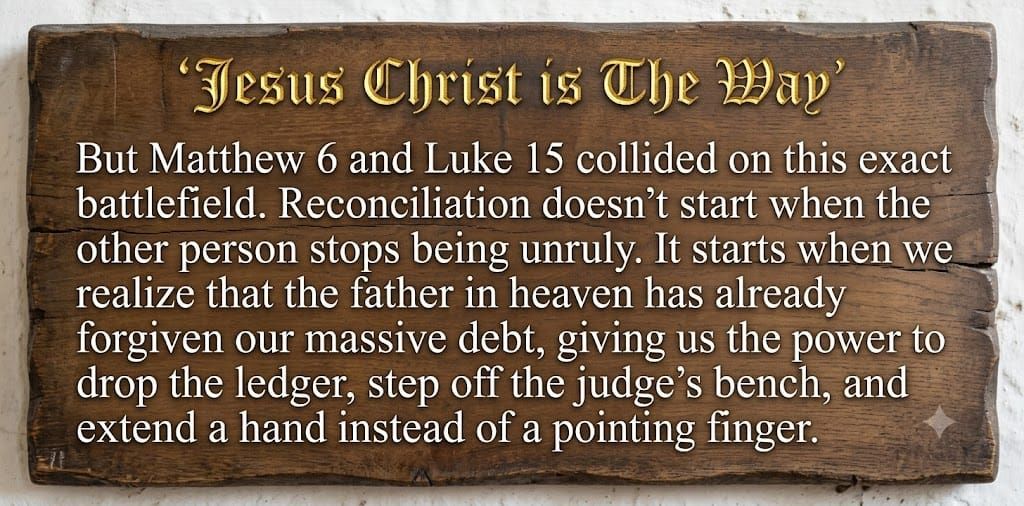
But Matthew 6 and Luke 15 collided on this exact battlefield. Reconciliation doesn’t start when the other person stops being unruly. It starts when we realize that the Father in Heaven has already forgiven our massive debt, giving us the power to drop the ledger, step off the judge’s bench, and extend a hand of mercy, love, and forgiveness instead of a pointing finger.
Conclusion: The Grace in the Kitchen Sink
It is easy to look at these grand biblical narratives and lose sight of the fact that grace is meant to be lived out in the trenches of daily life. For me, that trench showed up in my own home today.
Yesterday, I asked my daughter to wash the dishes. I reminded her several times. Yet, as I write this, the sink remains full—in fact, even more dishes have piled up. The natural human reaction is to scold, to lean into frustration, and to demand immediate compliance.
Some might look at this situation and ask: “But what about biblical discipline? Doesn’t the Old Testament say to ‘spare the rod and spoil the child’?”
It is a fair question. But to answer it, we have to understand what the rod actually is. In the ancient biblical world, the rod belonged to the shepherd. A shepherd never used his rod to beat his sheep in anger. Instead, he used it to fight off predators, to gently part the wool to inspect the sheep’s hidden wounds, and to give a wandering lamb a soft nudge back to the path. The rod was an instrument of protective love, not reactionary wrath.
When we choose mercy over scolding, we aren’t abandoning discipline—we are elevating it.
As I look at that mountain of dirty plates, I see a mirror of my own life. How many times has Christ asked me to do something, only for me to ignore His voice and pile up an even bigger mess? How many years has He quietly stepped in and cleaned up after my stubborn, unruly heart?
So, I am going to step up to the sink and clean it up myself.
Instead of scolding my daughter, I am going to choose to remind her of my unmovable affection and gently ask her to please listen next time. Why choose this instead of a harsh chastisement? Because that is exactly how our Father in Heaven treats us. He doesn’t cast us out when we leave a mess; He steps into our mess, reminds us of His love, and reasons with us.
When our children witness that kind of radical mercy, they aren’t driven away by anger—they are drawn to the light of the true Father. It is His kindness that leads us to repentance, and it is that same kindness that invites our children to step back into His grace.
We all have choices. Even when we choose not to listen, Christ doesn’t abandon us in the field or leave the coin to rot in the dirt. He gives us a gentle, loving nudge.
The Father isn’t waiting for us—or our children—to get it all together before He loves us. He is standing at the edge of the property, scanning the horizon, ready to run the moment a heart turns toward home. Drop the defenses, stop running, wash the dishes of grace, and let yourself be found.
"Very rarely will anyone die for a righteous person, though for a good person someone might possibly dare to die. But God demonstrates his own love for us in this: While we were still sinners, Christ died for us." — Romans 5:7–8
Bridge to the Next Study: Chapters 16 & 17
Our journey through the Gospel of Luke doesn’t end in the dirty dust of Chapter 15. In our next study, we cross the bridge into Chapters 16 and 17. The Great Doctor continues to diagnose our hearts as he shifts from the Joy of Being Found to the Stewardship of Being Kept. We will confront the haunting reality of the Rich Man and Lazarus, the choices we make with the things of this world, and the radical call to faith that moves mountains and forgives without bounds.
Closing Prayer
Heavenly Father, we thank You that You are a God who gets His hands dirty to sweep the floors of our lives and bring us home. Forgive us for the times we play the blame game, keeping a ledger of wrongs against those we love while ignoring the massive debt You have already washed clean for us. Give us the grace to pick up the Shepherd’s rod of protective love in our homes today, rather than the weapons of our own reactionary anger. Nudge our hearts back to You and let us rest in the absolute assurance that You are our anchor. We ask these things in the beautiful name of Jesus. Amen.
The Lord’s Prayer
Our Father, who art in heaven, hallowed be thy name. Thy kingdom come, thy will be done, on earth as it is in heaven. Give us this day our daily bread, and forgive us our debts, as we also have forgiven our debtors. And lead us not into temptation, but deliver us from evil. For thine is the kingdom, and the power, and the glory, forever. Amen.
Grace and Peace Be with You Always,
Tomas
© 2026 The-Way.blog Digital Publications. All Rights Reserved.
📖 Deep-Dive Reference Suite
I. Comprehensive Biblical References
- The Relentless Search: Luke 15:1–10 (The Lost Sheep & The Lost Coin)
- The Posture of the Heart: Luke 18:9–14 (The Pharisee & The Tax Collector)
- The Choice of the Cross: Luke 23:32–43 (The Two Thieves on the Cross)
- The Ultimate Substitute: Matthew 27:15–26, Mark 15:6–15 (The Release of Barabbas)
- The Daily Battle of Grace: Matthew 6:9–15 (The Lord’s Prayer & The Law of Forgiveness)
II. Critical and Exegetical Footnotes
- The Shepherd’s Rod (Shebet): In ancient Near Eastern pastoral practices, the rod (shebet in Hebrew) was fundamentally an instrument of defense, counting, and alignment (cf. Psalm 23:4, court reckoning in Leviticus 27:32). Exegetical misuse often conflates it with structural violence, whereas the primary function was the identification of skin/wool disease and structural redirection of a straying animal.
Barabbas (Bar-Abba): The text presents a profound lexical irony. Bar-Abba translates to “Son of the Father” (bar = son, abba = father). The historical narrative forces a cosmic-theological evaluation: the crowd demands the liberation of a false, rebellious son of the Father (Barabbas) while condemning the true, obedient Son of the Father (Jesus the Christ).
III. Canonical Cross-References: The Reversal of Eschatological Status
The sudden, unearned justification of the tax collector, the paradise promised instantly to a dying criminal, and the return of the prodigal son all serve as canonical anchors for Luke’s primary theological theme: the reversal of eschatological status.
This directly anticipates the coming weight of Luke 16 (The Rich Man and Lazarus), where the transactional values of this world are entirely turned upside down in eternity.
See also: Ezekiel 34:16 (”I will search for the lost and bring back the strays”); Micah 7:18 (”He does not stay angry forever but delights to show mercy”).
Digital Copyright Notice
Copyright © 2026. All Rights Reserved. This document is protected under international copyright and digital rights management laws.
- Fair Use Citation: Short quotations or excerpts used in blog reviews, theological essays, or academic papers must provide appropriate attribution referencing the author and title of this work.
- Permitted Use: Permission is granted to download, store, electronically view, and print physical copies of this text solely for personal use, private study, small group Bible discussions, or local church ministry settings.
Prohibited Use: No part of this digital publication may be reproduced, redistributed, resold, hosted on public servers, or transmitted in any form or by any means, including photocopying, digital file sharing, recording, or translation into other languages, for commercial purposes without the prior written permission of the copyright holder.