
The Gospel of Luke Review Chapter 22
A Sacred Transition: Jesus transforms the ancient Passover meal into the Lord’s Supper. When Jesus lifts the cup, He explicitly invokes Jeremiah’s prophecy—marking the moment the Old Covenant gives way to the New.
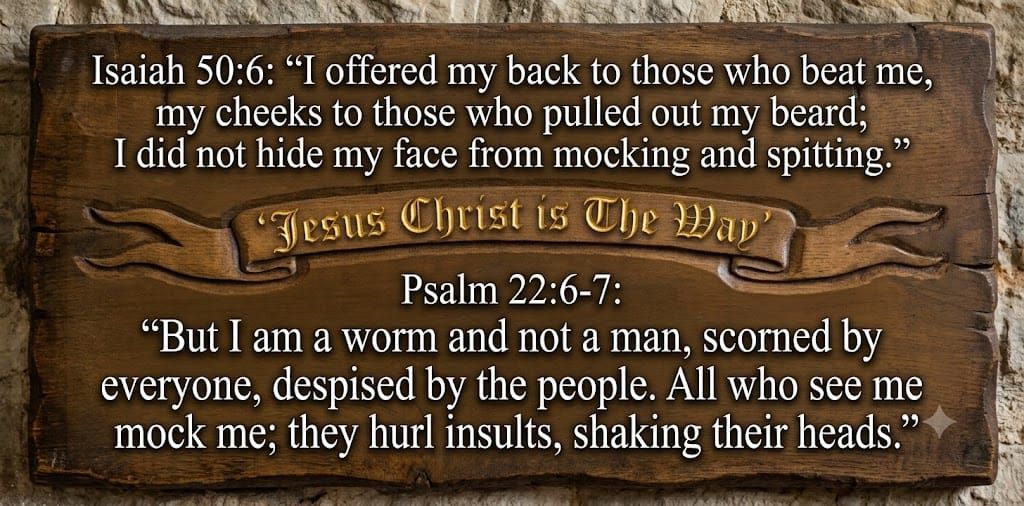
The Table, The Betrayal, The Denial, and The Mockery
Welcome to The-Way Ministry
Good afternoon, and welcome, brothers and sisters! May the peace of our Lord Jesus Christ and His abundant blessings be with you as we study His Word together today.
Before we open today’s text, I want to invite you to lock arms with us as a regular partner in this ministry. This daily journey through the Word is a labor of love, and it directly sustains my family as I dedicate my time to writing and teaching. If The Way has been a breath of fresh air for your walk with Christ, would you consider subscribing?
You can join our community completely free to receive these devotionals, or choose a paid subscription to help us fund and expand this work. If you’d rather throw a one-time blessing into the pot, you can also “buy me a coffee” below. Every single bit of your partnership matters!
[Join The Way Substack (Free or Paid Subscription)]
[Support via The Way Blog (One-Time Gift)]
Thank you so much for your prayers, your presence, and your financial partnership. It means the world to us.
The Divine Timeline: From Atonement to Passover
My truest belief is that there are absolutely no accidents in the Kingdom of God. As believers, we can easily fall into the habit of viewing the life of Christ as a series of disconnected historical events—a birth here, a teaching there, and an execution at the end.
But when you look beneath the surface at the specific timing of the Hebrew calendar, you realize that every single moment of Christ’s life was an unshakeable, meticulously timed appointment dictated by God’s sovereign will. To truly understand the weight of what happens in the Upper Room in Luke 22, we have to look at how God bookended Christ’s entire earthly mission using His holiest days:
- The Day of Atonement (Yom Kippur): This is the holiest day of the year on the biblical calendar—the one specific day the High Priest entered the Holy of Holies to offer blood to cover the sins of the nation. I am deeply inclined to believe that this day marks the actual birth of Christ. Think about the profound beauty of that timing: instead of a human high priest entering a physical room once a year to temporarily veil sin, God Himself physically entered our world to dwell among us. From the very moment of His birth, the Incarnation was entirely about ultimate reconciliation.
- The Passover: The celebration of Israel’s national rescue from the death angel in Egypt. Jesus wasn’t arrested and executed on a random weekend because the authorities finally caught up with Him. He was crucified at the exact hour the Passover lambs were being slaughtered in the Temple. The shadow of the Old Covenant met the perfect substance of the New—the blood on the wooden doorposts of Egypt perfectly mirroring the blood on the wooden beams of the Cross.
By weaving the Day of Atonement (His arrival to cover sin) together with the Passover (His sacrifice to conquer death), we see a flawless, divine design. God’s true will was operating on an exact timeline that no human plot could alter.
It is with this profound realization—that everything was marching toward a predetermined cosmic hour—that we must approach Luke 22. Before the betrayal of Judas is set in motion, and before the disciples sit down for the Last Supper, we must recognize that Jesus was not a victim of circumstance. He was the author of a grand design, stepping intentionally into the hour He had eagerly desired since the foundation of the world.
In Luke 22, Jesus speaks two sobering truths at the Passover table:
“But behold, the hand of My betrayer is with Me on the table.” — Luke 22:21
“Simon, Simon! Indeed, Satan has asked for you, that he may sift you as wheat. But I have prayed for you, that your faith should not fail; and when you have returned to Me, strengthen your brethren.” — Luke 22:31–32
We often look at these passages and ask: Who is the betrayer? We know him as Judas. Who is the one who denied Jesus? We know him as Peter.
But if we look closely into the mirror of Scripture, the real culprit is us—our sins, our lack of faith, and our spiritual blindness. Yet even knowing what was in their hearts (and ours), Christ still sat at the table.
Let’s review Luke 22 together and highlight the key points:
1. The Plot and the Passover Preparation (v. 1–13)
“Then Satan entered Judas, surnamed Iscariot, who was numbered among the twelve.” — Luke 22:3
- The Dark Alliance: Religious leaders seek a way to kill Jesus without inciting a crowd riot. Satan enters Judas Iscariot, who agrees to betray Him for money (v. 3–5). In Scripture, this terrifying phrase—“Satan entered Judas”—is used on two separate occasions: here, before Judas goes to the chief priests, and later during the Last Supper itself (John 13:27). The Gospel writers explicitly depict Satan’s progressive influence and eventual control over Judas (see also John 13:2, John 17:12).
- Sovereign Control: Jesus directs Peter and John to prepare the Passover meal with exact instructions about a man carrying a pitcher of water, showing that, despite the darkness brewing, Christ remains in full control of the timeline.
Insight: The Illusion of Forced Control
We often look at Pharaoh and Judas Iscariot as history’s ultimate villains—isolated figures driven by pure malice. But if you look closer at their stories, a much deeper, more profound psychological pattern emerges. It isn’t just a story of bad intentions; it is a masterclass in the self-destruction of forced control.
Both men suffered from the same fatal flaw: they felt power slipping through their fingers, panicked, overthought their strategies, and inadvertently engineered their own downfalls.
2. The Last Supper & The New Covenant (v. 14–23)
The Ancient Promise
“Behold, the days are coming, says the Lord, when I will make a new covenant with the house of Israel and with the house of Judah... I will put My law in their minds, and write it on their hearts; and I will be their God, and they shall be My people... For I will forgive their iniquity, and their sin I will remember no more.”
— Jeremiah 31:31, 33–34
- A Sacred Transition: Jesus transforms the ancient Passover meal into the Lord’s Supper. When Jesus lifts the cup, He explicitly invokes Jeremiah’s prophecy—marking the moment the Old Covenant gives way to the New.
- The Elements: The broken bread represents His body given for us; the cup represents the New Covenant in His blood, poured out for humanity’s sins (v. 19–20).
- The Betrayer at the Table: Jesus reveals that the hand of His betrayer is on the table (v. 21). Even in the presence of impending betrayal, Christ still extends the bread and the cup.
The Call to Self-Examination
“For I received from the Lord that which I also delivered to you: that the Lord Jesus on the same night in which He was betrayed took bread; and when He had given thanks, He broke it and said, ‘Take, eat; this is My body which is broken for you; do this in remembrance of Me.’ In the same manner, He also took the cup after supper, saying, ‘This cup is the new covenant in My blood. This do, as often as you drink it, in remembrance of Me.’... Therefore whoever eats this bread or drinks this cup of the Lord in an unworthy manner will be guilty of the body and blood of the Lord. But let a man examine himself...”
— 1 Corinthians 11:23–25, 27–28
When Paul re-instates this ordinance to the church in Corinth, he reminds us of what happened that night in Luke 22. Approaching the table requires an honest look inward—recognizing our brokenness so that we can fully appreciate the grace being extended to us.
3. Greatness vs. Servanthood & The Two Predictions (v. 24–38)
- Pride in the Shadow of the Cross: Right after the ultimate declaration of sacrifice, the mood in the upper room breaks down into something incredibly ordinary and human. A dispute breaks out among the disciples about which of them is the greatest. Anyone who grew up in a house with siblings knows this exact dynamic. No matter how solemn the occasion may be, sibling rivalries have a way of bubbling to the surface. Even in Christ’s final hours, the disciples are bickering like children in the backseat of an old station wagon over who is going to get the window seat.
- Kingdom Leadership: To correct them, Jesus draws a sharp contrast. He points to the Gentile world, where pagan kings lord their power over people and demand to be called “Benefactors”—buying forced loyalty through top-down authority. But Jesus reframes leadership entirely for His followers: “But not so among you; on the contrary, he who is greatest among you, let him be as the younger, and he who governs as he who serves” (v. 26).
- Peter’s Sifting & Jesus’ Intercession:
- Jesus warns Simon Peter that Satan has requested to “sift him as wheat.”
- Crucially, Jesus doesn’t say “I prayed that you wouldn’t fall,” but rather “I have prayed for you, that your faith should not fail; and when you have returned to Me, strengthen your brethren” (v. 32). Redemption is built right into the prophecy!
- Peter boasts of his readiness to die for Christ, prompting Jesus’ prediction that Peter will deny Him three times before the rooster crows (v. 34).
4. Agony in Gethsemane (v. 39–46)
“And being in anguish, he prayed more earnestly, and his sweat was like drops of blood falling to the ground.” — Luke 22:44
- The Cup of Wrath: Jesus retreats to the Mount of Olives to pray. In anguish, He prays, “Father, if it is Your will, take this cup away from Me; nevertheless, not My will, but Yours, be done” (v. 42).
- Somatic Agony: His sweat becomes like great drops of blood falling to the ground as an angel strengthens Him—highlighting the incredible weight of the world’s sin resting on His shoulders.
Medical Insight: The Reality of Hematidrosis
As a physician, Luke notices things other Gospel writers miss. He is the only one who records this chilling, visceral detail. From a medical standpoint, what Jesus experienced is a rare, documented physiological phenomenon known as hematidrosis.
Under conditions of extreme, unimaginable psychological stress or terror, the tiny subcutaneous capillaries surrounding the sweat glands can actually rupture under intense pressure. The blood then mixes with sweat and exudes fluid, pouring from the skin in large droplets.
Luke isn’t using poetic exaggeration here; he is recording a clinical reality. Jesus wasn’t just facing the mental anticipation of a painful physical execution; the sheer spiritual and emotional weight of bearing the brokenness of the world was literally bursting His capillaries from the inside out.
5. Betrayal, Arrest, & Denial (v. 47–62)
- The Kiss: Judas leads an armed crowd and identifies Jesus with a sign of affection—a kiss (v. 47–48).
- Peter’s Fall: As Jesus is taken to the High Priest’s house, Peter follows at a distance. Around a fire in the courtyard, three people recognize Peter, and he denies knowing Him three times.
- The Look of Grace: Immediately after the third denial, the rooster crows, and Jesus turns and looks straight at Peter (v. 61). Peter remembers the Lord's word, goes outside, and weeps bitterly.
Warning: The Slow Erosion of Resentment
Judas did not become a betrayer overnight; he allowed Satan to cloud his mind over time, nursing grievances until his heart grew completely dark. It is a sobering warning for us today. Think about how easily we snap in anger or fume over a minor interruption. When we let our anger smolder, we give the enemy a foothold.
Scripture routinely warns us about the danger of unchecked resentment. We see it all the way back in Genesis when God warned a brooding Cain:
“Why are you angry? Why is your face downcast?” — Genesis 4:6
Jesus echoed this critical warning in the Sermon on the Mount:
“Anyone who is angry with a brother or sister will be subject to judgment... and anyone who says, ‘You fool!’ will be in danger of the fire of hell.” — Matthew 5:22
Judas allowed small drops of frustration to turn into a flood of betrayal. What small irritations are we letting smolder in our own hearts today?
6. Mockery & The Sanhedrin Trial (v. 63–71)
The Promised Son of Man & Seated King
“In my vision at night I looked, and there before me was one like a son of man, coming with the clouds of heaven… He was given authority, glory, and sovereign power; all nations and peoples of every language worshiped him.”
— Daniel 7:13–14
“The Lord says to my lord: ‘Sit at my right hand until I make your enemies a footstool for your feet.’”
— Psalm 110:1
- Physical and Verbal Abuse: The guards mock, beat, and blindfold Jesus, taunting Him to prophesy who hit Him (v. 63–65).
The High Council: Before the council of elders, chief priests, and scribes, Jesus explicitly claims His divine identity. By declaring that He will sit at the right hand of the power of God, He directly applies the Messianic fulfillments of Daniel 7 and Psalm 110 to Himself.
The Deepest Irony of History
The trial before the Sanhedrin exposes the deepest irony of human history: the religious judges of Israel are completely blind to the true Judge of the world standing right in front of them.
In this tense, small room, the ultimate exchange took place. Christ allowed Himself to be bound, blindfolded, and beaten so that our spiritual blindness could be cured. He willingly traded His perfect righteousness for our deep shame.
Key Takeaway: Luke 22 demonstrates human weakness in contrast to divine grace. Judas responds to failure with despair; Peter responds with godly sorrow leading to restoration. Jesus willingly accepts the cup of judgment so that our failure does not have to be the final word.
Looking Ahead
As the sun rises on the morning of His trial, the scene changes, but the divine stakes remain the same. The religious leaders have reached their hasty verdict, but they lack the civil authority under Roman rule to execute Him—setting the stage for Luke 23, where Christ stands before Pilate and Herod as the true, innocent Lamb.
Conclusion & Call to Action
Luke 22 reminds us that Christ knew every detail of our frailty—our capacity to compromise like Judas, to argue over status like the disciples, and to shrink back in fear like Peter—yet He still chose to sit at the table and give His life for us. The blood of the New Covenant was not poured out for perfect people, but for broken sinners in desperate need of a Savior.
Steps for Reflection This Week
- Examine Your Heart: Before taking Communion or stepping into prayer today, take a quiet moment to lay down any smoldering resentment, hidden pride, or subtle anger before it roots deep in your spirit.
- Anchor in Intercession: Remember that when you stumble, Christ’s response isn’t condemnation—it is intercession. Cry out to Him in repentance, knowing He has already prayed for your restoration.
- Partner with The Way: If this teaching stirred your walk with God today, share this devotional with a friend or family member who needs an encounter with Christ’s grace.
Closing Prayer
Heavenly Father, we humble ourselves before You today as we behold the weight of Luke 22. We acknowledge our own spiritual blindness, our pride, and the times we have turned away from You. Thank You that Christ stepped intentionally into the cosmic hour to bear the cup of wrath that we deserved. Protect our hearts from the slow erosion of bitterness, strengthen us when Satan seeks to sift us like wheat, and let Your grace turn our weeping into restoration. In Jesus’ holy and mighty name, Amen.
The Lord’s Prayer
Our Father in heaven,
Hallowed be Your name.
Your kingdom come,
Your will be done
On earth as it is in heaven.
Give us this day our daily bread.
And forgive us our debts,
As we forgive our debtors.
And do not lead us into temptation,
But deliver us from the evil one.
For Yours is the kingdom and the power and the glory forever. Amen.
In Christ’s Grace and Truth,
Tomas
The-Way Ministry
Standing on Truth, Walking the Narrow Way

Appendix I: Comprehensive Biblical References
- Passover & Atonement Timeline
- Scriptures: Exodus 12:1–14, Leviticus 16:15–19, John 1:29
- Significance: Connects the Passover lamb and Yom Kippur sacrifice to Christ’s death.
- Judas’ Betrayal & Satanic Entry
- Scriptures: Luke 22:3–6, John 13:2, John 13:27, John 17:12
- Significance: Traces the progressive influence of Satan over Judas.
- Institution of the New Covenant
- Scriptures: Jeremiah 31:31–34, Luke 22:19–20, 1 Corinthians 11:23–29
- Significance: Fulfills the Old Testament prophecy of the law written on human hearts.
- True Greatness & Servanthood
- Scriptures: Luke 22:24–27, Mark 10:42–45, Philippians 2:5–8
- Significance: Reverses worldly hierarchical structures in favor of servanthood.
- Peter’s Prediction & Intercession
- Scriptures: Luke 22:31–34, Job 1:6–12, Zechariah 3:1–2, John 21:15–17
- Significance: Highlights Satanic testing versus Christ’s sovereign priestly intercession.
- Agony in Gethsemane
- Scriptures: Luke 22:39–46, Isaiah 53:10, Hebrews 5:7–8
- Significance: Displays Christ’s somatic anguish and submissive obedience.
- The Warning on Unchecked Anger
- Scriptures: Genesis 4:6–7, Matthew 5:21–22, Ephesians 4:26–27
- Significance: Illustrates how smoldering resentment provides a demonic foothold.
- Trial before the Sanhedrin
- Scriptures: Daniel 7:13–14, Psalm 110:1, Luke 22:66–71
- Significance: Explicit Messianic self-identification before the High Priest.
Appendix II: Critical and Exegetical Footnotes
- Luke 22:3 (Satan entered Judas)
- Greek Term: $\text{e\bar{i}s\bar{e}lthen}$ ($\epsilon\hat{\iota}\sigma\hat{\eta}\lambda\theta\epsilon\nu$)
- Exegetical Note: The Greek verb signifies more than external temptation; it describes active spiritual possession and yield of volition, previously prepared by Judas’ ongoing moral compromise (cf. John 12:6).
- Luke 22:20 (New Covenant in My blood)
- Greek Term: $\text{h\bar{e}\ kain\bar{e}\ diath\bar{e}k\bar{e}}$ ($\dot{\eta}\ \kappa\alpha\iota\nu\dot{\eta}\ \delta\iota\alpha\theta\acute{\eta}\kappa\eta$)
- Exegetical Note: The phrase explicitly translates the Hebrew Berit Chadashah from Jeremiah 31:31. Blood ratification was necessary under Ancient Near Eastern covenantal law (cf. Genesis 15, Exodus 24:8).
- Luke 22:31–32 (Satan has asked for you)
- Greek Terms: $\text{hym\bar{a}s}$ ($\acute{\upsilon}\mu\tilde{\alpha}\varsigma$) vs. $\text{peri\ sou}$ ($\pi\epsilon\rho\grave{\iota}\ \sigma o\tilde{\upsilon}$)
- Exegetical Note: The pronoun “you” in verse 31 ($\text{hym\bar{a}s}$) is plural in Greek, meaning Satan demanded to sift all the disciples. However, in verse 32, Jesus shifts to the singular ($\text{peri\ sou}$)—” I have prayed for YOU [Simon] specifically.”
- Luke 22:44 (Hematidrosis)
- Textual Evidence: Luke 22:43–44
- Exegetical Note: The textual authenticity of verses 43–44 is widely supported by early church fathers such as Irenaeus and Justin Martyr. From a medical standpoint, this phenomenon aligns precisely with severe capillary rupture around the sweat glands, resulting in sweat-like drops of blood.
Appendix III: Canonical Cross-References: The Reversal of Eschatological Status
· The Passover Lamb
· Old Covenant: The blood of an unblemished lamb painted on wooden doorposts saved Israel from physical death (Exodus 12).
· Gospel Fulfillment: Jesus institutes the New Covenant in His blood on the wooden beams of the cross (Luke 22:19–20).
· Eschatological Reality: Christ is eternally worshiped as the Worthy Lamb who conquered death (Revelation 5:6).
· The High Priest & Yom Kippur
· Old Covenant: The High Priest entered an earthly room once a year with animal blood to temporarily cover national sin (Leviticus 16).
· Gospel Fulfillment: Christ enters Gethsemane and the Cross, offering His own body and blood under severe somatic anguish (Luke 22:44).
· Eschatological Reality: Christ enters the true Heavenly Sanctuary once for all, securing eternal redemption (Hebrews 9:11–12).
· Earthly Kings vs. Heavenly Servant
· Old Covenant / Worldly Model: Gentile rulers lord authority over their subjects, demanding praise as “Benefactors” through top-down power (Luke 22:25).
· Gospel Fulfillment: Jesus flips worldly power upside down by serving, choosing the path of the Cross before receiving the Crown (Luke 22:26–27).
· Eschatological Reality: Christ is exalted above all earthly powers as King of kings and Lord of lords (Revelation 19:16).
The trial in Luke 22 serves as a pivotal cosmic pivot. Human judges condemn the sinless Son of Man, but the Old Testament prophecies cited during the trial (Daniel 7:13–14, Psalm 110:1) guarantee an absolute reversal of status:
- Earthly Sanhedrin Verdict: Condemned, mocked, blindfolded, and bound as a criminal.
Heavenly Divine Verdict: Vindicated, resurrected, and seated at the right hand of God, where every knee will bow and every tongue confess that Jesus Christ is Lord (Philippians 2:9–11).
Digital Copyright Notice
Copyright © 2026. All Rights Reserved. This document is protected under international copyright and digital rights management laws.
- Fair Use Citation: Short quotations or excerpts used in blog reviews, theological essays, or academic papers must provide appropriate attribution referencing the author and title of this work.
- Permitted Use: Permission is granted to download, store, electronically view, and print physical copies of this text solely for personal use, private study, small group Bible discussions, or local church ministry settings.
Prohibited Use: No part of this digital publication may be reproduced, redistributed, resold, hosted on public servers, or transmitted in any form or by any means, including photocopying, digital file sharing, recording, or translation into other languages, for commercial purposes without the prior written permission of the copyright holder.