
The Gospel of Luke Review Chapters 13-14
The Tree: That small act of setting one bound person free was the launching pad for an unstoppable Kingdom. The Kingdom starts tiny and unnoticed, but it explodes outward until it creates a massive, safe refuge for the broken and outcasts (the birds) to find rest.
Squeezing Through the Narrow Door and Upending the Feast
Welcome to The-Way Ministry
Good afternoon, and welcome, brothers and sisters! May the peace of our Lord Jesus Christ and His abundant blessings be with you as we study His Word together today.
Before we open up today’s text, I want to invite you to lock arms with us as a regular partner in this ministry. This daily journey through the Word is a labor of love, and it directly sustains my family as I dedicate my time to writing and teaching. If The Way has been a breath of fresh air for your walk with Christ, would you consider subscribing?
You can join our community completely free to receive these devotionals or choose a paid subscription to help us fund and expand this work. If you’d rather just throw a one-time blessing into the pot, you can also “buy me a coffee” below. Every bit of your partnership matters.
Thank you so much for your prayers, your presence, and your financial partnership. It means the world to us.
When we peel back the layers of translation and look at centuries of traditional formatting, we finally meet the real people behind the pages. The raw, unfiltered humanity of Peter, James, John, and Paul reminds us that they weren’t just characters in an ancient book—they were people just like us, navigating faith in real-time. That is the moment the Bible truly wakes up. It ceases to be a distant historical archive and becomes a living mirror, reflecting our own hearts right back at us.
As we look into that mirror along the dusty roads of Luke’s Gospel, we find that the teachings in Chapters 13 and 14 form a powerful, consecutive narrative unit. If the previous chapters warned us against inward hypocrisy, these chapters step out of the shadows and demand a dramatic, real-time response. Here, Jesus confronts us with a dual challenge: The Turn (a radical, urgent call to repentance) and The Table (a total, revolutionary upending of social and spiritual status).
Chapter 13: Squeezing Through the Narrow Door
Dismantling the “Karma” Trap: Repent or Perish (Luke 13:1–5)
Think of a teacher standing at a chalkboard. When they want to emphasize a crucial point, they might raise their voice, pause, or tap the board firmly. It’s their way of telling the students: “Wake up! Pay attention—this will be on the test.” That is exactly what Jesus is doing in this passage. By repeating Himself word-for-word, He is tapping on the chalkboard of our hearts. He is delivering an urgent, stark warning and laying out a clear choice: choose life with Him or perish.
The chapter opens with bystanders bringing Jesus the local breaking news. Pontius Pilate had just brutally slaughtered a group of Galilean worshippers, mingling their blood with their own sacrifices. In first-century Jewish thought, a sudden, violent tragedy like this was widely assumed to be a sign of God’s hidden judgment. The crowd wanted Jesus to confirm their bias—to agree that those Galileans must have been terrible, secret sinners to deserve such a horrific end.
Instead, Jesus completely rejects this “theology of karma” and exposes their finger-pointing:
“Do you think that these Galileans were worse sinners than all the other Galileans because they suffered this way? I tell you, no! But unless you repent, you too will all perish.” — Luke 13:2–3
To drive the point home, He brings up another recent disaster: eighteen everyday people crushed to death when the Tower of Siloam suddenly collapsed. Again, He asks: Were they more guilty than everyone else living in Jerusalem? His answer is exactly the same.
The Takeaway: Jesus completely disconnects earthly tragedy from personal guilt. In doing so, He shifts our focus away from analyzing why others died and forces us to look at how we are currently living.
Tragedy isn’t God’s scorecard; it’s a megaphone reminding us that our timeline is not our own, and that repentance is an immediate, daily necessity. When disaster strikes, it isn’t God saying, “Look how angry I am at them.” It’s God saying, “Look how little time you have left. Come home.”
The Mercy of the Extra Year (Luke 13:6–9)
To illustrate this urgent need for change, Jesus shares the Parable of the Barren Fig Tree. A man has a fig tree planted right in the middle of his prime vineyard soil. For three straight years, he comes looking for fruit and finds absolutely nothing. Frustrated, he tells the gardener to chop it down: “Why should it use up the soil?”
But the gardener steps into the gap and pleads for the tree’s life:
“Sir, leave it alone for one more year, and I’ll dig around it and fertilize it. If it bears fruit next year, fine! If not, then cut it down.” — Luke 13:8–9
What stands out first about this parable is how short, focused, and entirely to the point it is. Right after giving a heavy warning about perishing, Jesus uses this brief story to show us the ultimate heart of God: even when we are stubborn and refuse to change, His desire is not destruction. He gives us time because He does not want to lose a single soul.
It is a beautiful but sobering picture of patient urgency, broken down by two vivid details:
- The Soil is Grace: The extra year isn’t a permanent pass to keep doing nothing; it is a hard-fought extension of grace.
- The Expectation is Fruit: The Gardener actively tends to us—digging up the compacted soil of our hearts and adding fertilizer to help us grow. But God expects tangible fruit (a life of active love, justice, and faith), not just pretty green leaves that take up space.
Look closely at who handles the crisis. Jesus is referring to Himself as the keeper of the vineyard—the one who steps between the owner’s judgment and the barren tree, pleading, “Give it one more year.” This beautifully mirrors Jesus Christ as our High Priest and Advocate. Just as the book of Hebrews portrays Him, Jesus is the one constantly interceding on our behalf. Yet He doesn’t just ask for more time; He promises to actively work on us—pouring out His grace, truth, and Holy Spirit to give us every opportunity to thrive. Through His mediation, we are given a second chance. But the warning from the first five verses still stands: the extra time is given specifically so that we will repent and bear fruit.
From Bondage to Expansion: The Unseen Force of the Kingdom (Luke 13:10–21)
Right after warning the crowd that time is short and fruit is expected, Jesus demonstrates exactly what Kingdom fruit looks like. He shifts from a fictional, barren fig tree to a real, physically bound woman sitting right in front of Him on the Sabbath. The text moves seamlessly from this intimate miracle into two back-to-back parables about growth. While it may seem like a sudden change of subject, Jesus is actually using the healed woman to clarify what the mustard seed and the yeast really mean.
1. The Visible Break from Bondage
For eighteen years, this daughter of Abraham was physically bent double, completely unable to stand upright. Her posture perfectly mirrored the spiritual state of the people under rigid, legalistic systems: crushed, looking downward, and unable to free themselves.
When the synagogue leader objects to the healing because it violates his strict Sabbath checklist, Jesus calls out the utter hypocrisy. He points out that they would gladly untie a thirsty animal on the Sabbath to give it water. Then He delivers the core message of the miracle:
“Then should not this woman, a daughter of Abraham, whom Satan has kept bound for eighteen long years, be set free on the Sabbath day from what bound her?” — Luke 13:16
Jesus redefines the Sabbath. It isn’t a day of heavy restrictions meant to keep people bound; it is the ultimate day of release, restoration, and freedom.
2. The Mustard Seed: The Outward Explosion of Freedom
Immediately after shaming His opponents and freeing the woman, Jesus asks, “What is the kingdom of God like?” He compares it to a tiny mustard seed. In the ancient world, wild mustard was invasive, fast-growing, and often viewed as a nuisance if it got into a clean garden. By planting it intentionally, the man in the parable is doing something unexpected. The seed grows so large that it becomes a sanctuary where birds can nest.
The link to the crippled woman is beautiful:
- The Seed: Her healing looked small—a brief interaction in a local synagogue that the religious leaders tried to shut down.
The Tree: That small act of setting one bound person free was the launching pad for an unstoppable Kingdom. The Kingdom starts tiny and unnoticed, but it explodes outward until it creates a massive, safe refuge for the broken and outcasts (the birds) to find rest.
3. The Yeast: The Inward, Unstoppable Transformation
Jesus then pivots to a domestic image: a woman mixing yeast into sixty pounds of flour—an enormous amount of dough capable of feeding an entire village. Yeast works silently, invisibly, and from the inside out. You cannot see it working, but you cannot stop its influence once it is inside the dough.
This is exactly what happened inside that synagogue:
- The religious system was external, rigid, and cold—leaving the woman bent over for nearly two decades.
- Jesus brought the Kingdom, which acts like yeast. It started silently inside her body, instantly straightening her spine and filling her mouth with praise.
The Takeaway: By placing the parables right next to the healing, Luke shows us that the Kingdom of God isn’t a political takeover; it is an organic, life-giving force. It starts like a tiny seed or a hidden pinch of yeast—often starting with a single, overlooked person whose life’s heavy burdens have bound. But once Jesus speaks freedom into that space, it alters everything, expanding outward until the entire world is transformed by His grace.
Squeezing Through the Narrow Door (Luke 13:22–30)
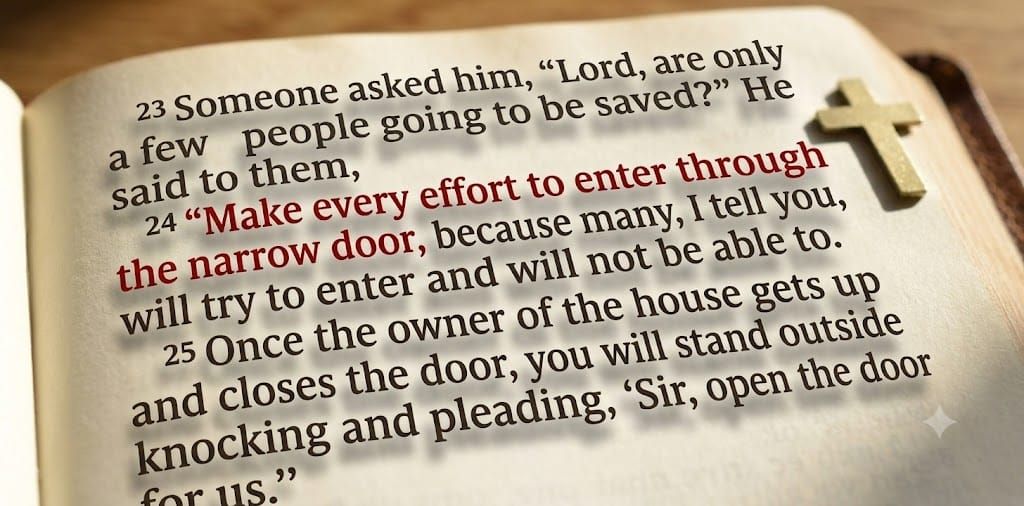
As Jesus continues His slow march toward Jerusalem, an onlooker stops Him with a speculative, academic question: “Lord, are only a few people going to be saved?”
True to form, Jesus refuses to calculate a census. Instead, He turns the theoretical question into an intensely personal, practical command:
“Strive to enter through the narrow door, because many, I tell you, will try to enter and will not be able to.” — Luke 13:24
The Greek word for “strive” here is ἀγωνίζεσθε (agonizesthe)—the root of our modern word agonize. It is a heavy term used by ancient athletes and soldiers to describe intense, concentrated struggle. Jesus isn’t saying we have to work to earn our way into heaven. Rather, He is saying that following Him requires a focused, intentional effort to strip down—dropping our bulky bags of pride, self-sufficiency, legalism, and worldly compromise just to fit through the narrow frame.
This warning echoes all the way back to the days of Noah. As the ancient rains began to pour, it was the Lord who shut the door of the Ark, leaving those on the outside desperately trying to get in. Jesus is our Ark. He is the ultimate Gatekeeper, and when that narrow door finally clicks shut, the opportunity ends. This ties perfectly back to the beginning of Luke 13, reinforcing the baseline truth: repent or perish.
This reality holds up a terrifying mirror to a massive danger within modern faith: the trap of casual proximity.
Jesus warns that simply standing near the door, being familiar with His sermons, or claiming we “ate and drank” in His presence won’t cut it. Many mistakenly think they are secure simply because they attend church, follow civic rules, and perform respectable deeds. But when the Master locks the door, those relying on casual proximity will find themselves standing outside in the cold, realizing too late that they traded real intimacy for dynamic religious habits.
The ultimate tragedy is followed by a stunning cosmic plot twist. The seats at the great heavenly banquet table will not be empty; they will be filled by completely unexpected guests coming from the east, west, north, and south. As Jesus famously concludes:
“Indeed, there are those who are last who will be first, and first who will be last.” — Luke 13:30
Chapter 14: Upending the Feast
If Chapter 13 demands that we squeeze through a narrow door, Chapter 14 shows us what the room looks like once we are inside. Reclining at a Sabbath dinner in the home of a prominent Pharisee, Jesus observes the guests aggressively jockeying for positions of honor. He uses their social climbing to expose the upside-down nature of Kingdom status.
A Man with Dropsy Healed on the Sabbath (Luke 14:1–6)
The dinner is an interrogation disguised as a feast. The religious leaders are watching Jesus closely (παρατηρούμενοι / parateroumenoi—systematically spying on Him). They have even planted a certain man right before Him who has dropsy.
The Reality of the Man’s Suffering
Before we look at the trap the Pharisees were trying to set, it helps to understand what this man was going through. In the ancient world, “dropsy” was the term used for what we know today as edema—a severe, abnormal buildup of fluid in the body’s tissues, usually causing intense, painful swelling in the legs, feet, and ankles. It wasn’t just uncomfortable; it was a visible symptom of a deeply rooted, failing body. This man wasn’t just a theological talking point. He was a person in desperate need of relief.
The Silence of the Self-Righteous
Knowing that the religious leaders were watching His every move, waiting to catch Him breaking their Sabbath rules, Jesus doesn’t hide. He goes on the offensive. He puts the lawyers and Pharisees on the spot with a direct, anchoring question:
“Is it lawful to heal on the Sabbath?” — Luke 14:3
Immediately, the room goes quiet. Their silence speaks volumes. They couldn’t say “No,” because forbidding a good deed would expose their lack of compassion to the crowd. But they wouldn’t say “Yes,” because their rigid legalism mattered more to them than human suffering.
After taking hold of the man, healing him, and letting him go, Jesus exposes their hypocrisy entirely:
“Which of you, having a donkey or an ox that has fallen into a pit, will not immediately pull him out on the Sabbath day?” — Luke 14:5
Once again, they have absolutely no answer. When we prioritize our own traditions over someone else’s suffering, we miss the heart of Christ entirely.
Take the Lowly Place (Luke 14:7–14)
Jesus then watches the guests aggressively choose the places of honor at the table and tells them a parable about a wedding feast.
The Temptation of the Head Table
What right or excuse do we ever have to seat ourselves at the head of the table? When we receive an invitation to a wedding, we are there simply as guests. Yet, how often do we naturally slide ourselves into positions of self-importance, assuming we deserve the best seats in life, in ministry, or in our communities?
Jesus challenges this pride directly, highlighting the absolute necessity of genuine humility. In the ancient world, honor and shame were the very foundation of identity and character. Being publicly asked to step down to a lower seat was a humiliating, defining disaster.
Stealing the Host’s Authority
If we look closely at this parable, we see an even deeper layer: Jesus is the Groom. When we realize that He is the true Host of the feast, the entire picture shifts. It is not our wedding; it is His. We do not get to determine our own status or worth at His table. When we try to exalt ourselves, we are essentially trying to steal the Host’s authority. True honor doesn’t come from pushing our way to the front; it comes from waiting for the Groom to look at us in our humility and say:
“Friend, go up higher. Then you will have glory in the presence of those who sit at the table with you. For whoever exalts himself will be humbled, and he who humbles himself will be exalted.” — Luke 14:10–11
Hospitality Without a Price Tag
Jesus then expands this call to humility by turning the spotlight onto how we treat others. He challenges us to give up our exclusive guest lists and instead invite the poor, the crippled, the lame, and the blind—those who cannot possibly repay our kindness.
The best hospitality is always given, never exchanged. True righteousness doesn’t look for a payback or a social return on investment; it is offered free of charge and graciously, just as God in Christ has freely forgiven us. When we serve without expecting anything in return, we trade earthly applause for divine approval, trusting that our true reward is safely held at the resurrection of the just.
Conclusion: Keeping the Focus on Christ
As we look back over the grand landscape of Luke 13 and 14, the central message remains beautifully clear: everything must be Christ-centered.
In Chapter 13, Jesus reminds us that our short time on earth is an urgent window for personal accountability. Tragedy is not a metric for evaluating other people’s sins; it is a wake-up call to inspect our own lives for genuine, active fruit before the narrow door is closed forever.
Moving into Chapter 14, we see this exact same inward reality tested at the dinner table. Jesus reminds us that God’s holy days were made to bring life and healing to man, not to trap us in rigid legalism. True worship—whether on Saturday or Sunday—was never meant to be a cold, ritualistic checklist. Instead, it is a beautiful gathering of His flock, a holy Bible study where we come together to dive into Scripture and understand it deeper through the power of the Holy Spirit.
To live out what we learned today, we must walk away with that very heart of humility Jesus modeled. Let us stop trying to secure the highest seats at the table or trying to enforce rigid rules on others. Instead, let us approach His Word and His people with true humility. Let us invite the poor, the crippled, and the lost into a loving embrace, leaving all judgment to God’s perfect will, and trusting the Host to raise us up in His perfect timing.
Call to Action
This week, let’s take this roadway teaching off the page and onto our streets:
- Inspect Your Fruit: Use the grace of this “extra year” to let the Gardener dig around your heart and cultivate genuine, active repentance.
- Take the Lowest Seat: Look for practical ways to step down from the scramble for status and elevate someone else in your home, workplace, or church.
- A Question for Our Own Hearts: This convicting silence of the Pharisees reminds me of the day we will all pass away and enter God’s heavenly presence. How are we going to answer Him when He asks: “Did you show mercy and love to those who needed it, or did you turn and walk in the other direction?” Let us choose mercy today.
Looking Ahead
In our next review, we will cross a major milestone in Luke’s travel narrative. Having established the radical nature of the Kingdom table, Jesus turns to address the staggering depth of the Father’s heart for those who have lost their way. Get ready as we open up Chapter 15 and explore three of the most famous parables ever told: The Lost Sheep, The Lost Coin, and The Prodigal Son.
Closing Prayer
Heavenly Father, Lord of the harvest and Master of the feast,
We thank You for the bracing clarity of Your Word. Forgive us for the times we have allowed our souls to become bloated with pride, legalism, or a thirst for worldly approval. Give us the courage to drop our heavy baggage and push through the narrow door of true discipleship each day. Help us to value people over protocols, to seek the lowest seat, and to reflect Your radical grace to a broken world.
We lift our voices together as one family, praying the very words our Savior taught us:
The Lord’s Prayer
Our Father, who art in heaven,
hallowed be Thy name.
Thy kingdom come,
Thy will be done on earth as it is in heaven.
Give us this day our daily bread,
and forgive us our trespasses,
as we forgive those who trespass against us.
And lead us not into temptation,
but deliver us from evil.
For Thine is the kingdom, and the power,
and the glory, forever and ever.
Amen.
Grace and Peace Be with You Always,
Tomas
© 2026 The-Way.blog Digital Publications. All Rights Reserved.
Appendix: Study Guide & Exegetical Resources
I. Comprehensive Biblical References
Passage
Core Theological Theme
Historical / Cultural Context
Luke 13:1–5
Radical Repentance & The Rejection of Karma
Galileans slain by Pilate; the tragic collapse of the Tower of Siloam.
Luke 13:6–9
Cultivation & Fruitfulness
The Parable of the Barren Fig Tree: agricultural patience as a picture of grace.
Luke 13:22–30
The Narrow Door & Eschatological Exclusion
Squeezing through the narrow door (agonizesthe); being shut out from the feast.
Luke 14:1–6
Sabbath Rest vs. Legalistic Rigidity
Healing of the man with dropsy (hydrōpikos); utilizing Kal Vachomer logic.
Luke 14:7–11
Humility vs. Social Climbing
Etiquette at a Pharisee’s feast; overturning the first-century honor/shame system.
Luke 14:12–14
Hospitality Without a Price Tag
Command to invite the poor, crippled, lame, and blind over wealthy neighbors.
II. Critical and Exegetical Footnotes
- Luke 13:24 (Strive / Greek: ἀγωνίζεσθε / agonizesthe): An athletic and military term meaning to wrestle, strain, or exert concentrated, agonizing effort. Jesus uses it not to suggest we earn salvation by works, but to show that entering the Kingdom requires an intentional, wholehearted abandonment of self-sufficiency.
- Luke 14:2 (Dropsy / Greek: ὑδρωπικός / hydrōpikos): A precise, technical Greek medical term for edema (severe fluid retention). In first-century Jewish culture, dropsy carried a heavy moral stigma, often viewed as a physical manifestation of hidden greed, sin, or a “bloated” ego.
- Luke 14:5 (Donkey or Ox / Rabbinic Argument Logic): Jesus employs a classical rabbinic hermeneutical rule called Kal Vachomer (argument a fortiori, or “from the lighter to the heavier”). If a legal exception is immediately made on the Sabbath to prevent property damage or financial loss to an animal, it is infinitely more lawful to deliver a human being from chronic captivity.
III. Canonical Cross-References: The Reversal of Eschatological Status
The theme of the reversal of eschatological status (where the proud are cast down and the marginalized are lifted high) is a core theological thread running through the entire canon of Scripture:
- The Magnificat (Luke 1:52–53): “He has brought down rulers from their thrones but has lifted up the humble. He has filled the hungry with good things but has sent the rich away empty.”
- The Beatitudes and Woes (Luke 6:20, 24): “Blessed are you who are poor, for yours is the kingdom of God... But woe to you who are rich, for you have already received your comfort.”
- The Proverb of Humility (Proverbs 25:6–7): “Do not exalt yourself in the king’s presence, and do not claim a place among his great men; it is better for him to say to you, ‘Come up here,’ than for him to humiliate you before those of high rank.” (The exact scriptural framework Jesus uses for the feast discourse in Luke 14).
Digital Copyright Notice
Copyright © 2026. All Rights Reserved. This document is protected under international copyright and digital rights management laws.
- Fair Use Citation: Short quotations or excerpts used in blog reviews, theological essays, or academic papers must provide appropriate attribution referencing the author and title of this work.
- Permitted Use: Permission is granted to download, store, electronically view, and print physical copies of this text solely for personal use, private study, small group Bible discussions, or local church ministry settings.
Prohibited Use: No part of this digital publication may be reproduced, redistributed, resold, hosted on public servers, or transmitted in any form or by any means, including photocopying, digital file sharing, recording, or translation into other languages, for commercial purposes without the prior written permission of the copyright holder.