
The Gospel of Luke Review Chapters 16 & 17
In Luke 16, Jesus holds up that mirror through the parable of the Shrewd Manager. In studying this text, it is vital to notice exactly what the master praises. He doesn’t praise the man’s dishonesty; rather, he praises his shrewdness, his foresight, his urgency, and his resourcefulness.
The Law, the Prophets, and the Kingdom: Sin, Faith, and Duty
Welcome to The-Way Ministry
Welcome to The-Way Ministry! Good afternoon, and welcome, brothers and sisters! May the peace of our Lord Jesus Christ and His abundant blessings be with you as we study His Word together today.
Before we open up today’s text, I want to invite you to lock arms with us as a regular partner in this ministry. This daily journey through the Word is a labor of love, and it directly sustains my family as I dedicate my time to writing and teaching. If The Way has been a breath of fresh air for your walk with Christ, would you consider subscribing?
You can join our community completely free to receive these devotionals or choose a paid subscription to help us fund and expand this work. If you'd rather just throw a one-time blessing into the pot, you can also "buy me a coffee" below. Every bit of your partnership matters.
- [Join The Way Substack (Free or Paid Subscription)]
- [Support via The Way Blog (One-Time Gift)]
Thank you so much for your prayers, your presence, and your financial partnership. It means the world to us.
Part I: The Heart, The Loopholes, and The Account (Luke 16)
When we peel back the layers of translation and look at centuries of traditional formatting, we finally meet the real people behind the pages. The raw, unfiltered humanity of Peter, James, John, and Paul reminds us that they weren't just characters in an ancient book—they were people just like us, navigating faith in real-time. That is the moment the Bible truly wakes up. It ceases to be a distant historical archive and becomes a living mirror, reflecting our own hearts right back at us.
In Luke 16, Jesus holds up that mirror through the parable of the Shrewd Manager. In studying this text, it is vital to notice exactly what the master praises. He doesn’t praise the man’s dishonesty; rather, he praises his shrewdness, his foresight, his urgency, and his resourcefulness.
Jesus uses this shocking example to make a sharp contrast. He notes that the “people of this world” are often much more strategic, urgent, and clever about securing their earthly futures than the “people of the light” are about securing their eternal ones. The manager recognized a looming crisis, knew his time was short, and used the temporary resources at his disposal to secure his future. Jesus is fundamentally asking us: Are we applying that same level of urgency and intentionality to the Kingdom of God?
This sharp standard is exactly how Jesus exposes a systemic issue among the religious leaders of His day: the constant search for cultural and religious loopholes. In those days, leaders had created legal workarounds that allowed a man to divorce his wife for almost any reason at all, destroying her livelihood just so he could marry someone else. It was the ultimate display of selfishness, greed, and breaking a sacred covenant.
Jesus uses marriage as a direct test case to expose their hearts, essentially saying:
“You claim to love God’s Law, but you twist it to serve your own desires—whether it’s your money or your relationships.”
In the biblical narrative, marriage is never just a social contract; it is a living picture of God’s covenant with His people. Just as the Prophet Hosea was commanded to remain faithful to an unfaithful wife to mirror God’s relentless love for Israel, Jesus shows that human loopholes cannot dismiss a sacred bond.
This beautifully mirrors the core lesson of the Shrewd Manager. Just like that manager used his temporary authority to secure future relationships, we are called to be faithful with both our wealth and our vows. In the Kingdom of God, we don’t look for loopholes to serve ourselves; we look for ways to serve our Master faithfully.
Our Kingdom Account
When we look at the Shrewd Manager, the thief on the cross, and Jesus’ warning to the Pharisees, the message for us today is clear: We are all managers, and our time is short. As the Psalmist reminds us in Psalm 49:
"For he sees wise men die; likewise, the fool and the senseless person perish, and leave their wealth to others. Their inner thought is that their houses will last forever... Nevertheless, man, though in honor, does not remain; he is like the beasts that perish." (Psalm 49:10-12)
God has entrusted us with time, money, talents, and relationships. None of it truly belongs to us; it belongs to the Master. The question Jesus leaves us with is not, “How much did you accumulate?” but rather, “How shrewdly did you use what you had to impact eternity?”
Like the thief on the cross, it is never too late to make the right move. If you have been squandering what God gave you, today is the day to pivot, look to Jesus, and say, “Lord, direct my heart.” Let us stop looking for worldly loopholes to justify our comfort and start pressing into His Kingdom with everything we’ve got.
Part II: The Diagnostic Map of the Heart (Luke 17)
As we transition into Luke 17, the narrative shifts from managing resources to managing the internal landscape of our souls. The opening of Luke 17 is not a random collection of moral rules; it is a diagnostic map of the human heart under pressure.
Here, Jesus exposes the traps—the skandalon (stumbling blocks)—that snare us, sets a standard of radical forgiveness that completely breaks our human willpower, and then anchors us in the quiet reality of our baseline duty. When the disciples realize the sheer weight of this calling, they cry out, "Increase our faith!" But Jesus redirects them to the quality, not the quantity, of their belief.
We do not need a massive, loud, political faith to reshape the secular empires of this world. We need a mustard-seed faith that connects us to a sovereign God. By choosing to step off the fractured highways (derekh) of worldly anxiety and onto the narrow path (hodos) of Christ, we participate in that divine exchange (chalaf) promised by Isaiah. We stop demanding human kings to fight temporary battles, and we take up our true mantle: humble servants who find their strength renewed not by winning a cultural war, but by simply doing what we have been commanded to do.
Gratitude and the Inward Kingdom
This collision of God’s direct rule with human expectation plays out beautifully in the final movements of Chapter 17, providing real-world demonstrations of what a transformed heart looks like:
- The Cleansing of the Ten Lepers (Luke 17:11–19): Here, we move from the theory of duty to the heart of gratitude. Ten men receive physical healing as they walk along a dusty road on the border of Samaria, but only a single outsider—a Samaritan—turns back, glorifying God, and throws himself at the feet of Jesus. It is a profound lesson in what it means to truly recognize the Source of our renewed strength. Will we be like the 90% who take God’s physical blessings and run back to the corporate grind? Or will we be like the lone Samaritan, running back to give active, vibrant praise?
- The Coming of the Kingdom (Luke 17:20–37): Finally, Jesus directly addresses the very trap we wrestle with today. When the Pharisees demand to know when the Kingdom of God will arrive—looking for a physical, geopolitical shift—Jesus delivers a startling correction: “The kingdom of God is within you.”
Jesus points back to the sweeping warnings of Genesis, referencing the days of Noah and Sodom. When the flood gates opened in Noah’s day, and when the fire fell in Lot’s, public opinion and worldly distractions vanished in a flash. The only thing that mattered was personal alignment with God.
Part III: The Combined Finale & Call to Action
Throughout history, the people of Israel were no strangers to the supernatural; they stood as eyewitnesses to the dead being raised. From the ancient miracles of the prophets Elijah and Elisha to the jaw-dropping moment Jesus called Lazarus out of the tomb, these historic events served as undeniable proof of divine power overcoming the grave. Yet, all of these resurrections were merely arrows pointing to the ultimate event: the Resurrection of Christ Jesus three days after His death on the Cross.
Astonishingly, even in the face of this cosmic victory, unbelief prevailed. When Mary Magdalene and the women returned from the garden with the announcement of the empty tomb, the Apostles did not rejoice—they doubted, running to inspect the tomb for themselves rather than trusting the report. It echoes the heartbreaking cry of God throughout the ages: ‘Oh ye of little faith, how many times must I provide you proof?’
Miracles have rarely cured doubt. Even Thomas demanded touching the wounds before he would surrender his skepticism. In a world desperate for signs, Christ’s final words to Thomas stand as a timeless promise to us all: ‘Blessed are those who have not seen and yet have believed.’
In the end, regardless of differences among Orthodox, Catholic, and Protestant scriptures, the ultimate purpose remains unchanged. Beyond the debates over canon and tradition, the scriptures exist to point us toward a living reality: allowing the Holy Spirit to guide us in our quest for an eternal relationship with God, through His Son, Jesus Christ—the Way.
This requires a humility that we must constantly strive for, remembering not to judge other traditions. We must look to Paul’s letter to the Philippians, written from the dark confines of a prison cell. Even as he watched others preach Christ out of envy and rivalry, Paul looked past their flawed motives and chose to rejoice simply because Christ was being proclaimed. If Christ is preached, the boundary lines we draw matter very little; His truth still breaks through. The Apostle James echoes this urgent call to be holy, patient, and honest living as we await the final account:
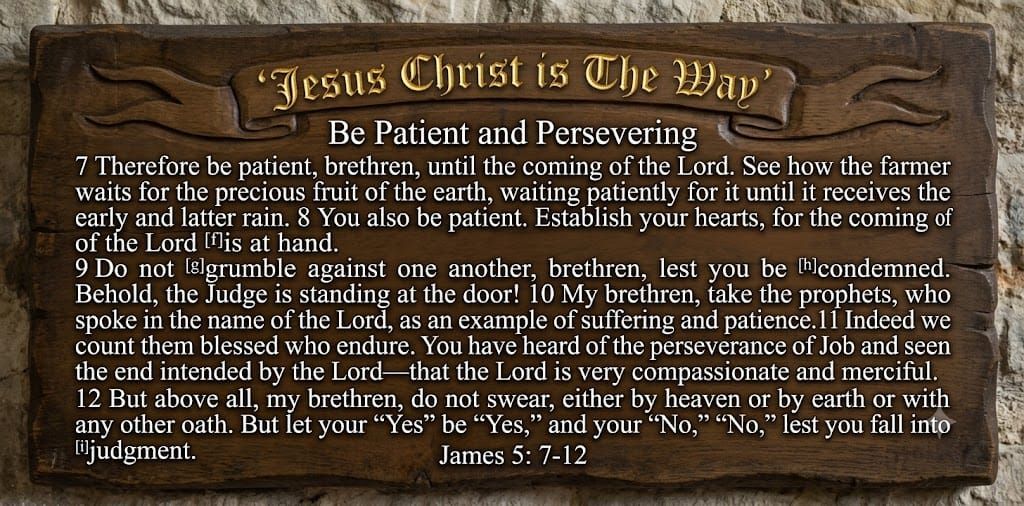
"Therefore, be patient, brethren, until the coming of the Lord... Establish your hearts, for the coming of the Lord is at hand. Do not grumble against one another, brethren, lest you be condemned. Behold, the Judge is standing at the door!... But above all, my brethren, do not swear either by heaven or by earth or with any other oath. But let your 'Yes' be 'Yes,' and your 'No,' 'No,' lest you fall into judgment." (James 5:7-9, 12)
Laying Down the Alignment
As we close this reflection, let us look at the walls we have built in our own lives, the chasms of doubt, the barriers of denominational pride, and the quickness with which we judge another servant of the Master. Christ did not conquer the grave so that we would remain locked in rooms of fear or divided by human traditions. He called us out of the tomb to walk in unity.
We cannot rely on a pastor’s faith, a church organization’s rules, or the comfort of a busy, distracted routine. God gave us free will—the power of choice—and with that comes complete, inescapable personal responsibility.
This week, challenge yourself to lay down judgment. Look past the outward packaging of tradition and look for the fruit of the Spirit. Where you have demanded physical signs before you will step out in faith, dare to trust His voice. Let us step away from the digital screens and the political noise this week. Let us return to the simplicity of our duty, break through our self-imposed boundaries, and fully rely on the Holy Spirit to guide us along The-Way, resting in the promise that He will give us wings like eagles for the miles ahead.
Conclusion & Summary: The Reality of the Kingdom
As we look back at the grand architecture of Luke 16 and 17, Jesus leaves us with an inescapable reality: the Kingdom of God is not a geopolitical theater to be observed from afar, but a radical, transformative reign that takes root deep within the human heart. From the urgent shrewdness of the manager to the striking gratitude of the lone Samaritan leper, we have been shown that true faith does not look for religious loopholes or demand spectacular signs. Instead, it anchors itself in active obedience, radical forgiveness, and complete personal responsibility. We are merely stewards of a brief vapor of time, called to lay down our denominational walls, our pride, and our self-justifications, choosing instead to walk humbly along The-Way.
Until next time, may you walk securely in The-Way of Christ Jesus.
The Bridge: Looking Ahead to Luke 18 & 19
Our journey now brings us to the threshold of Luke Chapters 18 and 19, where the rubber of our internal baseline duty meets the road of Christ’s final approach to Jerusalem. If chapters 16 and 17 provided a diagnostic map of the human heart under pressure, the upcoming text serves as the ultimate litmus test for Kingdom entry.
In our next review, we will encounter a series of profound paradoxes that turn human wisdom completely upside down:
- The Posture of Kingdom Citizenship (Luke 18): We will watch Jesus contrast the self-righteous prayers of a Pharisee with the broken, justified cry of a tax collector. We will see the Kingdom shut out the elite status of a Rich Young Ruler who cannot detangle his heart from his wealth, only to be opened wide to the helpless vulnerability of little children and the persistent, desperate cries of a blind beggar outside Jericho.
- The Convergence of Mercy and Authority (Luke 19): We will climb a sycamore tree with Zacchaeus to witness a scandalous display of immediate, restorative grace, before following Jesus into the gates of Jerusalem. There, the King who rides in on a humble colt will weep over a blind city and violently cleanse the temple—driving out the exact type of religious exploitation and commercial loopholes He exposed in Luke 16.
Call to Action
This week, challenge yourself to move from the theory of faith to the posture of a servant. Look closely at where you are still counting your own coins, building your own earthly kingdoms, or holding onto religious pride. Drop the defense mechanisms. Dare to step out in simple, daily obedience without demanding a sign, and let your "Yes" be "Yes."
Closing Prayer
Heavenly Father, Master of the Harvest, we surrender our hearts to Your direct rule today. Strip away our legalism, our horizontal judgments, and our desire for worldly comfort. Grant us a mustard-seed faith that moves us into radical obedience and genuine gratitude. Teach us to be faithful managers of the time, relationships, and resources You have lent us, keeping our eyes firmly fixed on eternity. As we prepare our hearts for the road to Jerusalem, may we receive Your Kingdom like little children. In the holy name of Jesus Christ, our Way, we pray.
Amen.
The Lord's Prayer
Our Father, who art in heaven,
Hallowed be Thy name.
Thy kingdom come,
Thy will be done,
On earth as it is in heaven.
Give us this day our daily bread,
And forgive us our trespasses,
As we forgive those who trespass against us.
And lead us not into temptation,
But deliver us from evil.
For Thine is the kingdom, and the power, and the glory, forever.
Amen.
In Christ's Grace and Truth,
Tomas
The-Way Ministry
Standing on Truth, Walking the Narrow Way
@"© 2026 The-Way.blog Digital Publications. All Rights Reserved."
Appendix: Study Tools & Academic Appendices
I. Comprehensive Biblical References
To aid in your personal study, use this systematic index mapping the primary source texts, sub-narratives, and prophetic anchors covered across this review cycle:
|
Text
Reference |
Theme
/ Narrative Block |
Character
Focus / Prophetic Paradigm |
|
Luke
16:1–13 |
Parable
of the Unjust/Shrewd Manager |
The
Steward, The Master |
|
Luke
16:14–18 |
The
Law, Hypocrisy, and Divorce Loopholes |
The
Pharisees, The Discarded Wife |
|
Luke
16:19–31 |
The
Rich Man and Lazarus |
Abraham,
Lazarus, The Five Brothers |
|
Luke
17:1–4 |
Stumbling
Blocks (Skandalon) & Forgiveness |
The
Offender, The Rebuked Brother |
|
Luke
17:5–10 |
Mustard
Seed Faith & The Duty of Unprofitable Servants |
The
Apostles, The Master of the Field |
|
Luke
17:11–19 |
The
Cleansing of the Ten Lepers |
The
Nine, The Grateful Samaritan |
|
Luke
17:20–37 |
The
Inward Kingdom & The Days of the Son of Man |
Noah,
Lot, Lot's Wife |
|
Psalm
49:10–15 |
The
Vanity of Earthly Accumulation & Sheol |
The
Fool, The Upright |
|
James
5:1–12 |
Warning
to Rich Oppressors & Call to Patience |
Job,
The Judge at the Door |
|
Philippians
1:15–18 |
Preaching
Christ from Flawed Motives |
Paul
in Chains, The Rival Preachers |
II. Critical and Exegetical Footnotes

Luke 16:8 (phronimōs / Shrewdly): The master's praise of the manager does not constitute a moral endorsement of fraud (adikia). Exegetically, Jesus isolates the manager’s foresight—the acute awareness of an impending day of accounting and the subsequent tactical use of present, liquid assets to secure a place in a future, permanent reality.

Luke 16:16 (Pressing into it): The Greek phrase biázetai eis autēn carries a dual semantic capability. It can mean that people are forcefully breaking into the Kingdom with holy violence and urgency (as the "people of the light" ought to do), or it highlights that everyone is violently opposing and trying to force their way past its terms via self-made loopholes.

Luke 17:1 (Skandalon / Offenses): Originally referring to the trigger-stick or bait-trap used to ensnare an animal. Jesus applies it to systemic internal attitudes—pride, greed, and lack of forgiveness—that trap the community of faith in destructive, cyclical loops.

Luke 17:6 (Derekh vs. Hodos): In Hebrew thought, derekh denotes a well-trodden, cultural highway. Jesus calls His followers off these macro-societal, anxious highways and onto the narrow, distinct path (hodos) of absolute, immediate reliance upon God.

Luke 17:21 (Entos hymōn / Within/Among you): A major point of translation debate. While traditional formatting highlights "within your heart" (inward/spiritual kingdom), it also syntactically means "in your midst." Jesus, standing right in front of the Pharisees, was the living embodiment of the Kingdom present among them, though completely missed by their geopolitical paradigms.
III. Canonical Cross-References: The Reversal of Eschatological Status
The structural thematic engine running through Luke 16 and 17 is the Great Reversal—the Kingdom reality where the first are made last, the rich are emptied, the high are brought low, and the excluded are brought inside the covenant boundary lines.
[Genesis / Prophetic Warnings] (Noah/Lot/Sodom)
│ Worldly status/comfort instantly vaporized by divine judgment.
▼
[Luke 16: Parable of Lazarus]
│ Rich Man (Fine linen/Earthly luxury) ──► Cast into Torment / Sheol
│ Lazarus (Sores/Beggar at the gate) ──► Carried to Abraham's Bosom
▼
[Luke 17: The Ten Lepers]
│ The 9 Insiders (Received physical gift)──► Return to societal privilege
│ The 1 Samaritan (Outcast/Foreigner) ──► Throws himself at Jesus' feet
▼
[James 5 / New Testament Epistles]
The Rich weep and howl ──► The suffering/patient are vindicated
- The Rich Man and Lazarus vs. Psalm 49: The description of the rich man perishing despite his fine linen perfectly mirrors the warning of Psalm 49:14: "Like sheep they are laid in the grave; Death shall feed on them... And their beauty shall be consumed in the grave." Conversely, Lazarus exemplifies verse 15: "But God will redeem my soul from the power of the grave."
- The Samaritan Outcast vs. The Pharisees: In both chapters, the religious insiders who hold structural keys (the Pharisees seeking loopholes in ch. 16; the nine cleansed lepers heading to the priests in ch. 17) miss the actual presence of the King. Meanwhile, the societal outcasts (the beggar Lazarus, the Samaritan foreigner) end up possessing the eternal inheritance.
- The Eschatological Urgency (Luke 17:26-32 vs. James 5:7-9): Jesus' warnings regarding the suddenness of the days of Noah and Lot find their perfect canonical echo in the Epistle of James. As the world accumulates temporary wealth and security through comfort and fraud, the believer is told to remain patient, steady the heart, and avoid corporate grumbling because "the Judge is standing at the door!"
Digital Copyright Notice
Copyright © 2026. All Rights Reserved. This document is protected under international copyright and digital rights management laws.
- Fair Use Citation: Short quotations or excerpts used in blog reviews, theological essays, or academic papers must provide appropriate attribution referencing the author and title of this work.
- Permitted Use: Permission is granted to download, store, electronically view, and print physical copies of this text solely for personal use, private study, small group Bible discussions, or local church ministry settings.
Prohibited Use: No part of this digital publication may be reproduced, redistributed, resold, hosted on public servers, or transmitted in any form or by any means, including photocopying, digital file sharing, recording, or translation into other languages, for commercial purposes without the prior written permission of the copyright holder.