The Gospel of Luke Review: Chapters 23 &24
“Were not our hearts burning within us while he talked with us on the road and opened the Scriptures to us?” (Luke 24:32)
Jesus Before Pilate and Herod, Grace from the Cross, and The Ascension of Jesus
Welcome to The-Way Ministry
Good afternoon, and welcome, brothers and sisters! May the peace of our Lord Jesus Christ and His abundant blessings be with you as we study His Word together today.
Before we open today’s text, I want to invite you to lock arms with us as a regular partner in this ministry. This daily journey through the Word is a labor of love, and it directly sustains my family as I dedicate my time to writing and teaching. If The Way has been a breath of fresh air for your walk with Christ, would you consider subscribing?
You can join our community completely free to receive these devotionals or choose a paid subscription to help us fund and expand this work. If you’d rather throw a one-time blessing into the pot, you can also support us directly below. Every single bit of your partnership matters!
[Join The Way Substack (Free or Paid Subscription)]
[Support via The Way Blog (One-Time Gift)]
Thank you so much for your prayers, your presence, and your financial partnership. It means the world to us.
When we read these Gospels, remember that the men and women who walked with Christ came from all walks of life. Open your mind and heart through the grace and Spirit of Christ Jesus as we dive into these incredible final chapters of Luke.
1. Jesus Before Pilate and Herod (Luke 23:1–25)
As Chapter 23 opens, Jesus is bound and brought before the earthly authorities of His day. What stands out immediately in Luke’s account is the relentless, threefold declaration of innocence that echoes through the courtroom:
- Pilate’s First Verdict: “I find no basis for a charge against this man” (Luke 23:4).
- Herod’s Assessment: Herod questioned Him thoroughly and mocked Him, but found no capital crime, sending Him back uncondemned (Luke 23:15).
- Pilate’s Second Verdict: “I have examined him in your presence and have found no basis for your charges against him... he has done nothing to deserve death” (Luke 23:14–15).
Reflection: The Innocent for the Guilty
In the courtyard of Luke 23, two sons stand before the world:
- Jesus Barabbas (The Prodigal Son): The ultimate broken, rebellious child. He took life into his own hands, broke the law through violent insurrection, and ended up bound in a prison of his own making.
- Jesus the Christ (The Obedient Son): The perfect, holy Son who lived in absolute submission to the Father.
Here is the profound, beautiful twist of the Gospel: The Prodigal Son walks free, but only because the Righteous Son steps into his place.
The Big Picture
In this single courtroom scene, Luke pulls the overarching narrative of Scripture together. He shows that while the world defaults to the violent path of Cain, God uses that exact moment to enact the ultimate redemption of the prodigal:
- Barabbas represents all of us—the guilty children set free because the Elder Brother stepped into the gap.
- Human justice fails, but divine purpose prevails. Pilate caved to political pressure, trading the innocent Prince of Peace for a convicted murderer.
- The bankruptcy of human power systems is exposed. A Roman governor compromises truth for political survival, an apostate ruler demands a miracle for entertainment, and a religious nation chooses a rebel over their Creator.
Humanity revealed its deepest defect in that courtyard: we readily bend the knee to the violent way of Barabbas if it protects our immediate comfort and helps us avoid the radical demands of the true King.
Yet, rising above this tragic display of human weakness is the staggering reality of God’s sovereignty. Pilate didn’t win. The mob didn’t win. In their blind fury, they were unwittingly fulfilling the eternal blueprint of redemption—the innocent Son stepping into the death sentence of the guilty, trading His perfect liberty for our chains.
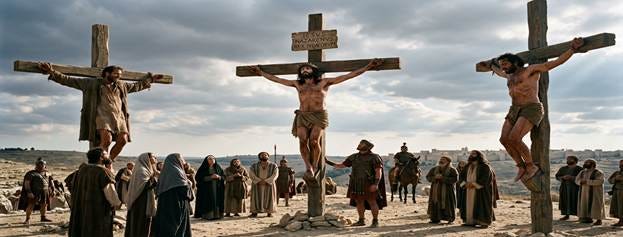
2. The Grace of Jesus from the Cross (Luke 23:26–49)
Even in His final agonizing hours, Jesus’ ministry of extended grace never stops. Luke captures two profound moments of radical grace spoken from Golgotha:
1. Grace for His Executioners
“Father, forgive them, for they do not know what they are doing.” (Luke 23:34)
While soldiers cast lots for His clothes, Jesus offers intercessory prayer for those nailing Him to the cross. His instinct in physical agony is still redemption.
2. Grace for the Outcast
“Truly I tell you, today you will be with me in paradise.” (Luke 23:43)
Flanked by two criminals, one mocks Him, but the other recognizes His sovereignty: “Jesus, remember me when you come into your kingdom.” This man had no time to perform good works, be baptized, or clean up his life. He offered simple, humble faith—and Jesus met him immediately with unconditional salvation.
By offering this blanket forgiveness to both the leaders and the common people, Jesus is not waiting for an apology. He is ratifying the New Covenant, both legally and spiritually. Under the Mosaic Law, strict distinctions were made between defiant sins and sins committed in ignorance or blind allegiance (Leviticus 4). By labeling their horrific actions as ignorance, Jesus—acting as the ultimate High Priest—opens the legal door for His sacrifice to cover them.
The placement of this prayer is critical: the forgiveness was spoken first, and the relentless cruelty kept right on going. The religious rulers sneered at His identity; the Roman soldiers mocked Him to assert political dominance while offering Him cheap wine vinegar; and Pilate’s sarcastic notice hung above Him. This proactive, shield-like grace stood between the mockers and divine judgment, even as they continued to hurl insults.
3. Resurrection, Emmaus, and The Ascension (Luke 24:1–53)
Death could not hold Him. Chapter 24 transitions from the dark grief of the tomb into radiant, resurrection joy—yet the disciples almost miss it entirely.
The Emmaus Road & The Danger of a Blind Soul (Luke 24:13–35)
Two heavy-hearted disciples walk toward Emmaus, treating the news of the empty tomb like a delusional rumor. They dismiss the first-hand testimonies of their closest friends, so blinded by disappointment that they fail to recognize Jesus matching them step for step on the dirt road.
The Warning for Us: When our faith wavers and we focus strictly on our circumstances, we risk missing Christ walking right beside us in the middle of our trial.
Jesus unpacks the Old Testament Scriptures to show how the Messiah had to suffer before entering His glory. It isn’t until He breaks bread in their home that their eyes are opened:
“Were not our hearts burning within us while he talked with us on the road and opened the Scriptures to us?” (Luke 24:32)
From Witnesses to Ascension Glory (Luke 24:36–53)
Once their eyes are opened, Jesus shifts their gaze from the miracle of the moment to the mission of the future. They are no longer just followers; they are official witnesses. He promises them the Holy Spirit, telling them to wait in Jerusalem until they are “clothed with power from on high.”
Leading them out to Bethany on the Mount of Olives, Jesus lifts His hands, blesses them, and ascends into heaven before their eyes. The Gospel closes with a complete reversal of how the chapter began: fear and grief are replaced by unstoppable worship, praise, and great joy.
The Crossroads of Chapter 24
Throughout this account, one reality stands out above all else: God’s grace always leaves room for your choice.
- The women chose to investigate the tomb and remember His words.
- Peter chose to run toward hope despite his crushing guilt.
- The Emmaus disciples chose to open their home and invite the “Stranger” inside rather than let Him walk on by himself.
Christ is alive, holding absolute authority over every dark force in your path, and walking right alongside you. What will you choose today? Will you stay frozen in past disappointments, or will you run toward the hope and grace of the resurrection?
Key Takeaways for Our Walk Today
- Grace has no disqualifiers: If the thief on the cross could be saved in his final moments, then no one is ever beyond the reach of Christ’s mercy.
- Scripture kindles the heart: When you feel discouraged on your own “Emmaus Road,” return to God’s Word—that is where Christ reveals Himself and sets our hearts on fire.
Live in Ascension Joy: Our Savior is alive, ruling at the right hand of God, and continually interceding for us.
Conclusion: The Great Eschatological Reversal
As we close our review of Luke 23 and 24, we witness the ultimate realization of what scholars call the Eschatological Reversal—the hallmark theme woven throughout Luke’s Gospel.
From Mary’s Magnificat (”He has brought down rulers from their thrones but has lifted up the humble”) to the Beatitudes (”Blessed are you who are poor, for yours is the kingdom of God”), Luke consistently reveals a Kingdom where human status is flipped upside down.
In these final chapters, this divine reversal reaches its climax:
- The Innocent and the Guilty: Barabbas, the condemned insurrectionist, steps out of prison into freedom, while Jesus, the sinless Son, steps onto the cross in his place.
- The Proud and the Penitently Broken: Self-righteous rulers mock from the sidelines, yet a dying criminal on a neighboring cross receives the immediate promise of Paradise.
- The Blind and the Seeing: Highly educated religious elites fail to recognize the Messiah, while broken followers on a dirt road to Emmaus have their eyes opened as He breaks bread.
Through the Cross, Resurrection, and Ascension, God overturns human expectations forever. Worldly power and pedigree are rendered meaningless; only humble faith, repentance, and surrender grant access to the eternal Kingdom.
The Bridge: From Luke to the Gospel of John
While Luke presents Jesus as the Son of Man—the compassionate Savior who walked among the outcast, fulfilled prophecy, and died as the righteous substitute—the Gospel of John invites us to step into a complementary, majestic vantage point.
Luke leaves us at the Mount of Olives, watching Jesus ascend into heaven in glory. John opens by pulling back the curtain of eternity: “In the beginning was the Word, and the Word was with God, and the Word was God” (John 1:1).
Where Luke traces Jesus’ lineage back to Adam to highlight His shared humanity, John reveals Jesus as the eternal, uncreated Son of God who took on flesh to dwell among us. As we prepare to begin our new series through John, we transition from observing the Savior on the dusty roads of Judea to beholding the divine Light that pierces all darkness.
Call to Action
- Reflect: Has your faith become comfortable or cynical like the disciples on the Emmaus road? Ask the Holy Spirit to rekindle a “burning heart” within you as you dive into Scripture this week.
- Share: Grace has no disqualifiers. Identify one person in your life who feels “too far gone” for God’s mercy and commit to praying for them by name every day this week.
- Partner: If this daily journey through the Word has strengthened your walk, consider sharing this post with a friend or supporting The-Way Ministry through a free or paid subscription.
Closing Prayer & The Lord’s Prayer
Heavenly Father, thank You for the radical grace displayed in the Gospel of Luke. Thank You that when we were bound like Barabbas in the prison of our own sin, Christ stepped into our place to buy our freedom. As we leave the empty tomb and look up toward the ascended Lord, fill us with Ascension joy and fire our hearts with Your Spirit. Open our eyes to see Jesus walking alongside us on our daily road and grant us the courage to choose Him above all else. In Jesus’ mighty name, Amen.
The Lord’s Prayer
Our Father, who art in heaven, hallowed be Thy name.
Thy kingdom come, thy will be done, on earth as it is in heaven.
Give us this day our daily bread, and forgive us our trespasses, as we forgive those who trespass against us.
And lead us not into temptation, but deliver us from evil.
For Thine is the kingdom, and the power, and the glory, forever and ever. Amen.
In Christ’s Grace and Truth,
Tomas
The-Way Ministry
Standing on Truth, Walking the Narrow Way

Exegetical & Canonical Appendix
I. Comprehensive Biblical References
- Jesus Before Pilate & Herod: Luke 23:1–25; Matthew 27:11–26; Mark 15:1–15; John 18:28–40.
- Crucifixion & Radical Grace: Luke 23:26–49; Leviticus 4:13–20; Isaiah 53:5, 12; Psalm 22:18.
- Resurrection & Emmaus Road: Luke 24:1–35; Deuteronomy 18:15–18; Isaiah 61:1–2; Psalm 16:10.
- Ascension & Commission: Luke 24:36–53; Acts 1:1–11; Daniel 7:13–14; Psalm 110:1.
II. Critical and Exegetical Footnotes
- The Legal Declaration of Innocence (Luke 23:4, 14, 15, 22): Luke places deliberate emphasis on Pilate’s threefold formal acquittal—using the phrase ouden aition (οὐδὲν αἴτιον, meaning “no basis for a charge” or “no fault”)—to emphasize judicial purity. Under Roman law, this explicitly establishes that Jesus died not as a state criminal, but strictly as a sacrificial substitute.
- “Father, Forgive Them...” (Luke 23:34): Jesus acts in His High Priestly capacity, making intercession for sins committed in ignorance—agnoia (ἄγνοια). This fulfills the Levitical typology (Leviticus 4), in which unintentional sins could receive ritual atonement, thereby legally opening the door for New Covenant grace.
- Eschatological Reversal (Hē Eschatē Anastrophē / ἡ ἐσχάτη ἀναστροφή): In Lukan theology, the Kingdom of God fundamentally overturns worldly hierarchies. The dramatic shift in status between Barabbas/the Penitent Thief and the Sanhedrin demonstrates that spiritual entry into the Kingdom depends solely on faith and repentance, not institutional status or privilege.
- “Clothed with Power” (Luke 24:49): The Greek term endysēsthe (ἐνδύσησθε) denotes being wrapped in or clothed with a garment. Luke uses this vivid metaphor to bridge his Gospel and the book of Acts, signaling the Spirit-led (pneumatic) transformation that comes at Pentecost.
III. Canonical Cross-References: The Reversal of Eschatological Status
Old Testament Shadow
Lucan Fulfillment
New Testament Epistles / Revelation
Hannah’s Song (1 Sam 2:7–8): “The Lord makes poor and makes rich... He raises the poor from the dust.”
Mary’s Magnificat (Luke 1:52–53): “He has brought down rulers... and lifted up the humble.”
James 2:5: “Has God not chosen the poor of this world to be rich in faith and heirs of the kingdom?”
The Rejected Stone (Psalm 118:22): “The stone which the builders rejected has become the chief cornerstone.”
The Trial & Cross (Luke 23:11, 18): Earthly leaders reject the King in favor of a criminal.
1 Peter 2:7: “The stone which the builders rejected has become the chief cornerstone.”
The Suffering Servant (Isaiah 53:12): “He was numbered with the transgressors.”
The Penitent Thief (Luke 23:32–43): Jesus is crucified between two criminals, extending grace to the outcast.
2 Corinthians 5:21: “He made Him who knew no sin to be sin for us.”
The Messianic Banquet (Isaiah 25:6–9): A feast prepared for all nations, leaving the proud outside.
The First & The Last (Luke 13:30 / 24:30–32): Outsiders dine with the Messiah while insiders are left in darkness.
Revelation 19:9: “Blessed are those who are called to the marriage supper of the Lamb!”
Digital Copyright Notice
Copyright © 2026. All Rights Reserved. This document is protected under international copyright and digital rights management laws.
- Fair Use Citation: Short quotations or excerpts used in blog reviews, theological essays, or academic papers must provide appropriate attribution referencing the author and title of this work.
- Permitted Use: Permission is granted to download, store, electronically view, and print physical copies of this text solely for personal use, private study, small group Bible discussions, or local church ministry settings.
Prohibited Use: No part of this digital publication may be reproduced, redistributed, resold, hosted on public servers, or transmitted in any form or by any means, including photocopying, digital file sharing, recording, or translation into other languages, for commercial purposes without the prior written permission of the copyright holder